Development of a Parent–Adolescent Relationship Training Program Based on the Lived Experiences of Mothers of Children with Social Anxiety Disorder and Examination of Its Effectiveness on Adolescents’ Social Adjustment, Social Anxiety, and Emotion Regulation
DOI:
https://doi.org/10.61838/Keywords:
social anxiety, training program, mothers’ lived experiences, parent–adolescent relationship, emotion regulation.Abstract
Objective: The present study aimed to develop a parent–adolescent relationship training program based on the lived experiences of mothers of adolescents with social anxiety disorder and to examine its effectiveness on adolescents’ social adjustment, social anxiety, and emotion regulation.
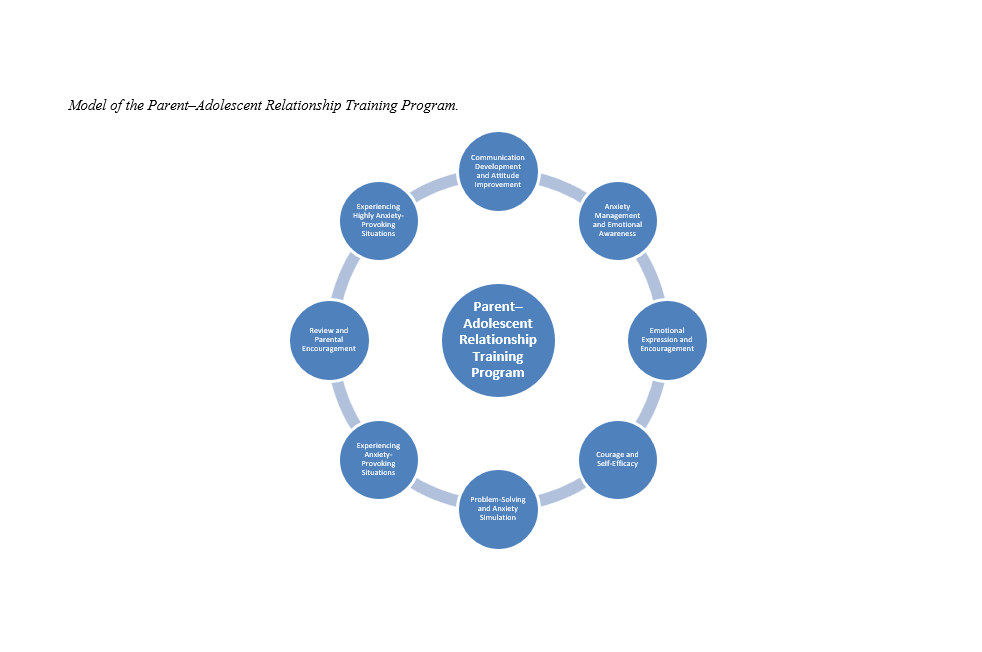
Methods and Materials: The study employed an exploratory sequential mixed-methods design. In the qualitative phase, semi-structured interviews were conducted with 20 mothers of adolescents with social anxiety disorder selected through purposeful sampling, and the data were analyzed using Colaizzi’s descriptive phenomenological method, resulting in the extraction of eight main themes and 24 subthemes. Based on these findings, an eight-session parent–adolescent relationship training program was developed and its content validity was evaluated by 20 experts in psychology and counseling. In the quantitative phase, the study used a quasi-experimental pretest–posttest design with a three-month follow-up and a control group. Thirty adolescents aged 12–16 years with social anxiety disorder were selected through convenience sampling and randomly assigned to experimental and control groups. The experimental group participated in eight weekly 90-minute group sessions for mothers, while the control group received no intervention. Data were collected using the Adolescent Social Anxiety Questionnaire, Social Adjustment Questionnaire, and Cognitive Emotion Regulation Questionnaire. Data analysis was conducted using multivariate analysis of covariance (MANCOVA), univariate analysis of covariance (ANCOVA), and paired-samples t-tests with Bonferroni adjustment in SPSS version 26.
Findings: The results of multivariate analysis of covariance demonstrated that the parent–adolescent relationship training program had a significant effect on the linear combination of social adjustment, social anxiety, and emotion regulation variables (Wilks’ lambda = 0.28, F = 21.35, p < .001, η² = 0.72). Univariate analyses indicated that the intervention significantly increased social adjustment (F = 19.55, p < .001, η² = 0.42), significantly reduced social anxiety (F = 43.12, p < .001, η² = 0.62), and significantly improved emotion regulation (F = 12.18, p = .002, η² = 0.31). The results of paired-samples t-tests at the three-month follow-up stage showed no significant differences between posttest and follow-up scores (p > .05), indicating the stability of intervention effects over time.
Conclusion: The findings indicate that a parent–adolescent relationship training program grounded in the lived experiences of mothers can effectively reduce adolescents’ social anxiety while improving social adjustment and emotion regulation. The stability of intervention effects at follow-up suggests that experiential and family-centered educational approaches may create enduring emotional and relational changes within the family system. Therefore, integrating parents’ lived experiences into intervention design may provide a culturally sensitive and practically effective approach for improving psychological functioning among adolescents with social anxiety disorder.
Downloads
References
Ansar, N., Nissen Lie, H. A., & Stiegler, J. R. (2024). The effects of emotion-focused skills training on parental mental health, emotion regulation and self-efficacy: Mediating processes between parents and children. Psychotherapy Research, 34(4), 518-537.
Beyranvand, N., & Rezaei, M. (2025). The Effectiveness of Unified Transdiagnostic Treatment on Depressive Symptoms and Alexithymia in Adolescents with Social Anxiety Disorder. Clinical Psychology, 2, 85-98.
Danesh, A. (2025). Examining the Mediating Role of Secure Attachment to Parents in the Relationship between Parent-Adolescent Conversation Quality and Emotional Self-Regulation in Generation Z Adolescents. Twelfth International Conference on Interdisciplinary Studies in Health Sciences, Psychology, Management, and Educational Sciences,
Halldorsson, B., Waite, P., Harvey, K., Pearcey, S., & Creswell, C. (2023). In the moment social experiences and perceptions of children with social anxiety disorder: A qualitative study. British Journal of Clinical Psychology, 62(1), 53-69.
Holmqvist Larsson, K., & Zetterqvist, M. (2024). An emotion regulation skills training for adolescents and parents: Perceptions and acceptability of methodological aspects. Frontiers in Psychiatry, 15, 1448529.
Hosseini, F., Abedi, M., & Gorji, Y. (2024). Comparing the Effect of Parent-Adolescent Relationship-Based Counseling Based on Adolescents' Lived Experiences with Quality of Life Therapy on Adolescents' Personal Adjustment. First International Conference and Second National Conference on Quality Living from the Perspective of Psychology, Counseling, and Social Work,
Kuang, X., Ren, F., Lee, J. C. K., & Li, H. (2024). Parent-child relationships and adolescents' non-cognitive skills: Role of social anxiety and number of friends. Behavioral Sciences, 14(10), 961.
Mohammadi, M., Khorramdel, K., & Zafarkhah, Z. (2025). Parenting in Social Anxiety: A Systematic Review Study. Eleventh International Conference on Knowledge and Technology of Educational Sciences, Social Studies, and Psychology of Iran,
Mohammadzadeh, N., Heidaripour, S., Mohajer Bajgiran, S., & Saeedi, S. A. (2025). The Mediating Role of Parent-Child Interactions in the Relationship between Parents' Psychological Well-Being and Social Adjustment of Adolescent Female Students in Mashhad. Twenty-First International Conference on Management and Humanities Research in Iran,
Moradi, S., Hasan Begi, N., Zarei Norouzi, A., & Haghgouye Koochesfahani, S. S. (2023). Examining the Role of Perceived Social Support and Emotion Regulation in Predicting Adolescent Social Anxiety. Third National Conference on Child and Adolescent Clinical Psychology,
Naor-Ziv, R., Shamay-Tsoory, S., & Levy-Gigi, E. (2023). The effectiveness of interpersonal emotion regulation and the role of anxiety in parent-adolescent relationships. Cognitive therapy and research, 47(4), 648-654.
Nasehi, H., Mireei, H., & Nasehi, H. (2025). The Effectiveness of Cognitive Behavioral Therapy on Rumination and Anxiety Sensitivity in Adolescents with Social Anxiety. Eleventh Scientific Research Conference on Educational Sciences, Psychology, and Social and Cultural Harms of Iran,
Nikkhah Delshad, M., Asayesh, M. H., & Gholamali Lavasani, M. (2023). The Mediating Role of Self-Esteem and Emotion Regulation in the Relationship between Mothers' Early Maladaptive Schemas and Mother-Adolescent Daughter Conflicts. Family Research(76), 649-670.
Pinkard, C. (2025). A Mother's Understanding of her Adolescent: A Social Anxiety Study Walden University].
Rabiei, S. (2013). Comparison of Self-Esteem, Adjustment, Mental Health, and Academic Hope among Adolescents with and without Relationships with the Opposite Sex Islamic Azad University, Marvdasht Branch].
Rahmani, N., Teymuri, S., Bayazi, M. H., & Rajaei, A. R. (2023). The effectiveness of a family-friendly program on parental meta-worry beliefs and health anxiety and social anxiety disorder in children. Current Psychology, 42(13), 11344-11354.
Rashed, H., Amin Yazdi, S. A., & Bordbar, M. (2025). The Relationship between Maternal Attachment Dimensions and Child Emotion Regulation: The Mediating Role of Irrational Beliefs and Maternal Reflective Functioning. Applied Psychology, 1, 77-102.
Ravankhah, L., & Tavakoli Saleh, L. (2023). Phenomenology of the Lived Experiences of Adjusted and Maladjusted Adolescents with Perceived Parent-Child Communication. Third National Conference on Applied Ideas in Educational Sciences, Psychology, and Cultural Studies,
Sattari, M. (2022). A Review of the Role of Emotion Regulation Skills in Reducing Adolescent Social Anxiety. Tenth International Conference on New Research Achievements in Educational Sciences, Psychology, and Social Sciences,
Tse, Z. W. M., Emad, S., Hasan, M. K., Papathanasiou, I. V., Rehman, I. U., & Lee, K. Y. (2023). School-based cognitive-behavioural therapy for children and adolescents with social anxiety disorder and social anxiety symptoms: A systematic review. PLoS One, 18(3), e0283329.
van Loon, A. W., Creemers, H. E., Vogelaar, S., Miers, A. C., Saab, N., Westenberg, P. M., & Asscher, J. J. (2023). The effectiveness of school-based skills-training programs reducing performance or social anxiety: Two randomized controlled trials. Child & Youth Care Forum, 52(6), 1323-1347.
Vosoughi, M. (2024). The Relationship between Adolescents' Perception of the Family Psychosocial Climate and Adolescents' Social Adjustment and Isolation. Twenty-First International Conference on Research in Psychology, Counseling, and Educational Sciences,
Walder, N., Berger, T., & Schmidt, S. J. (2023). Prevention and treatment of social anxiety disorder in adolescents: Protocol for a randomized controlled trial of the online guided self-help intervention SOPHIE. Jmir Research Protocols, 12(1), e44346.
Downloads
Additional Files
Publication Timeline
- Submitted
- Revised
- Accepted