The Relationship Between Impulsivity, Cognitive Consequences, and the Severity of Sports Injuries Among Iraqi Swimmers
DOI:
https://doi.org/10.61838/Keywords:
Impulsivity, Swimmers, Sports Injuries, Cognitive consequences, Injury Prevention, Athletic PerformanceAbstract
Objective: This study aimed to investigate the relationship between impulsivity, Cognitive consequences of sports injuries, and the severity of sports injuries among Iraqi swimmers.
Methods and Materials: This applied, quantitative, descriptive-survey study was conducted among competitive swimmers in Iraq. The statistical population consisted of Iraqi swimmers, from whom 129 participants were selected using purposive and convenience sampling methods based on the sample size estimated through G*Power software. Data were collected using the Cognitive consequences of Sports Injuries Questionnaire developed by Rokan Hassan et al. (2022) and the Barratt Impulsiveness Scale (1994). Descriptive statistics were used to summarize participant characteristics and study variables. Inferential analyses were performed using Pearson correlation coefficients and linear regression analyses in SPSS version 23. All statistical tests were conducted at a significance level of 0.05.
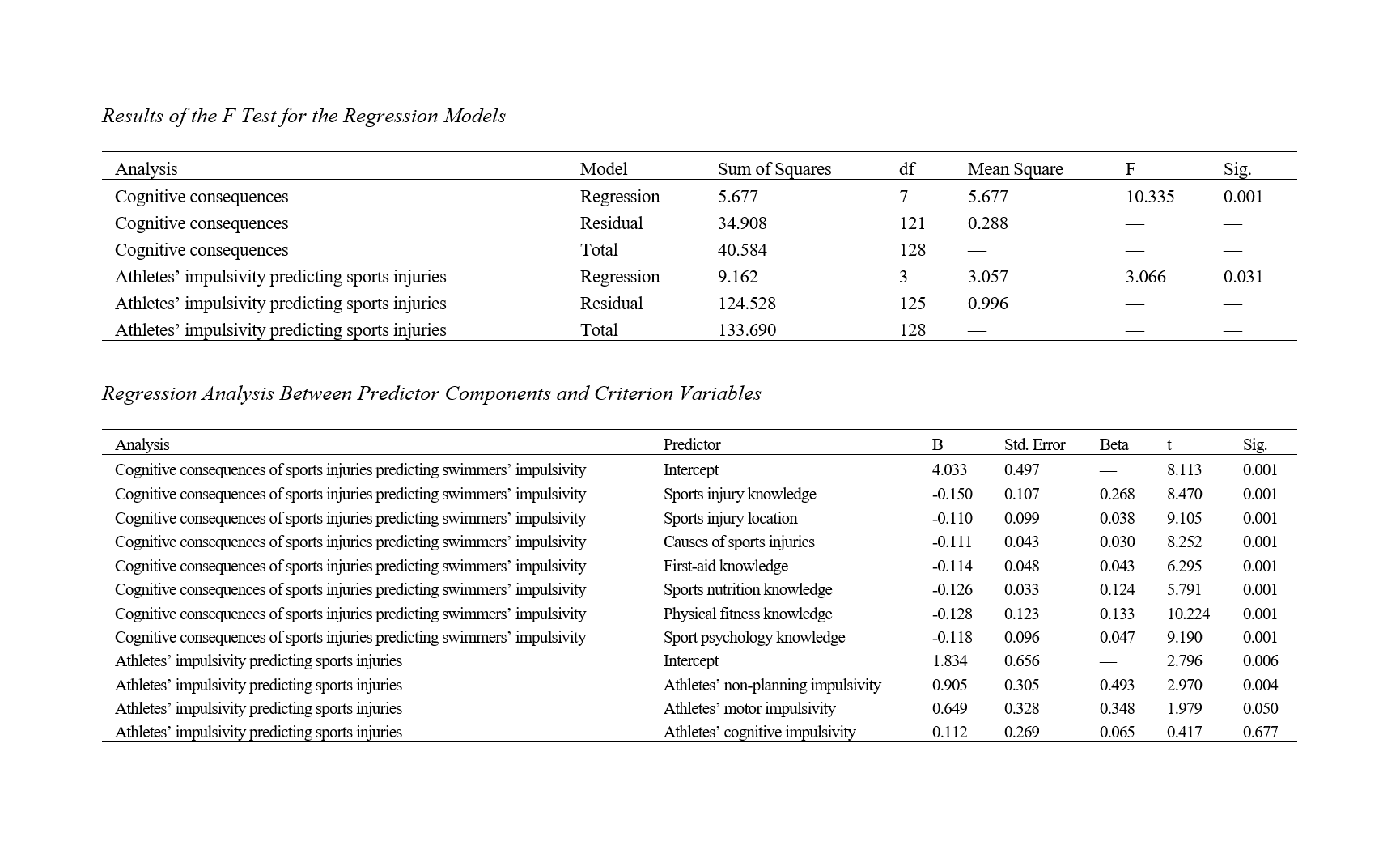
Findings: The results demonstrated significant negative relationships between all dimensions of Cognitive consequences of sports injuries and swimmers’ impulsivity levels (p < .001). Greater awareness and understanding of the Cognitive consequences associated with sports injuries were linked to lower levels of impulsive behavior among athletes. Regarding the relationship between impulsivity dimensions and sports injuries, cognitive impulsivity was not significantly associated with injury occurrence or severity (p = .677). However, a significant positive relationship was found between non-planning impulsivity and sports injuries (p = .004), indicating that swimmers who exhibited poorer planning tendencies experienced higher injury rates. Furthermore, motor impulsivity showed a significant positive association with sports injuries (p = .050), suggesting that athletes with greater tendencies toward acting without sufficient control were more likely to sustain injuries. Overall, the findings highlight the predictive role of specific impulsivity dimensions in sports injury occurrence among swimmers.
Conclusion: The findings suggest that cognitive awareness regarding the consequences of sports injuries and lower levels of impulsive behavior are associated with a reduced likelihood of injury among swimmers. In particular, non-planning and motor impulsivity appear to be important risk factors for sports injuries, whereas cognitive impulsivity does not significantly contribute to injury occurrence.
Downloads
References
Aghdasi, M. T., & Ahmadi, A. (2016). The Relationship Among Controlling Coach Behaviors, Psychological Needs Thwarting, Sport Devaluation, and Intention to Continue Sport Participation in Adolescent Athletes. Sport Psychology Studies, 5(17), 57-70.
Asghari, A. (2023). Comparison of Impulsivity, Alexithymia, and Self-Harming Behaviors in Students with Internet Addiction and Normal Students. Bimonthly of Education Strategies in Medical Sciences, 16(4), 412-420.
Barry, L., Lyons, M., McCreesh, K., Powell, C., & Comyns, T. (2021). The Relationship Between Training Load and Pain, Injury and Illness in Competitive Swimming: A Systematic Review. Physical therapy in sport, 48, 154-168. https://doi.org/10.1016/j.ptsp.2021.01.002
Beidler, E., Donnellan, M. B., Kontos, A., Pontifex, M., Nogle, S., & Covassin, T. (2021). The Relationship Between Impulsivity, Sensation Seeking, and Concussion History in Collegiate Student-Athletes. Athletic Training & Sports Health Care, 13(6), e402-e412. https://doi.org/10.3928/19425864-20210519-01
Belilos, E., Jow, S., & Maxwell, M. (2023). Descriptive Epidemiology of High School Swimming and Diving Injuries. Clinical Journal of Sport Medicine, 33(4), 428-434. https://doi.org/10.1097/JSM.0000000000001121
Besharat, M. A., Ghahramani, M. H., & Ahmadi, N. (2013). Athletics Impulsivity Traits: A Comparison Between Contact and Noncontact Sports. Research in Sport Management and Motor Behavior, 3(5), 13-23.
Byrd, M. M., Kontos, A. P., Eagle, S. R., & Zizzi, S. (2021). Preliminary Evidence for a Relationship Between Anxiety, Anger, and Impulsivity in Collegiate Athletes with Sport-Related Concussion. Journal of Clinical Sport Psychology, 16(2), 89-108. https://doi.org/10.1123/jcsp.2020-0003
Connolly, E. J., Royle, M. L., Wood, L., Wingert, A. C., & Temple, J. R. (2025). Cause of Head Injury and Between- and Within-Individual Changes in Impulsivity and Binge Drinking. Drug and Alcohol Dependence, 112836. https://doi.org/10.1016/j.drugalcdep.2025.112836
Ghayebzadeh, S., Zardoshtian, S., Amiri, E., Giboin, L. S., & Machado, D. G. d. S. (2023). Anodal Transcranial Direct Current Stimulation over the Right Dorsolateral Prefrontal Cortex Boosts Decision Making and Functional Impulsivity in Female Sports Referees. Life, 13(5), 1131. https://doi.org/10.3390/life13051131
González-Hernández, J., Capilla Díaz, C., & Gómez-López, M. (2019). Impulsiveness and Cognitive Patterns: Understanding the Perfectionistic Responses in Spanish Competitive Junior Athletes. Frontiers in psychology, 10, 1605. https://doi.org/10.3389/fpsyg.2019.01605
Gorbanalipour, M., Alilou, S., & Zardi Nahr, A. (2025). The Role of Feeling of Inferiority and Distress Tolerance in Predicting the Tendency to Addiction According to the Mediator Role of Experiential Avoidance in College Students. Research in cognitive and behavioral sciences, 15(1), 23-44.
Gračanin, I., Djurović, M., Stanić, D., Burhaein, E., Demirci, N., Ram, R., Singh, R., Koliopoulos, T., & Skrypchenko, I. (2023). Prevention of Shoulder Injuries in Swimmers. International Journal of Academic Health and Medical Research, 7(2), 186-190.
Hill, L., Mountjoy, M., & Miller, J. (2022). Non-Shoulder Injuries in Swimming: A Systematic Review. Clinical Journal of Sport Medicine, 32(3), 256-264. https://doi.org/10.1097/JSM.0000000000000903
Hsu, C., Krabak, B., Cunningham, B., & Borg-Stein, J. (2024). Swimming Anatomy and Lower Back Injuries in Competitive Swimmers: A Narrative Review. Sports health, 16(6), 971-981. https://doi.org/10.1177/19417381231225213
Ivarsson, A., & Johnson, U. (2010). Psychological Factors as Predictors of Injuries Among Senior Soccer Players: A Prospective Study. Journal of sports science & medicine, 9(2), 347.
Madžar, T., Milošević, M., Hrabač, P., & Heningsberg, N. (2017). Psychological Aspects of Sports Injuries Among Male Professional Soccer Players in Croatia. Kinesiology, 49(1), 84-91. https://doi.org/10.26582/k.49.1.5
McKenzie, A., Larequi, S. A., Hams, A., Headrick, J., Whiteley, R., & Duhig, S. (2023). Shoulder Pain and Injury Risk Factors in Competitive Swimmers: A Systematic Review. Scandinavian Journal of Medicine & Science in Sports, 33(12), 2396-2412. https://doi.org/10.1111/sms.14454
Millán-Sánchez, A., Madinabeitia, I., de la Vega, R., Cárdenas, D., & Ureña, A. (2023). Effects of Emotional Regulation and Impulsivity on Sports Performance: The Mediating Role of Gender and Competition Level. Frontiers in psychology, 14, 1164956. https://doi.org/10.3389/fpsyg.2023.1164956
Mohammadi, H., Azimkhani, A., & Tehranchi, A. (2023). The Effect of Combined Exercises on Taekwondo Practitioners' Motivational and Impulsive Self-Talk. Sports Psychology, 15(2), 109-124.
Morris, L. A., O'Callaghan, C., & Le Heron, C. (2022). Disordered Decision Making: A Cognitive Framework for Apathy and Impulsivity in Huntington's Disease. Movement Disorders, 37(6), 1149-1163. https://doi.org/10.1002/mds.29013
Naderi, A., & Shaabani, F. (2024). The Relationship Between Personality Traits and Sports Injuries, Based on the Stress and Sports Injury Model: A Systematic Review. The Scientific Journal of Rehabilitation Medicine, 13(1), 2-17. https://doi.org/10.32598/SJRM.13.1.16
Patenteu, I., Gawrych, R., Bratu, M., Vasile, L., Makarowski, R., Bitang, A., & Nica, S. A. (2024). The Role of Psychological Resilience and Aggression in Injury Prevention Among Martial Arts Athletes. Frontiers in psychology, 15, 1433835. https://doi.org/10.3389/fpsyg.2024.1433835
Rokan Hassan, O., & Ahmad Altaravaneh, M. (2022). Cognitive Assessment of Sports Injuries Among Iraqi Swimming Club Coaches Mutah University].
Seifourian, M., Shabani Moghadam, K., Seyyed Ameri, M. H., & Farahani, A. (2024). Mediating Role of Perceived Social Support in Predicting Motivation for Football Betting Based on Attitude and Impulsivity. Sports Psychology, 16(2), 16-32.
Tingaz, E. O., Ekiz, M. A., & Çakmak, S. (2020). Examination of Mindfulness and Impulsiveness in University Student-Athletes in Terms of Sports Injury Development History. Current Psychology, 1-9. https://doi.org/10.1007/s12144-020-01024-4
Trinidad, A., González-Garcia, H., & López-Valenciano, A. (2021). An Updated Review of the Epidemiology of Swimming Injuries. Pm&r, 13(9), 1005-1020. https://doi.org/10.1002/pmrj.12503
Vignaud, E., Menu, P., Daley, P., Grondin, J., Dauty, M., & Fouasson-Chailloux, A. (2023). Artistic Swimming Injuries in Young Elite Athletes: An 11-Year Follow-Up. Clinical Journal of Sport Medicine, 33(4), 421-427. https://doi.org/10.1097/JSM.0000000000001139
Downloads
Additional Files
Publication Timeline
- Submitted
- Revised
- Accepted