The Relationship Between Early Maladaptive Schemas and Adolescents’ Social Anxiety: The Mediating Role of Locus of Control
DOI:
https://doi.org/10.61838/Keywords:
Early maladaptive schemas, Social anxiety, Adolescents, Locus of controlAbstract
Objective: The present study aimed to investigate the relationship between early maladaptive schemas and adolescents’ social anxiety and to examine the mediating role of locus of control in this relationship.
Methods and Materials: This descriptive-correlational study was conducted among male students enrolled in vocational high schools in District 8 of Tehran, Iran. Based on Morgan’s sample size table, 210 students were selected using convenience sampling. Data were collected using the Young Schema Questionnaire–Short Form (YSQ-SF), the Social Phobia Inventory (SPIN), and Rotter’s Locus of Control Scale. The study focused on five schema domains that demonstrated the strongest relationships with social anxiety, including Social Isolation/Alienation, Defectiveness/Shame, Emotional Inhibition, Negativity/Pessimism, and Failure. Descriptive statistics and Pearson correlation coefficients were computed to examine relationships among variables. Multiple regression analysis was used to identify the strongest predictors of social anxiety, and structural equation modeling was employed to test the mediating role of locus of control. Statistical analyses were performed using SPSS and AMOS software at a significance level of 0.05.
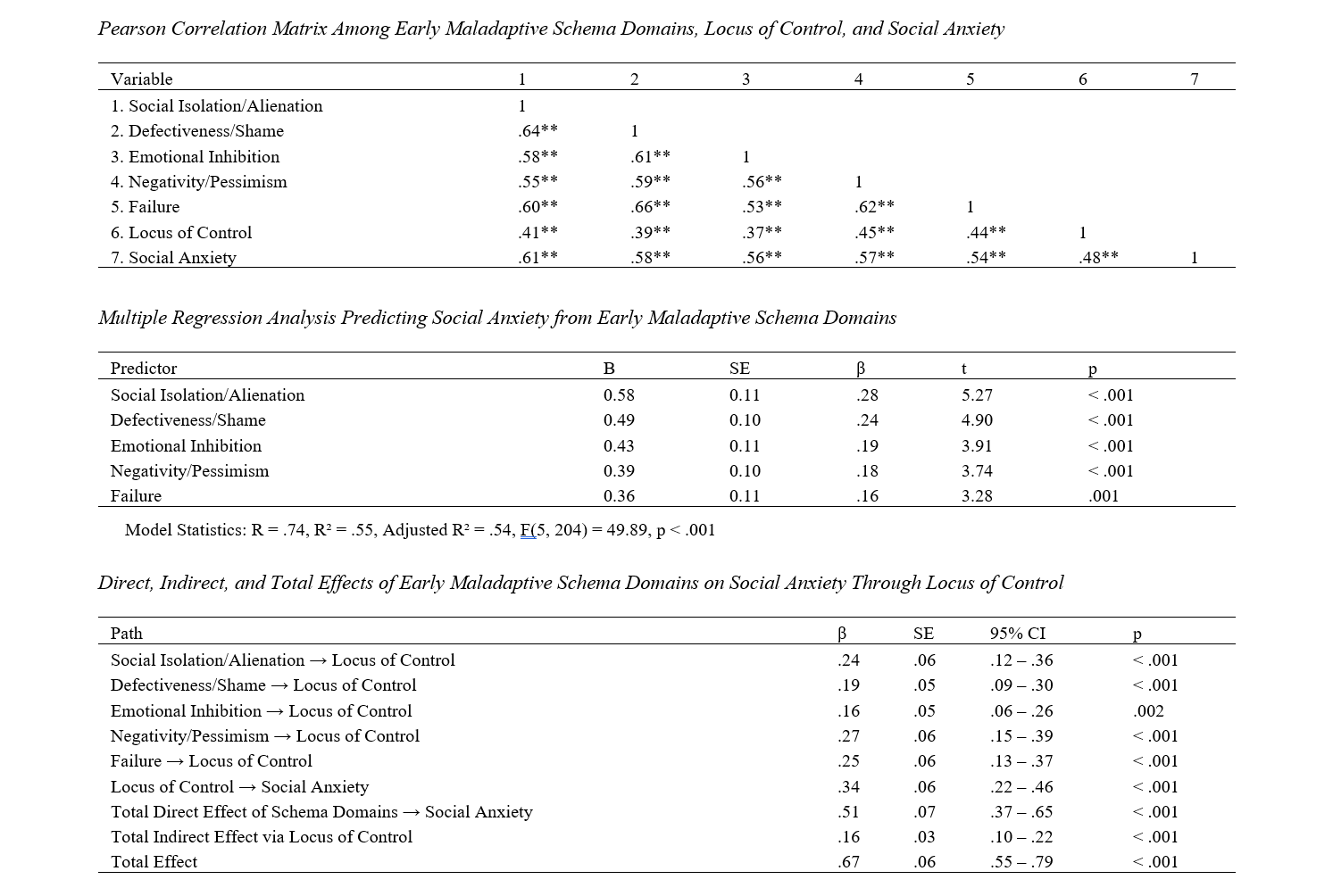
Findings: The results revealed significant positive correlations between all five schema domains and social anxiety (p < .01). Social Isolation/Alienation demonstrated the strongest association with social anxiety (r = .61), followed by Defectiveness/Shame (r = .58), Negativity/Pessimism (r = .57), Emotional Inhibition (r = .56), and Failure (r = .54). All schema domains were also significantly associated with external locus of control (p < .01). Multiple regression analysis indicated that the five schema domains collectively explained 55% of the variance in social anxiety scores (R² = .55, p < .001), with Social Isolation/Alienation emerging as the strongest predictor. Structural equation modeling demonstrated that locus of control significantly mediated the relationship between maladaptive schemas and social anxiety. The indirect effect through locus of control was statistically significant (β = .16, p < .001), while the direct effect remained significant (β = .51, p < .001), indicating partial mediation.
Conclusion: The findings suggest that maladaptive schemas related to social disconnection, shame, emotional suppression, pessimistic thinking, and perceived failure are important cognitive vulnerabilities associated with adolescent social anxiety.
Downloads
References
Bär, A., Bär, H. E., Rijkeboer, M. M., & Lobbestael, J. (2023). Early Maladaptive Schemas and Schema Modes in Clinical Disorders: A Systematic Review. Psychology and Psychotherapy: Theory, Research and Practice, 96(3), 716-747.
Behzadi, F., & Ashouri, M. (2024). Examining the Effectiveness of Solution-Focused Therapy on Self-Efficacy and Social Anxiety in Adolescents with Low Vision. Applied Psychology Quarterly.
Bishop, A., Younan, R., Low, J., & Pilkington, P. D. (2022). Early Maladaptive Schemas and Depression in Adulthood: A Systematic Review and Meta-Analysis. Clinical Psychology & Psychotherapy, 29(1), 111-130.
Dou, Q., Chang, R., & Xu, H. (2023). Body Dissatisfaction and Social Anxiety among Adolescents: A Moderated Mediation Model of Feeling of Inferiority, Family Cohesion and Friendship Quality. Applied Research in Quality of Life, 1-21.
Fredrick, J. W., & Luebbe, A. M. (2024). Prospective Associations between Fears of Negative Evaluation, Fears of Positive Evaluation, and Social Anxiety Symptoms in Adolescence. Child Psychiatry & Human Development, 55(1), 195-205.
Hedayati, M., Zarani, F., Nejati, V., Motabi, F., & Heydari, M. (2020). Semantic Network of Rejection and Disconnection: Developing Persian Vocabulary and Examining Its Relationship with Early Maladaptive Schemas in the Domain of Rejection and Disconnection. Knowledge and research in applied psychology(4), 1-15.
Hosseini Abrishami, M., Eslamian, E., Shah Hosseini, S., Fazeli, F., & Heydari, Z. (2022). Predicting Happiness Based on Locus of Control, Personality Traits, and Academic Self-Efficacy among Female Students. Research in Curriculum and Educational Planning, 12(1), 89-102.
Jamshidi, A., Maschi, F., & Zeighami Mohammadi, S. (2024). Predicting Social Anxiety Based on Early Maladaptive Schemas in Students. Nursing Education, 13(3), 13-24.
Jefferies, P., & Ungar, M. (2020). Social Anxiety in Young People: A Prevalence Study in Seven Countries. PLoS One, 15(9), e0239133.
Kebritchi, A., & Abolghasemi, S. (2025). The effectiveness of schema therapy on self-focused attention and symptoms of social anxiety disorder. Journal of Psychological Science, 24(154), 205-221.
Kesavayuth, D., Poyago-Theotoky, J., & Zikos, V. (2020). Locus of Control, Health and Healthcare Utilization. Economic Modelling, 86, 227-238.
Malekzadeh, l., Emadi, S. Z., & naghsh, z. (2024). The Effectiveness of Group Schema Therapy on Cognitive Emotion Regulation and Emotional Behavior Regulation in Mothers with Children with Learning Disabilities. Psychology of Exceptional Individuals, 14(53), 201-227. https://doi.org/10.22054/jpe.2023.71499.2524
Masoumi, M., Zargham Hajebi, M., Rabiei, M., & Zarghami, M. H. (2022). Network Analysis of Early Maladaptive Schemas and Career Adaptability among Students. Journal of Psychological Science, 21(116), 1679-1696.
Morgan, J. K., Conner, K. K., Fridley, R. M., Olino, T. M., Grewen, K. M., Silk, J., & Forbes, E. E. (2023). Adolescents' Hormonal Responses to Social Stress and Associations with Adolescent Social Anxiety and Maternal Comfort: A Preliminary Study. Child Psychiatry & Human Development, 1-11.
Mousavi, S. V., Rezaei, S., Atefi Karjondani, S., & Javanparast, H. (2018). The Mediating Role of Locus of Control in the Relationship between Early Maladaptive Schemas and Social Anxiety in Adolescents. Journal of Psychology, 22(2), 172-187.
Pickering, L., Hadwin, J. A., & Kovshoff, H. (2020). The Role of Peers in the Development of Social Anxiety in Adolescent Girls: A Systematic Review. Adolescent Research Review, 5, 341-362. https://doi.org/10.1007/s40894-019-00117-x
Prospero, L., Riezzo, G., D'Attoma, B., Ignazzi, A., Bianco, A., Franco, I., Curci, R., Campanella, A., Bagnato, C. B., Porcelli, P., Giannelli, G., & Russo, F. (2025). The impact of locus of control on somatic and psychological profiles of patients with irritable bowel syndrome engaging in aerobic exercise. Scientific reports, 15(1), 3966. https://doi.org/10.1038/s41598-025-88466-7
Seddighi Arfaei, F., & Hajian, S. (2023). The Role of Ego Strength and Early Maladaptive Schemas in Suicidal Tendency among Adolescents in Isfahan. Journal of New Advances in Psychology, Educational Sciences and Education, 5(57).
Torres, J., Chen, D., & Peixoto, B. (2025). Locus of Control and Its Relationship with Motivation: Mediated by Grit. Journal of Adolescent and Youth Psychological Studies (JAYPS). https://doi.org/10.61838/
Yousefi Salekdeh, B., Soltani Shal, R., & Shakerinia, A. (2023). The role of irrational health beliefs, health locus of control, and health anxiety in predicting COVID-19 anxiety. Rooyesh-e-Ravanshenasi (Psychological Growth), 12(11), 33-42. http://frooyesh.ir/article-1-4671-fa.html
Downloads
Additional Files
Publication Timeline
- Submitted
- Revised
- Accepted