Comparing the Effectiveness of Metacognitive Therapy and Compassion-Focused Therapy on Repetitive Thinking in Female Students with Non-Clinical Depression
DOI:
https://doi.org/10.61838/Keywords:
Repetitive Thinking, Metacognitive Therapy, Compassion-Focused Therapy, Non-Clinical Depression, Female University Students.Abstract
Objective: The present study aimed to compare the effectiveness of Metacognitive Therapy (MCT) and Compassion-Focused Therapy (CFT) in reducing repetitive thinking among female university students with non-clinical depression and to identify the more effective intervention.
Methods and Materials: This quasi-experimental study employed a pretest–posttest control group design with a three-month follow-up assessment. The statistical population consisted of female students with non-clinical depression at Islamic Azad University, Sari Branch, during the 2025 academic year. Forty-five participants were selected through purposive sampling and assigned to three groups: Metacognitive Therapy (n=15), Compassion-Focused Therapy (n=15), and a control group (n=15). Participants in the intervention groups received eight 90-minute sessions based on Wells’ Metacognitive Therapy protocol and Gilbert’s Compassion-Focused Therapy protocol, respectively. Data were collected using the Repetitive Negative Thinking Scale and analyzed through repeated-measures ANOVA, Bonferroni post hoc tests, and Tukey comparisons.
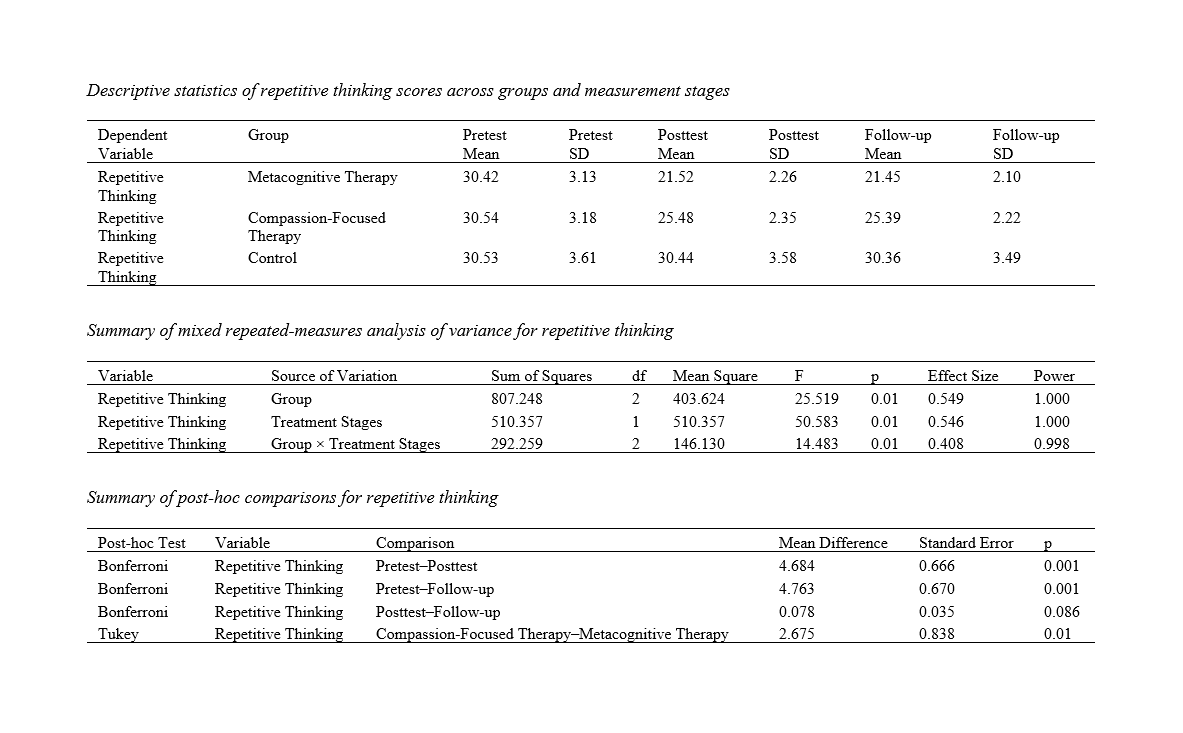
Findings: Repeated-measures ANOVA demonstrated significant main effects for group (F=25.519, p<0.01, η²=0.549) and time (F=50.583, p<0.01, η²=0.546), as well as a significant group-by-time interaction effect (F=14.483, p<0.01, η²=0.408). Bonferroni analyses revealed significant reductions in repetitive thinking from pretest to posttest and follow-up (p<0.001), whereas the difference between posttest and follow-up was not significant, indicating maintenance of treatment gains. Tukey comparisons further showed that Metacognitive Therapy produced significantly greater reductions in repetitive thinking than Compassion-Focused Therapy (p<0.01).
Conclusion: Both therapeutic approaches effectively reduced repetitive thinking among female students with non-clinical depression; however, Metacognitive Therapy demonstrated superior effectiveness. The findings suggest that directly modifying maladaptive metacognitive beliefs and cognitive processing styles may be more beneficial than compassion-based interventions for reducing repetitive thinking and preventing progression toward clinical depression.
Downloads
References
Alijani, F., & Ranjbar Kohan, Z. (2022). Effectiveness of Compassion-Focused Therapy on Negative Automatic Thoughts and Dysfunctional Attitudes in Patients with Major Depression. Quarterly Journal of Clinical Psychology Studies, 12(47), 21-43.
Asano, K., Tsuchiya, M., Okamoto, Y., Ohtani, T., Sensui, T., Masuyama, A., & Gilbert, P. (2022). Benefits of Group Compassion-Focused Therapy for Treatment-Resistant Depression: A Pilot Randomized Controlled Trial. Frontiers in psychology, 13, 903842. https://doi.org/10.3389/fpsyg.2022.903842
Bar-Sella, A., Richter, T., Zilcha-Mano, S., & Okon-Singer, H. (2022). How Social Experiences Affect Interpretation Bias among Individuals with Non-Clinical Depression: The Role of Ostracism. Frontiers in Psychiatry, 13, 819143. https://doi.org/10.3389/fpsyt.2022.819143
Batmaz, S., Altinoz, A. E., & Sonkurt, H. O. (2021). Cognitive Attentional Syndrome and Metacognitive Beliefs as Potential Treatment Targets for Metacognitive Therapy in Bipolar Disorder. World journal of psychiatry, 11(9), 589. https://doi.org/10.5498/wjp.v11.i9.589
Beaumont, E., Bell, T., McAndrew, S., & Fairhurst, H. (2021). The Impact of Compassionate Mind Training on Qualified Health Professionals Undertaking a Compassion-Focused Therapy Module. Counselling and Psychotherapy Research, 21(4), 910-922. https://doi.org/10.1002/capr.12396
Bedder, R. L., Hitchcock, P. F., & Sharp, P. B. (2024). Unraveling Repetitive Negative Thinking with Reinforcement Learning. https://doi.org/10.31234/osf.io/cu46a
Bell, T., Montague, J., Elander, J., & Gilbert, P. (2021). Multiple Emotions, Multiple Selves: Compassion Focused Therapy Chairwork. The Cognitive Behaviour Therapist, 14, e22. https://doi.org/10.1017/S1754470X21000180
Brailovskaia, J., Margraf, J., & Teismann, T. (2023). Repetitive Negative Thinking Mediates the Relationship between Addictive Facebook Use and Suicide-Related Outcomes: A Longitudinal Study. Current Psychology, 42(8), 6791-6799. https://doi.org/10.1007/s12144-021-02025-7
Brown, R. L., Wood, A., Carter, J. D., & Kannis-Dymand, L. (2022). The Metacognitive Model of Post-Traumatic Stress Disorder and Metacognitive Therapy for Post-Traumatic Stress Disorder: A Systematic Review. Clinical Psychology & Psychotherapy, 29(1), 131-146. https://doi.org/10.1002/cpp.2633
Carter, A., Gilbert, P., & Kirby, J. N. (2021). Compassion-Focused Therapy for Body Weight Shame: A Mixed Methods Pilot Trial. Clinical Psychology & Psychotherapy, 28(1), 93-108. https://doi.org/10.1002/cpp.2488
Constantin, K., Penney, A. M., Pope, C. J., Miedema, V. C., Tett, R. P., & Mazmanian, D. (2021). Negative Repetitive Thoughts Clarify the Link between Trait Emotional Intelligence and Emotional Distress. Current Psychology, 40, 5526-5535. https://doi.org/10.1007/s12144-019-00497-2
Crone, R. L., Brown, R. J., & Bell, T. (2024). Like I'd Been Listened to without Actually Saying Words: Picturing the Nurturer in Compassion-Focused Therapy. Counselling and Psychotherapy Research, 24(3), 936-948. https://doi.org/10.1002/capr.12730
Esmailzadeh, A., Touzanadeh Jani, H., Zendedel, A., & Bagherzadeh Golmakani, Z. (2023). Comparison of the Effectiveness of Mindfulness-Based Cognitive Therapy and Metacognitive Therapy on Repetitive Thoughts and Negative Meta-Emotional Dimensions in Individuals with Substance Use. Journal of Neyshabur University of Medical Sciences, 11(2), 51-65.
Forthman, K. L., Kuplicki, R., Yeh, H. W., Khalsa, S. S., Paulus, M. P., & Guinjoan, S. M. (2023). Transdiagnostic Behavioral and Genetic Contributors to Repetitive Negative Thinking: A Machine Learning Approach. Journal of psychiatric research, 162, 207-213. https://doi.org/10.1016/j.jpsychires.2023.05.039
Fox, J., Cattani, K., & Burlingame, G. M. (2021). Compassion Focused Therapy in a University Counseling and Psychological Services Center: A Feasibility Trial of a New Standardized Group Manual. Psychotherapy Research, 31(4), 419-431. https://doi.org/10.1080/10503307.2020.1783708
Frostadottir, A. D., & Dorjee, D. (2019). Effects of Mindfulness Based Cognitive Therapy (MBCT) and Compassion Focused Therapy (CFT) on Symptom Change, Mindfulness, Self-Compassion, and Rumination in Clients with Depression, Anxiety, and Stress. Frontiers in psychology, 10, 1099. https://doi.org/10.3389/fpsyg.2019.01099
Gilbert, P., Huxter, M., & Choden. (2024). Exploration of Evolution-Informed Compassion-Focused Therapy and Buddhist Approaches to Insight Meditation: A Three-Way Exploration. Mindfulness, 15(5), 1014-1037. https://doi.org/10.1007/s12671-023-02141-4
Goad, E. J., & Parker, K. (2021). Compassion-Focused Therapy Groups for People with Intellectual Disabilities: An Extended Pilot Study. Journal of Intellectual Disabilities, 25(4), 661-679. https://doi.org/10.1177/1744629520925953
Hamilton, J. L., Do, Q. B., Choukas-Bradley, S., Ladouceur, C. D., & Silk, J. S. (2021). Where It Hurts the Most: Peer Interactions on Social Media and in Person Are Differentially Associated with Emotional Reactivity and Sustained Affect among Adolescent Girls. Research on Child and Adolescent Psychopathology, 49, 155-167. https://doi.org/10.1007/s10802-020-00725-5
Inostroza, C., Bustos, C., Bühring, V., González, L., & Cova, F. (2024). Stress, Repetitive Negative Thinking, and Mental Health in Chilean University Students: An Ecological Momentary Assessment Study. Frontiers in psychology, 15, 1400013. https://doi.org/10.3389/fpsyg.2024.1400013
Jansen, P. (2021). Self-Compassion and Repetitive Thinking in Relation to Depressive Mood and Fear of the Future: An Investigation during the 2020 Coronavirus Pandemic in Semiprofessional Football Players. German Journal of Exercise and Sport Research, 51(2), 232-236. https://doi.org/10.1007/s12662-021-00712-y
Kroener, J., Eickholt, M. L., & Sosic-Vasic, Z. (2024). Group Based Metacognitive Therapy for Alcohol Use Disorder: A Pilot Study. Frontiers in Psychiatry, 15, 1375960. https://doi.org/10.3389/fpsyt.2024.1375960
Lim, S., & Park, J. H. (2024). Prefrontal Cortex Activation and Working Memory Performance in Individuals with Non-Clinical Depression: Insights from fNIRS. Acta Psychologica, 251, 104571. https://doi.org/10.1016/j.actpsy.2024.104571
Matos, M., Petrocchi, N., Irons, C., & Steindl, S. R. (2023). Never Underestimate Fears, Blocks, and Resistances: The Interplay between Experiential Practices, Self-Conscious Emotions, and the Therapeutic Relationship in Compassion Focused Therapy. Journal of Clinical Psychology, 79(7), 1670-1685. https://doi.org/10.1002/jclp.23474
McEvoy, P. M., Erceg-Hurn, D. M., Anderson, R. A., Campbell, B. N., Swan, A., Saulsman, L. M., & Nathan, P. R. (2015). Group Metacognitive Therapy for Repetitive Negative Thinking in Primary and Non-Primary Generalized Anxiety Disorder: An Effectiveness Trial. Journal of affective disorders, 175, 124-132. https://doi.org/10.1016/j.jad.2014.12.046
Melchior, K., van der Heiden, C., Deen, M., Mayer, B., & Franken, I. H. (2023). The Effectiveness of Metacognitive Therapy in Comparison to Exposure and Response Prevention for Obsessive-Compulsive Disorder: A Randomized Controlled Trial. Journal of Obsessive-Compulsive and Related Disorders, 36, 100780. https://doi.org/10.1016/j.jocrd.2023.100780
O'Toole, C., De Blasio, F., & Barry, R. (2022). Optimal Methodology for the Identification of Resting-State EEG Correlates of Non-Clinical Depression and Anxiety. Psychophysiology,
Palmieri, S., Mansueto, G., Scaini, S., Caselli, G., Sapuppo, W., Spada, M. M., & Ruggiero, G. M. (2021). Repetitive Negative Thinking and Eating Disorders: A Meta-Analysis of the Role of Worry and Rumination. Journal of clinical medicine, 10(11), 2448. https://doi.org/10.3390/jcm10112448
Ren, X., Mann, E., Wilhelm, R. A., Stewart, J. L., Kuplicki, R., Edwards, L. S., & Tsuchiyagaito, A. (2025). The Burden of Brooding on Neural Error Processing: The Role of Repetitive Negative Thinking in Major Depressive Disorder with and without Comorbid Anxiety Disorders. Journal of affective disorders, 369, 27-34. https://doi.org/10.1016/j.jad.2024.09.151
Sharma, V., Sagar, R., Kaloiya, G., & Mehta, M. (2022). The Scope of Metacognitive Therapy in the Treatment of Psychiatric Disorders. Cureus, 14(3). https://doi.org/10.7759/cureus.23424
Solem, S., Wells, A., Kennair, L. E. O., Hagen, R., Nordahl, H., & Hjemdal, O. (2021). Metacognitive Therapy versus Cognitive-Behavioral Therapy in Adults with Generalized Anxiety Disorder: A 9-Year Follow-Up Study. Brain and Behavior, 11(10), e2358. https://doi.org/10.1002/brb3.2358
Strand, E. R., Veium, L. T., Engvik, L. S., & Nordahl, H. (2023). Generic Group Metacognitive Therapy for Patients with Major Depressive Disorder and Related Problems: A Preliminary Evaluation in Specialized Mental Health Care. International Journal of Cognitive Therapy, 16(4), 497-509. https://doi.org/10.1007/s41811-023-00175-z
Thingbak, A., Wells, A., & O'Toole, M. S. (2024). Group Metacognitive Therapy for Children and Adolescents with Anxiety and Depression: A Preliminary Trial and Test of Proposed Mechanisms. Journal of anxiety disorders, 107, 102926. https://doi.org/10.1016/j.janxdis.2024.102926
van Oort, J., Tendolkar, I., Collard, R., Geurts, D. E., Vrijsen, J. N., Duyser, F. A., & van Eijndhoven, P. F. (2022). Neural Correlates of Repetitive Negative Thinking: Dimensional Evidence across the Psychopathological Continuum. Frontiers in Psychiatry, 13, 915316. https://doi.org/10.3389/fpsyt.2022.915316
Wells, A. (2011). Metacognitive Therapy for Anxiety and Depression. Guilford Press.
Wells, A., Reeves, D., Capobianco, L., Heal, C., Davies, L., Heagerty, A., & Fisher, P. (2021). Improving the Effectiveness of Psychological Interventions for Depression and Anxiety in Cardiac Rehabilitation: PATHWAY—A Single-Blind, Parallel, Randomized, Controlled Trial of Group Metacognitive Therapy. Circulation, 144(1), 23-33. https://doi.org/10.1161/CIRCULATIONAHA.120.052428
Wells, A., Reeves, D., Heal, C., Fisher, P., Doherty, P., Davies, L., & Capobianco, L. (2023). Metacognitive Therapy Home-Based Self-Help for Anxiety and Depression in Cardiovascular Disease Patients in the UK: A Single-Blind Randomised Controlled Trial. PLOS Medicine, 20(1), e1004161. https://doi.org/10.1371/journal.pmed.1004161
Yasin, S., Othmani, A., Raza, I., & Hussain, S. A. (2023). Machine Learning Based Approaches for Clinical and Non-Clinical Depression Recognition and Depression Relapse Prediction Using Audiovisual and EEG Modalities: A Comprehensive Review. Computers in Biology and Medicine, 159, 106741. https://doi.org/10.1016/j.compbiomed.2023.106741
Zagaria, A., Ballesio, A., Vacca, M., & Lombardo, C. (2023). Repetitive Negative Thinking as a Central Node between Psychopathological Domains: A Network Analysis. International Journal of Cognitive Therapy, 16(2), 143-160. https://doi.org/10.1007/s41811-023-00162-4
Downloads
Additional Files
Publication Timeline
- Submitted
- Revised
- Accepted