Forecasting Daily Stress in Adolescents from Mood Variability, Sleep Quality, Social Interaction, and Smartphone Use Using Long Short-Term Memory Networks
Keywords:
Adolescent stress, long short-term memory, ecological momentary assessment, mood variability, sleep quality, social interaction, smartphone useAbstract
Objective: This study aimed to forecast next-day stress among Canadian adolescents using seven-day temporal sequences of mood variability, sleep quality, social interaction, and smartphone use through a long short-term memory network.
Methods and Materials: A prospective intensive longitudinal study was conducted with 312 adolescents aged 13–18 years recruited from Ontario, British Columbia, Alberta, and Quebec, Canada. Participants completed baseline assessments followed by 30 consecutive days of ecological momentary assessment and passive smartphone monitoring. Daily perceived stress was assessed each evening, mood was recorded four times daily, sleep quality was measured through morning sleep diaries, and social interaction was evaluated using daily self-reports and communication metadata. Passive smartphone indicators included total screen time, device unlocks, session duration, application-category use, and nighttime smartphone activity. Seven-day sliding windows were used to predict the following day’s stress. Data were divided at the participant level into training, validation, and independent test sets. The LSTM model was compared with persistence, multiple linear regression, random forest, and feedforward neural-network models.
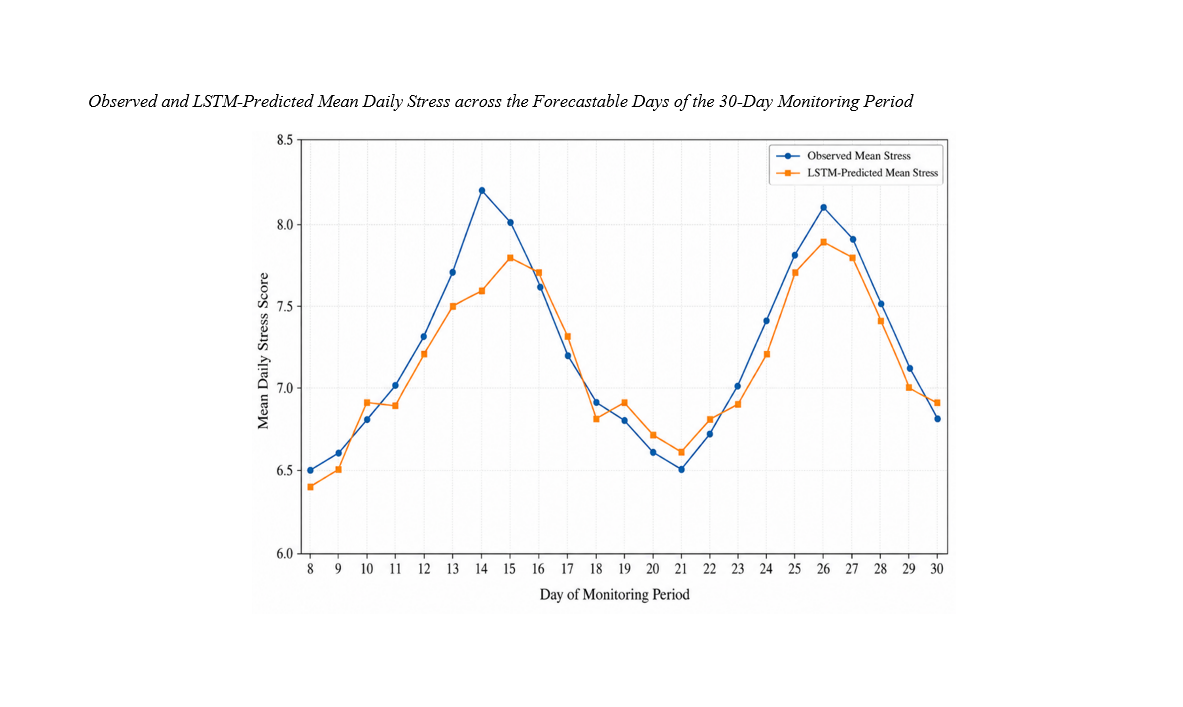
Findings: The LSTM model demonstrated the best predictive performance in the independent test set, with a mean absolute error of 1.42, root mean square error of 1.89, coefficient of determination of .62, and correlation of .79 between observed and predicted stress. It reduced mean absolute error by 27.6% compared with the persistence model, 20.2% compared with linear regression, 11.8% compared with random forest, and 7.8% compared with the feedforward neural network. Ablation analyses showed that removing mood, sleep, social-interaction, and smartphone-use variables increased prediction error, with mood variability producing the greatest decline in performance. Negative-mood variability, subjective sleep quality, nighttime smartphone use, loneliness, and previous-day stress were the most influential predictors.
Conclusion: Sequential patterns of mood, sleep, social experiences, and smartphone behavior can meaningfully forecast adolescents’ next-day stress, and LSTM networks offer greater predictive accuracy than conventional and nonsequential models.
Downloads
References
Ali, Z., Janarthanan, J., & Mohan, P. (2024). Understanding Digital Dementia and Cognitive Impact in the Current Era of the Internet: A Review. Cureus. https://doi.org/10.7759/cureus.70029
Alkureishi, L. A., Bernstein, K. D. A., & Hageman, J. R. (2024). Advice on Establishing Healthy Cell Phone Routines for Teenagers. Pediatric Annals, 53(7). https://doi.org/10.3928/19382359-20240529-01
Bezerra, L. B., Fortkamp, M., Silva, T. O., Vítor Cruz Rosa Pires de, S., Machado, A. A. V., & Souza, J. C. (2023). Excessive Use of Social Media Related to Mental Health and Decreased Sleep Quality in Students. Revista Eletrônica Acervo Saúde, 23(7), e13030. https://doi.org/10.25248/reas.e13030.2023
Bhatia, R. (2023). Impact of Increasing Media Use on Mental Health of Children and Adolescents. Current Opinion in Psychiatry, 36(6), 449-454. https://doi.org/10.1097/yco.0000000000000897
Crowhurst, S., & Hosseinzadeh, H. (2024). Risk Factors of Smartphone Addiction: A Systematic Review of Longitudinal Studies. Public Health Challenges, 3(2). https://doi.org/10.1002/puh2.202
Daraj, L. R., AlGhareeb, M., Almutawa, Y. M., Trabelsi, K., & Jahrami, H. (2023). Systematic Review and Meta-Analysis of the Correlation Coefficients Between Nomophobia and Anxiety, Smartphone Addiction, and Insomnia Symptoms. Healthcare, 11(14), 2066. https://doi.org/10.3390/healthcare11142066
Dibben, G., Martin, A., Shore, C. B., Johnstone, A., McMellon, C., Palmer, V. J., Pugmire, J., Riddell, J., Skivington, K., Wells, V., McDaid, L., & Simpson, S. (2023). Adolescents’ Interactive Electronic Device Use, Sleep and Mental Health: A Systematic Review of Prospective Studies. Journal of Sleep Research, 32(5). https://doi.org/10.1111/jsr.13899
Dreier, M. J., Boyd, S. I., Jorgensen, S. L., Merai, R., Fedor, J., Durica, K. C., Low, C. A., & Hamilton, J. L. (2023). Adolescents’ Daily Social Media Use and Mood During the COVID-19 Lockdown Period. https://doi.org/10.31234/osf.io/dfbrs
Gao, W., Hu, Y., Ji, J.-L., & Liu, X. (2023). Relationship Between Depression, Smartphone Addiction, and Sleep Among Chinese Engineering Students During the COVID-19 Pandemic. World journal of psychiatry, 13(6), 361-375. https://doi.org/10.5498/wjp.v13.i6.361
Gupta, V., Gupta, A., Valjiyani, S., Uppal, S., Gautam, S., & Vishwas, G. (2023). Physical, Psychological and Social Effects of Mobile Phone Use in Children: A Prospective Cohort Study. J Biomed Res Environ Sci, 4(8), 1206-1232. https://doi.org/10.37871/jbres1788
Haag, A. C., Nick, E. A., Chen, S., Telzer, E. H., Prinstein, M. J., & Bonanno, G. A. (2024). Investigating Risk Profiles of Smartphone Activities and Psychosocial Factors in Adolescents During the COVID‐19 Pandemic. Journal of Research on Adolescence, 35(1). https://doi.org/10.1111/jora.13045
Liu, X., Huang, L., McIntosh, C. W., Liu, J., & McDonald, C. C. (2025). Association Between Smartphone Attachment and Mental Health in Adolescents. Journal of Child and Adolescent Psychiatric Nursing, 38(3). https://doi.org/10.1111/jcap.70030
Maksniemi, E., Ketonen, E., Salonen, V., Lonka, K., & Salmela‐Aro, K. (2023). Social Media Use May Not Be That Harmful for Late Adolescents’ Sleep and the Following Day School Wellbeing - An Experience Sampling Study. https://doi.org/10.31234/osf.io/skdf2
Naima, M. A. (2023). The Effect of Screen Time on Children’s Behaviour. Mewfm, 21(9). https://doi.org/10.5742/mewfm.2023.95256194
Ng, M. Y., Frederick, J., Fisher, A. J., Allen, N. B., Pettit, J. W., & McMakin, D. L. (2023). Identifying Person-Specific Drivers of Depression in Adolescents: Protocol for a Smartphone-Based Ecological Momentary Assessment and Passive Sensing Study (Preprint). https://doi.org/10.2196/preprints.43931
Ntumi, S., Ogah, M., Nyarko, B., & Nimo, D. G. (2025). “Quiet Screens, Loud Minds”: Classroom-Based Assessment of Nocturnal Social Media Use, Sleep Quality, and Anxiety Among Middle Adolescents in Ghana. https://doi.org/10.21203/rs.3.rs-6645487/v1
Peuters, C., Maenhout, L., Cardon, G., Paepe, A. D., DeSmet, A., Lauwerier, E., Leta, K., & Crombez, G. (2024). A Mobile Healthy Lifestyle Intervention to Promote Mental Health in Adolescence: A Mixed-Methods Evaluation. BMC public health, 24(1). https://doi.org/10.1186/s12889-023-17260-9
Rathod, A., Ingole, A., Gaidhane, A., & Choudhari, S. G. (2022). Psychological Morbidities Associated With Excessive Usage of Smartphones Among Adolescents and Young Adults: A Review. Cureus. https://doi.org/10.7759/cureus.30756
Santos, R. M. S., Mendes, C. G., Bressani, G. Y. S., Ventura, S. d. A., Yago Jean de Almeida, N., Miranda, D. M. d., & Romano‐Silva, M. A. (2023). The Associations Between Screen Time and Mental Health in Adolescents: A Systematic Review. BMC psychology, 11(1). https://doi.org/10.1186/s40359-023-01166-7
Serrano, B. G., Spiers, A., Ruotong, L., Gangadia, S., Toledano, M. B., & Simplicio, M. D. (2022). Impact of Mobile Phones and Wireless Devices Use on Children and Adolescents’ Mental Health: A Systematic Review. European Child & Adolescent Psychiatry, 33(6), 1621-1651. https://doi.org/10.1007/s00787-022-02012-8
Shahnovsky, O., Ekstein, D., Friedman, T., Stemmer, M., Carmi, L., Benaroya‐Milshtein, N., Fine, S., & Barzilay, S. (2026). Understanding Sleep and Smartphone Use in Diverse Adolescents Through Passive Digital Monitoring. Journal of Research on Adolescence, 36(2). https://doi.org/10.1111/jora.70192
Singhal, P., Dhaliwal, N., Dabas, A., & Yadav, S. (2022). Optimizing Internet Use During Adolescence: eHealth Solutions. Annals of the National Academy of Medical Sciences (India), 58, 175-181. https://doi.org/10.1055/s-0042-1757738
Thiểm, V. Đ., & Tagliabue, M. (2025). Active Nudging Towards Digital Well-Being: Reducing Excessive Screen Time on Mobile Phones and Potential Improvement for Sleep Quality. Frontiers in Psychiatry, 16. https://doi.org/10.3389/fpsyt.2025.1602997
Vandendriessche, A., Verloigne, M., Boets, L., Joriskes, J., DeSmet, A., Dhondt, K., & Deforche, B. (2022). Psychosocial Factors Related to Sleep in Adolescents and Their Willingness to Participate in the Development of a Healthy Sleep Intervention: A Focus Group Study. BMC public health, 22(1). https://doi.org/10.1186/s12889-022-14278-3
Downloads
Additional Files
Publication Timeline
- Submitted
- Revised
- Accepted