Prediction of Cognitive Flexibility Based on Attention Control, Working Memory, and Problem-Solving Skills in Adolescents Using CatBoost
DOI:
https://doi.org/10.61838/Keywords:
Cognitive flexibility, attention control, working memory, problem-solving skills, adolescents, CatBoost, machine learning, executive functionsAbstract
Objective: The present study aimed to predict cognitive flexibility based on attention control, working memory, and problem-solving skills in adolescents using the CatBoost machine learning algorithm.
Methods and Materials: This study was conducted using a quantitative, descriptive-correlational, and predictive design. The statistical population included adolescents studying in secondary schools in Tehran during the 2025–2026 academic year. The final sample consisted of 384 adolescents selected through multistage cluster sampling. Data were collected using standardized self-report instruments measuring cognitive flexibility, attention control, working memory, and problem-solving skills. After preliminary data screening, descriptive indices, reliability coefficients, Pearson correlation coefficients, and machine learning-based predictive analyses were conducted. The CatBoost algorithm was used to predict cognitive flexibility, and the dataset was divided into training and test subsets. Model performance was evaluated using mean absolute error, mean squared error, root mean squared error, coefficient of determination, and five-fold cross-validation. Feature importance analysis was also performed to determine the relative contribution of each predictor.
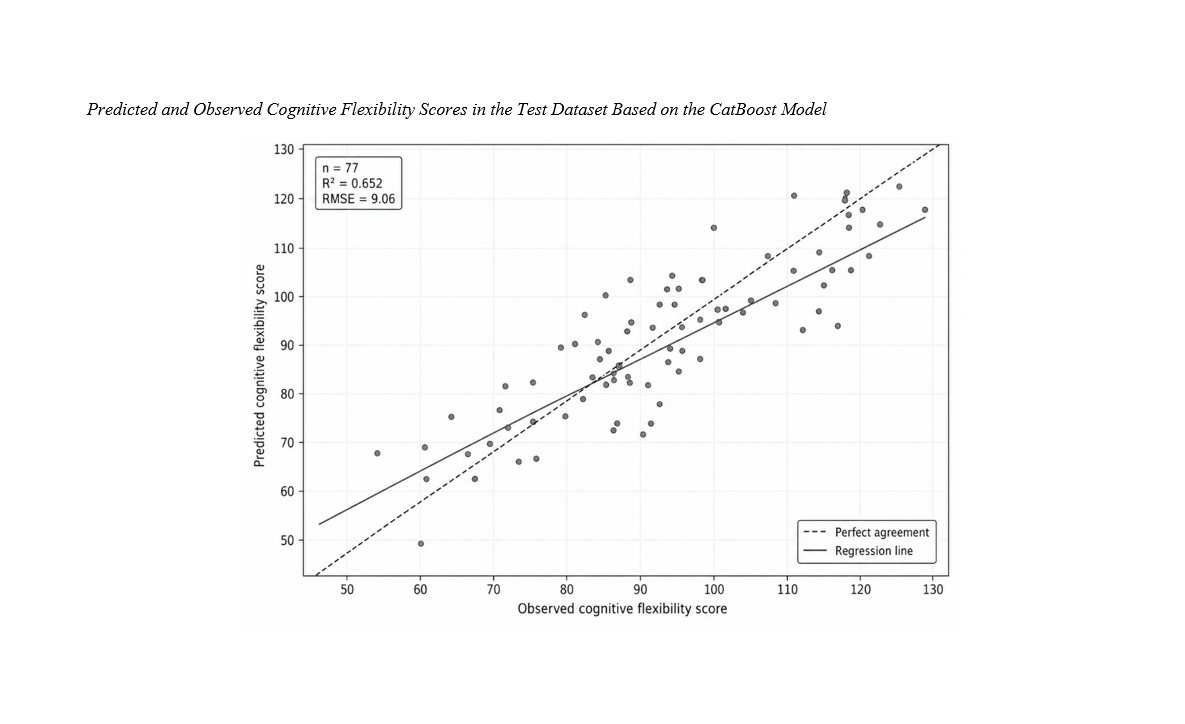
Findings: The results showed that cognitive flexibility had significant positive correlations with problem-solving skills (r = 0.61, p < 0.01), attention control (r = 0.55, p < 0.01), and working memory (r = 0.48, p < 0.01). The CatBoost model demonstrated acceptable predictive accuracy. In the training set, the model explained 76.5% of the variance in cognitive flexibility, while in the test set, it explained 65.2% of the variance. The cross-validation results also supported the stability of the model, with an average R² of 0.636. Feature importance analysis indicated that problem-solving skills had the highest predictive contribution, followed by attention control and working memory.
Conclusion: The findings indicate that cognitive flexibility in adolescents can be meaningfully predicted by problem-solving skills, attention control, and working memory. The CatBoost algorithm provided an effective predictive model and showed that problem-solving skills were the most important predictor.
Downloads
References
Arruda, M. A., Arruda, R., & Silva, J. A. D. (2025). Impact of Psychiatric Comorbidity, Resilience and Executive Function on Childhood and Adolescent Headaches: A Narrative Review. Cephalalgia, 45(9). https://doi.org/10.1177/03331024251364204
Ayuso, D. M. R., Pino-González, A. d., Torres-Jiménez, A., Juan-González, J., Celdrán, F. J., Franchella, M. C., Ortega-López, N., Triviño-Juárez, J. M., Garach-Gómez, A., Arrabal-Fernández, L., Medina-Martínez, I., & González, P. (2024). Enhancing Ecological Validity: Virtual Reality Assessment of Executive Functioning in Children and Adolescents With ADHD. Children, 11(8), 986. https://doi.org/10.3390/children11080986
Beckmann, E. A., & Mano, K. E. J. (2021). Advancing the Measurement of Executive Functioning in Pediatric Chronic Pain. Children, 8(8), 630. https://doi.org/10.3390/children8080630
Cabral, L. L. P., Browne, R. A. V., Freire, Y. A., Schwade, D., Souto, G. C., Dantas, M., Flávio Anselmo Silva de, L., Farias-Junior, L. F., Costa, E. C., & Barros, J. F. (2021). Cardiorespiratory Fitness and Performance in Multiple Domains of Executive Functions in School–Aged Adolescents. Frontiers in Physiology, 12. https://doi.org/10.3389/fphys.2021.640765
Charry-Sánchez, J. D., Ramírez-Guerrero, S., Vargas-Cuellar, M. P., Romero-Gordillo, M. A., & Talero‐Gutiérrez, C. (2022). Executive Functions in Children and Adolescents With Hearing Loss: A Systematic Review of Case-Control, Case Series, and Cross-Sectional Studies. Salud mental, 45(1), 35-49. https://doi.org/10.17711/sm.0185-3325.2022.006
Contreras-Osorio, F., Guzmán‐Guzmán, I. P., Cerda-Vega, E., Ríos, L. J. C., Ramírez‐Campillo, R., & Campos‐Jara, C. (2022). Effects of the Type of Sports Practice on the Executive Functions of Schoolchildren. International journal of environmental research and public health, 19(7), 3886. https://doi.org/10.3390/ijerph19073886
DelRosso, L. M., Vega‐Flores, G., Ferri, R., Mogavero, M. P., & Diamond, A. (2022). Assessment of Executive and Cognitive Functions in Children With Restless Sleep Disorder: A Pilot Study. Brain Sciences, 12(10), 1289. https://doi.org/10.3390/brainsci12101289
Drakatos, N., & Drigas, A. (2024). The Impact of STEAM Education Using Robotics on the Executive Function of Typical and ADHD Students Along With Developmental Exploration. Brazilian Journal of Science, 3(2), 113-122. https://doi.org/10.14295/bjs.v3i2.467
Escolano-Pérez, E., & Losada, J. L. (2024). Using Artificial Intelligence in Education: Decision Tree Learning Results in Secondary School Students Based on Cold and Hot Executive Functions. Humanities and Social Sciences Communications, 11(1). https://doi.org/10.1057/s41599-024-04040-y
Filipiak, S., & Hawrot, A. (2024). Negative Affect and Planning Ability in Preschool Children: A Mediation Model of Working Memory, Inhibition, and Cognitive Flexibility. Scandinavian journal of psychology, 66(2), 277-287. https://doi.org/10.1111/sjop.13085
Finnanger, T. G., Andersson, S., Chevignard, M., Johansen, G. O., Brandt, A. E., Hypher, R. E., Risnes, K., Rø, T. B., & Stubberud, J. (2022). Assessment of Executive Function in Everyday Life—Psychometric Properties of the Norwegian Adaptation of the Children’s Cooking Task. Frontiers in human neuroscience, 15. https://doi.org/10.3389/fnhum.2021.761755
Gentil-Gutiérrez, A., Santamaría‐Peláez, M., Mínguez-Mínguez, L. A., Fernández-Solana, J., González‐Bernal, J. J., González‐Santos, J., & Obregón-Cuesta, A. I. (2022). Executive Functions in Children and Adolescents With Autism Spectrum Disorder in Family and School Environment. International journal of environmental research and public health, 19(13), 7834. https://doi.org/10.3390/ijerph19137834
Gerhardt, S., Hoier, S., Schmidt, R., Weber, L., Mechler, K., Banaschewski, T., Haege, A., & Vollstädt‐Klein, S. (2025). Move by Move Towards Mental Health: A Pilot Study on Chess as a Therapeutic Approach in Adolescents With Mental Disorders. https://doi.org/10.1101/2025.10.29.25338524
Gordon-Murer, C., Stöckel, T., Sera, M., & Hughes, C. (2021). Developmental Differences in the Relationships Between Sensorimotor and Executive Functions. Frontiers in human neuroscience, 15. https://doi.org/10.3389/fnhum.2021.714828
Guo, B., Song, Y., Zhao, L., Cheng, X., Ma, H., Qiu, X., Yang, X., Qiao, Z., Zhao, E., Bu, T., Yang, J., Mishra, R., Yang, Y., & Zhou, J. (2022). Sleep Quality and Creativity in Chinese College Student During the COVID-19 Pandemic: The Mediating Role of Executive Function. Frontiers in Public Health, 10. https://doi.org/10.3389/fpubh.2022.987372
Happaney, K., & Zelazo, P. D. (2022). Development of Executive Function Skills in Childhood. 427-451. https://doi.org/10.1017/9781108399838.023
Hoseini, f. s., Alimoradi, K., & Jamshidi, F. (2022). Help Them Pass a Stormy Road: A Preliminary Study of Emotional Memory Management Training on Executive Functions and Difficulties in Emotional Regulation in Adolescents. Counselling and Psychotherapy Research, 22(4), 925-936. https://doi.org/10.1002/capr.12518
Košíková, E., Bakoš, V., Turoňová, D., Rašková, B., Mesárošová, B., Ostatníková, D., & Babinská, K. n. (2024). Hot and Cool Executive Functions in Children and Adolescents With Further Exploration in Adhd Context. Ansr, 66(2), 50-68. https://doi.org/10.31577/ansr.2024.66.2.2
Kupis, L., & Uddin, L. Q. (2023). Developmental Neuroimaging of Cognitive Flexibility: Update and Future Directions. Annual Review of Developmental Psychology, 5(1), 263-284. https://doi.org/10.1146/annurev-devpsych-120221-035310
Lachambre, C., Proteau-Lemieux, M., Lepage, J. F., Bussières, È.-L., & Lippé, S. (2021). Attentional and Executive Functions in Children and Adolescents With Developmental Coordination Disorder and the Influence of Comorbid Disorders: A Systematic Review of the Literature. PLoS One, 16(6), e0252043. https://doi.org/10.1371/journal.pone.0252043
Latino, F., Tafuri, F., Maisuradze, M., & Tafuri, M. G. (2025). Complex Motor Schemes and Executive Functions: A School-Based Dual-Challenge Intervention to Enhance Cognitive Performance and Academic Success in Early Adolescence. Journal of Intelligence, 13(11), 151. https://doi.org/10.3390/jintelligence13110151
Lee, S. J., Woodward, L. J., Moor, S., & Austin, N. (2024). Executive Functioning Challenges of Adolescents Born Extremely and Very Preterm. Frontiers in psychology, 15. https://doi.org/10.3389/fpsyg.2024.1487908
Liu, L., Xin, X., & Zhang, Y. (2025). The Effects of Physical Exercise on Cognitive Function in Adolescents: A Systematic Review and Meta-Analysis. Frontiers in psychology, 16. https://doi.org/10.3389/fpsyg.2025.1556721
Mao, F., Li, Z., Qiu, C., & Fang, Q. (2024). Developing Integrative Practice on Basic Soccer Skills to Stimulate Cognitive Promotion for Children and Adolescents. Frontiers in psychology, 15. https://doi.org/10.3389/fpsyg.2024.1348006
Oppenheimer, A., Coull, B. A., Weisskopf, M. G., & Korrick, S. (2021). Prenatal Exposure to Chemical Mixtures and Cognitive Flexibility Among Adolescents. Toxics, 9(12), 329. https://doi.org/10.3390/toxics9120329
Pablo-Ríos, M. V., Asencio, E. N., Gordo, P. M., Gómez, R. G., Porras‐Truque, C., & Moreno, L. M. G. (2024). Dysexecutive Symptomatology in Everyday Functioning and Academic Achievement in Adolescents. Frontiers in psychology, 15. https://doi.org/10.3389/fpsyg.2024.1323317
Pergantis, P., Bamicha, V., Chaidi, I., & Drigas, A. (2024). Driving Under Cognitive Control: The Impact of Executive Functions in Driving. World Electric Vehicle Journal, 15(10), 474. https://doi.org/10.3390/wevj15100474
Pergantis, P., Bamicha, V., Skianis, C., & Drigas, A. (2025). AI Chatbots and Cognitive Control: Enhancing Executive Functions Through Chatbot Interactions: A Systematic Review. Brain Sciences, 15(1), 47. https://doi.org/10.3390/brainsci15010047
Raj, S., Jemi, M. T., & Mammen, P. (2025). Clinical Practice Guidelines for Cognitive Impairment in Autism Spectrum Disorder – Assessment and Management. Indian Journal of Psychiatry, 67(1), 117-127. https://doi.org/10.4103/indianjpsychiatry.indianjpsychiatry_811_24
Robledo-Castro, C., Castillo, L., & Corchado, J. M. (2022). Artificial Cognitive Systems Applied in Executive Function Stimulation and Rehabilitation Programs: A Systematic Review. Arabian Journal for Science and Engineering, 48(2), 2399-2427. https://doi.org/10.1007/s13369-022-07292-5
Rocha, A., Almeida, L. S., & Perales, R. G. (2020). Comparison of Gifted and Non-Gifted Students’ Executive Functions and High Capabilities. Journal for the Education of Gifted Young Scientists, 8(4), 1397-1409. https://doi.org/10.17478/jegys.808796
Sayar, F. (2024). An Assessment of the Evolution of Executive Functions. Psikiyatride Guncel Yaklasimlar - Current Approaches in Psychiatry, 16(3), 517-531. https://doi.org/10.18863/pgy.1350386
Shi, P., Tang, Y., Zhang, Z., Feng, X., & Li, C. (2022). Effect of Physical Exercise in Real-World Settings on Executive Function of Typical Children and Adolescents: A Systematic Review. Brain Sciences, 12(12), 1734. https://doi.org/10.3390/brainsci12121734
Singh, K., Pany, S., Mohanty, S. P., Sahoo, P. K., & Rana, S. (2024). Efficacy of Cognitive Behavioral Intervention in Improving Executive Function of Children With High Functioning Autism Spectrum Disorder: A Meta-Analysis. International Journal of Special Education (Ijse), 39(1), 11-20. https://doi.org/10.52291/ijse.2024.39.2
Timko, C. A., Schnabel, J., & Orloff, N. C. (2024). The Importance of Improving Cognitive Flexibility in Adolescents With Anorexia Nervosa: The Case for Cognitive Remediation Therapy. International Journal of Eating Disorders, 57(5), 1109-1118. https://doi.org/10.1002/eat.24164
Vandoni, M., Giuriato, M., Pirazzi, A., Zanelli, S., Gaboardi, F., Pellino, V. C., Gazzarri, A. A., Baldassarre, P., Zuccotti, G., & Calcaterra, V. (2023). Motor Skills and Executive Functions in Pediatric Patients With Down Syndrome: A Challenge for Tailoring Physical Activity Interventions. Pediatric Reports, 15(4), 691-706. https://doi.org/10.3390/pediatric15040062
Downloads
Additional Files
Publication Timeline
- Submitted
- Revised
- Accepted