The Relationship of Classroom Emotion, Self-Compassion, and Tolerance of Ambiguity with Academic Anxiety among Female Senior High School Students in District 9 of Karaj
DOI:
https://doi.org/10.61838/Keywords:
Classroom Emotion, Self-Compassion, Tolerance of Ambiguity, Academic Anxiety, Female StudentsAbstract
Objective: This study aimed to examine the relationship of classroom emotion, self-compassion, and tolerance of ambiguity with academic anxiety among female senior high school students in District 9 of Karaj.
Methods and Materials: The present study employed a descriptive-correlational research design. The statistical population consisted of female senior high school students in District 9 of Karaj, from whom 210 students were selected initially through multistage cluster sampling and finally through convenience sampling. Data were collected using the Friedman and Jacob Test Anxiety Questionnaire (1997), the Classroom Emotion Questionnaire developed by Titsworth et al. (2010), the Tolerance of Ambiguity Questionnaire developed by Weden et al. (2003), and the Short Form of the Self-Compassion Scale developed by Raes et al. (2011). The collected data were analyzed using descriptive indices, Pearson correlation coefficient, and stepwise multiple regression analysis.
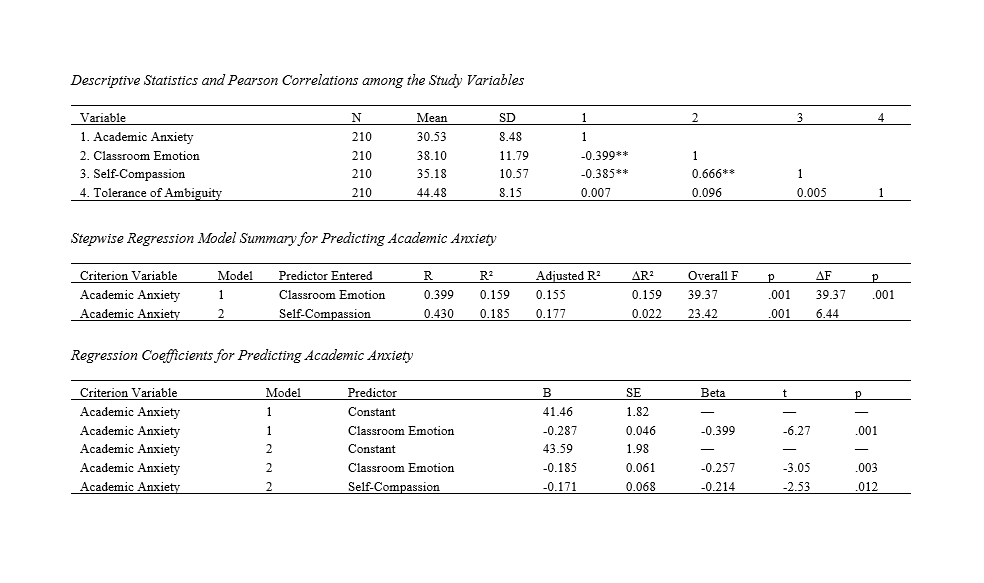
Findings: The inferential findings indicated a significant negative relationship between classroom emotion and academic anxiety, suggesting that more positive classroom emotional experiences were associated with lower levels of academic anxiety. A significant negative relationship was also found between self-compassion and academic anxiety, indicating that students with higher self-compassion experienced lower academic anxiety. In the stepwise regression analysis, classroom emotion emerged as the strongest predictor and explained 15.50% of the variance in academic anxiety. Self-compassion was added in the second step and explained an additional 2.20% of the variance. Together, classroom emotion and self-compassion accounted for 17.70% of the total variance in academic anxiety. Tolerance of ambiguity did not enter the final predictive model.
Conclusion: The findings suggest that classroom emotion and self-compassion are important psychological and educational variables in predicting academic anxiety among female senior high school students. Strengthening positive classroom emotional experiences and promoting self-compassion may help reduce students’ academic anxiety.
Downloads
References
Alshareef, N., Giga, S., & Fletcher, I. (2025). Test anxiety, emotional regulation and academic performance among medical students: A qualitative study. Medical Education Online, 30(1), 2505177. https://doi.org/10.1080/10872981.2025.2505177
Baezat, F., Sadeghi, M. S., Izadifard, R., & Roubenzadeh, S. (2012). Validation and standardization of the Friedman Test Anxiety Scale: Persian form. Psychological studies, 8(1).
Cassady, J. C., Helsper, A., & Quagliano, Q. (2024). The collective influence of intolerance of uncertainty, cognitive test anxiety, and academic self-handicapping on learner outcomes: Evidence for a process model. Behavioral Sciences, 14(2), 96. https://doi.org/10.3390/bs14020096
Cowand, A., Amarsaikhan, U., Ricks, R. F., Cash, E. D., & Sephton, S. E. (2024). Self-compassion is associated with improved well-being and healthier cortisol profiles in undergraduate students. Mindfulness, 15(7), 1831-1845. https://doi.org/10.1007/s12671-024-02383-w
Ghodsi, A., Talehpasand, S., Mohammadifar, M. A., & Rezaei, A. M. (2018). Psychometric properties of the Classroom Emotion Scale. Educational Psychology Studies, 15(29), 209-236.
Gomis, R., Garcia-Blanc, N., Ros-Morente, A., & Filella, G. (2025). Anxiety, emotional regulation and academic performance in early primary students: Impact of an intervention. Revista de Psicodidáctica, 30(2), 500166. https://doi.org/10.1016/j.psicoe.2025.500166
Han, S., Yusupbag, D., Yao, X., & Han, Z. (2023). Investigating the emotion patterns of students' abnormal interactions in primary class teaching contexts. Sustainability, 15(24), 16785. https://doi.org/10.3390/su152416785
Harouni, B., & Khosh Akhlaq, H. (2022). The mediating role of self-compassion in the relationship between self-concept and body image with social anxiety among female students of Isfahan University of Technology. Interdisciplinary Women's Studies, 4(1), e725895.
Hatun, O., & Demirci, İ. (2022). Developing the Cyberostracism Scale and examining its psychometric characteristics. International journal of mental health and addiction, 20(2), 1063-1082. https://doi.org/10.1007/s11469-020-00426-6
Homan, K. J., & Sirois, F. M. (2017). Self-compassion and physical health: Exploring the roles of perceived stress and health-promoting behaviors. Health Psychology Open, 4(2), 2055102917729542. https://doi.org/10.1177/2055102917729542
Iannello, P., Mottini, A., Tirelli, S., Riva, S., & Antonietti, A. (2017). Ambiguity and uncertainty tolerance, need for cognition, and their association with stress: A study among Italian practicing physicians. Medical Education Online, 22(1), 1270009. https://doi.org/10.1080/10872981.2016.1270009
Jia, T. (2024). A study of the causes and effects of anxiety among students in higher education. Journal of Education, Humanities and Social Sciences, 45, 111-115. https://doi.org/10.54097/zza43979
Jiménez-Mijangos, L. P., Rodríguez-Arce, J., Martínez-Méndez, R., & Reyes-Lagos, J. J. (2023). Advances and challenges in the detection of academic stress and anxiety in the classroom: A literature review and recommendations. Education and Information Technologies, 28(4), 3637-3666. https://doi.org/10.1007/s10639-022-11324-w
Langah, S., Khan, M., Ilyas, M., Abro, P., & Ahmed, N. (2024). Exploring the factors of anxiety affecting students' academic performance: A study of higher education institution of Larkana. Voyage Journal of Educational Studies, 4(1), 68-82. https://doi.org/10.58622/vjes.v4i1.117
Liang, H., & Mao, X. (2025). Emotion regulation and perceptions of academic stress as key predictors of academic motivation in second language learning. PLoS One, 20(8), e0327071. https://doi.org/10.1371/journal.pone.0327071
Lin, Y., Niu, R., & Yu, Z. (2023). Roles of ambiguity tolerance and learning effectiveness: Structural equation modeling evidence from EFL students' perceptions of factors influencing peer collaboration. Language Teaching Research, 0(0). https://doi.org/10.1177/13621688231216201
Moghimi, S. M., & Ramezan, M. (2015). Examining the reliability and validity of the Ambiguity Tolerance Questionnaire in an Iranian sample. Organizational Behavior Management.
Nguyen, A., Grummitt, L., Barrett, E. L., Bailey, S., Gardner, L. A., Champion, K. E., Halladay, J., Maratos, F., Hunter, E., Rowlinson, K., Chapman, C., Newton, N. C., & Birrell, L. (2025). The relationship between emotion regulation and mental health in adolescents: Self-compassion as a moderator. Mental Health & Prevention, 38, 200430. https://doi.org/10.1016/j.mhp.2025.200430
Pekrun, R. (2024). Control-value theory: From achievement emotion to a general theory of human emotions. Educational psychology review, 36(3), 83. https://doi.org/10.1007/s10648-024-09909-7
Raes, F., Pommier, E., Neff, K. D., & Van Gucht, D. (2011). Construction and factorial validation of a short form of the Self-Compassion Scale. Clinical Psychology & Psychotherapy, 18(3), 250-255. https://doi.org/10.1002/cpp.702
Shahbazi, M., Rajabi, G., Maghami, E., & Jolodari, A. (2015). Confirmatory factor structure of the Persian version of the revised Self-Compassion Scale in a group of prisoners. Psychological Methods and Models, 6(19), 31-46.
Soleimani Shabilou, N., Vahedi, S., & Nemati, S. (2019). The relationship of academic emotions of students, teachers, and parents with academic performance in science. Child Mental Health Quarterly, 6(1), 188-199.
Stromájer, G. P., Csima, M., Iváncsik, R., Varga, B., Takács, K., & Stromájer-Rácz, T. (2023). Stress and anxiety among high school adolescents: Correlations between physiological and psychological indicators in a longitudinal follow-up study. Children, 10(9), 1548. https://doi.org/10.3390/children10091548
Titsworth, S., Quinlan, M. M., & Mazer, J. P. (2010). Emotion in teaching and learning: Development and validation of the Classroom Emotions Scale. Communication Education, 59(4), 431-452. https://doi.org/10.1080/03634521003746156
Wu, Y., Xie, F., & Jiang, R. (2022). Academic anxiety, self-regulated learning ability, and self-esteem in Chinese candidates for college entrance examination during the COVID-19 outbreak: A survey study. Psychology research and behavior management, 15, 2383-2390. https://doi.org/10.2147/PRBM.S360127
Yu, M., Wang, H., & Xia, G. (2022). The review on the role of ambiguity of tolerance and resilience on students' engagement. Frontiers in psychology, 12, 828894. https://doi.org/10.3389/fpsyg.2021.828894
Zeng, Y., Sun, W., Wang, M., Wei, J., Sun, G., & Hu, J. (2023). The association between online class-related anxiety and academic achievement among undergraduates. Social Behavior and Personality: an international journal, 51(7), 1-13. https://doi.org/10.2224/sbp.12462
Zhang, Y., Luo, X., Che, X., & Duan, W. (2016). Protective effect of self-compassion to emotional response among students with chronic academic stress. Frontiers in psychology, 7, 1802. https://doi.org/10.3389/fpsyg.2016.01802
Zuo, T. (2025). From tolerance for ambiguity to stress and anxiety: The mediating role of need for cognitive closure among Chinese university students. Psychological Reports, 128(6), 3967-3998. https://doi.org/10.1177/00332941231212833
Downloads
Additional Files
Publication Timeline
- Submitted
- Revised
- Accepted