Effectiveness of Cognitive Behavioral Therapy on Emotional Self-Awareness and Self-Regulation Strategies in Adolescents from Single-Parent Families
DOI:
https://doi.org/10.61838/Keywords:
Cognitive behavioral therapy, emotional self-awareness, self-regulation strategies, adolescents, single-parent familiesAbstract
Objective: This study aimed to determine the effectiveness of cognitive behavioral therapy (CBT) in improving emotional self-awareness and self-regulation strategies among adolescents from single-parent families.
Methods and Materials: This study employed a quasi-experimental pretest–posttest design with an experimental group and a control group. The statistical population comprised adolescents from single-parent families who attended counseling centers in Tehran, Iran, during 2025. Using purposive non-random sampling, 30 eligible adolescents were selected and subsequently assigned randomly to either the experimental group (n = 15) or the control group (n = 15). Data were collected using standardized questionnaires assessing emotional self-awareness and self-regulation strategies. Participants in the experimental group received eight 90-minute CBT sessions, whereas the control group received no psychological intervention during the study period. Following completion of the intervention, both groups completed the posttest measures. The collected data were analyzed using appropriate descriptive and inferential statistical procedures to compare posttest scores while considering baseline differences between the two groups.
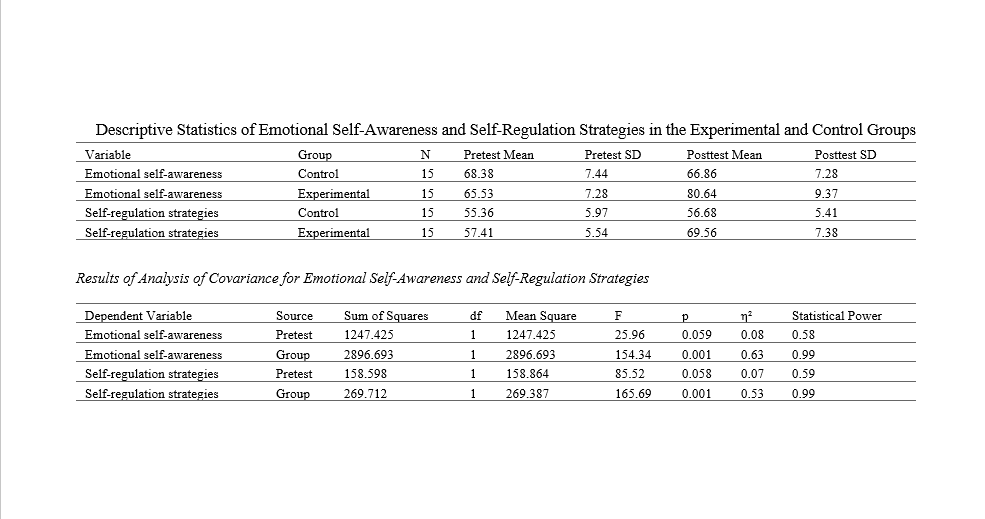
Findings: Inferential analyses demonstrated that, after controlling for pretest scores, the experimental group obtained significantly higher posttest scores in emotional self-awareness than the control group. CBT also produced a statistically significant improvement in the participants’ self-regulation strategies. Accordingly, significant between-group differences were observed in both dependent variables at the posttest stage, with the experimental group showing more favorable outcomes. These findings indicate that the observed improvements were attributable to participation in the CBT intervention rather than to baseline differences or the mere passage of time.
Conclusion: Cognitive behavioral therapy is an effective psychological intervention for enhancing emotional self-awareness and self-regulation strategies in adolescents from single-parent families. By helping adolescents identify and modify dysfunctional thoughts, recognize emotional experiences, and employ more adaptive cognitive and behavioral regulation strategies, CBT may strengthen their capacity to manage emotional and developmental challenges. Therefore, this intervention can be incorporated into counseling and psychological support programs designed for adolescents living in single-parent households.
Downloads
References
Azimi Roshan, H. (2022). The Effectiveness of Self-Regulated Learning Strategy Training on Social Adjustment and Academic Success of Sixth-Grade Elementary Students. Seventh National Conference on New Approaches in Education and Research, Mahmoudabad.
Barreiro, C. A., & Treglown, L. (2020). What Makes an Engaged Employee? A Facet-Level Approach to Trait Emotional Intelligence as a Predictor of Employee Engagement. Personality and individual differences, 159, 109892. https://doi.org/10.1016/j.paid.2020.109892
Ghorbani, S., & Sheikhan, R. (2025). The Effectiveness of Self-Awareness Skills Training on Cognitive Emotion Regulation, Identity Crisis, and Aggression in Single-Parent Adolescents. First National Conference on Research and Studies in Psychology and Educational Sciences: Mental Health in the Digital Age, Arak.
Inzlicht, M., Werner, K. M., Briskin, J. L., & Roberts, B. W. (2021). Integrating Models of Self-Regulation. Annual review of psychology, 72, 319-345. https://doi.org/10.1146/annurev-psych-061020-105721
Javid, M., Mohammadi, N., & Rahimi Taghanaki, C. (2022). The Effectiveness of Cognitive-Behavioral Emotion Regulation-Based Therapy on Emotion Regulation and Symptoms of Oppositional Defiant Disorder in Adolescents. Clinical Psychology: Innovations in Research and Practice, 14(4).
Koohi, V., & Yekani, M. (2021). The Effectiveness of Mindfulness Intervention on Improving Adolescents' Learning Self-Regulation. Seventh National Conference on New Findings in Positive Psychology, Bandar Abbas.
Lawlor, C., Vitoratou, S., Hepworth, C., & Jolley, S. (2021). Self-Reported Emotion Regulation Difficulties in Psychosis: Psychometric Properties of the Difficulties in Emotion Regulation Scale. Journal of Clinical Psychology, 77(10), 2323-2340. https://doi.org/10.1002/jclp.23164
Maksum, A., Widiana, I. W., & Marini, A. (2021). Path Analysis of Self-Regulation, Social Skills, Critical Thinking and Problem-Solving Ability on Social Studies Learning Outcomes. International Journal of Instruction, 14(3), 613-628. https://doi.org/10.29333/iji.2021.14336a
Margherio, S. M., Brickner, M. A., Evans, S. W., Sarno Owens, J., DuPaul, G. J., & Allan, N. P. (2020). The Role of Emotion Regulation in Alcohol Use Among Adolescents with Attention-Deficit/Hyperactivity Disorder. Psychology of Addictive Behaviors, 34(7), 772-782. https://doi.org/10.1037/adb0000582
Mirjani, R., & Valadkhani, F. (2024). The Role of Childhood Trauma in Predicting Attitudes Toward Romantic Relationships. Fourth National and First International Conference on Child and Adolescent Clinical Psychology, Ardabil.
Mohammadian, M., & Salahi, S. (2024). The Effectiveness of Group Cognitive-Behavioral Therapy on Academic Procrastination in Single-Parent Adolescents. Second National Conference on New Findings in Applied Psychology, Amol.
Motabi, F., & Fati, L. (2018). The Method and Practice of Therapy in Cognitive-Behavioral Theory. Shahrivar Publishing.
Sadock, B. J., Sadock, V. A., & Ruiz, P. (2015). Kaplan and Sadock's Synopsis of Psychiatry (M. Ganji, Trans.; 2nd Persian ed.). Savalan.
Shibani, H., Mikaeili, N., & Narimani, M. (2020). Comparison of the Effectiveness of Cognitive-Behavioral Therapy and Emotion Regulation Training on Irritability, Depression, Anxiety, Stress, and Emotional Regulation in Adolescents with Disruptive Mood Dysregulation Disorder. Clinical Psychology, 12(2), 41-50.
Sohrabi, E., Rasouli, M., & Eiri, V. (2025). Predicting Negative Automatic Thoughts Based on Emotional Self-Regulation in Adolescents from Divorced Families. Fourth International Scientific Congress of Students of Psychology, Educational Sciences, and Counseling, Tehran.
Sun, H., & Huang, H. (2019). The Efficacy of Cognitive Behavioral Therapy to Treat Depression and Anxiety and Improve Quality of Life Among Early-Stage Breast Cancer Patients. Integrative Cancer Therapies, 18, 100-109. https://doi.org/10.1177/1534735419829573
Tandon, A., Dhir, A., Almugren, I., AlNemer, G. N., & Mantymaki, M. (2021). Fear of Missing Out (FoMO) Among Social Media Users: A Systematic Literature Review, Synthesis and Framework for Future Research. Internet Research, 31(3), 782-821. https://doi.org/10.1108/INTR-11-2019-0455
Taukeni, S. G. (2015). Orphan Adolescents' Lifeworlds on School-Based Psychosocial Support. Health Psychology and Behavioral Medicine, 3(1), 12-24. https://doi.org/10.1080/21642850.2014.987778
Yu, D. (2018). Mother-Child Verbal Communication and Self-Regulation in Four-Year-Olds [Doctoral dissertation, University of Georgia].
Zou, H. X., Zhao, L. C., Wang, Q., Gao, Q. H., Yan, G., Wei, K. X., & Zhang, W. M. (2022). A Self-Regulation Strategy for Triboelectric Nanogenerator and Self-Powered Wind-Speed Sensor. Nano Energy, 95, 106990. https://doi.org/10.1016/j.nanoen.2022.106990
Downloads
Additional Files
Publication Timeline
- Submitted
- Revised
- Accepted