The Effectiveness of Emotion-Focused Therapy in Improving Psychological Flexibility and Zest for Life Among University Students Who Have Experienced a Romantic Breakup
DOI:
https://doi.org/10.61838/Keywords:
emotion-focused therapy, psychological flexibility, zest for life, romantic breakup, university studentsAbstract
Objective: This study aimed to investigate the effectiveness of emotion-focused therapy in improving psychological flexibility and zest for life among university students who had experienced a romantic breakup.
Methods and Materials: This study employed a quasi-experimental pretest–posttest control-group design with a follow-up assessment. The statistical population comprised all university students in Birjand who had experienced a romantic breakup during the 2025–2026 academic year. Participants were recruited through convenience sampling, and 30 eligible students were selected based on the inclusion and exclusion criteria and randomly assigned to an experimental group (n = 15) or a control group (n = 15). The research instruments included the Psychological Flexibility Questionnaire (2010) and the Zest for Life After Romantic Breakup Questionnaire (Shomali & Barkhordari, 2026). The experimental group received group-based emotion-focused therapy in eight 90-minute sessions held twice weekly, whereas the control group received no intervention during this period. The data were analyzed using repeated-measures analysis of variance and the Bonferroni post hoc test. Statistical analyses were conducted using SPSS version 27.
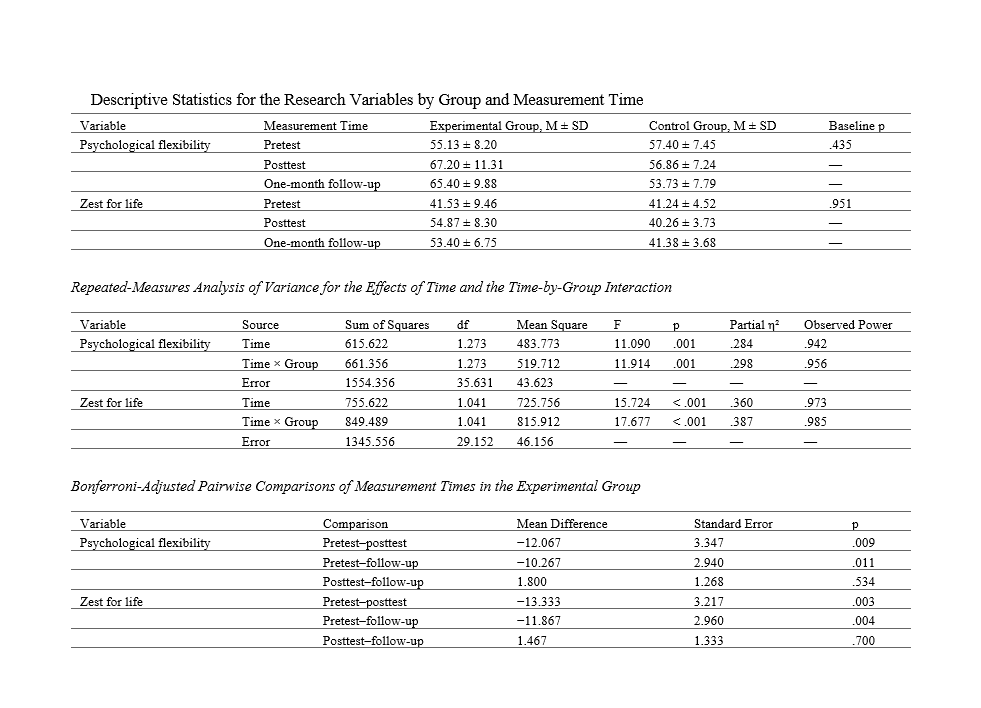
Findings: The results indicated that emotion-focused therapy had a significant effect on increasing psychological flexibility and zest for life among university students who had experienced a romantic breakup (p < .01). These effects were also maintained at the one-month follow-up assessment, and the differences between the experimental and control groups remained statistically significant for both variables (p < .05).
Conclusion: Based on the findings, emotion-focused therapy can be used as an effective intervention to improve psychological flexibility and enhance zest for life among university students who have experienced a romantic breakup. It is recommended that this therapeutic approach be implemented systematically within university psychological and counseling services, particularly for students experiencing emotional distress following romantic breakups.
Downloads
References
Bahadori Khosroshahi, J. (2025). Effectiveness of Academic Self-Assurance Training on Cognitive Flexibility and Cognitive Processing in Students with Reading Difficulties. A New Approach to Child Education, 7(2), 61-73.
Caspar, F., Berger, T., Holtforth, M. G., Babl, A., Heer, S., Lin, M., & Belz, M. (2023). The Impact of Integrating Emotion-Focused Components into Psychological Therapy: A Randomized Controlled Trial. Journal of Clinical Psychology, 79(2), 296-315. https://doi.org/10.1002/jclp.23421
del Palacio-Gonzalez, A., Clark, D. A., & O'Sullivan, L. F. (2017). Distress Severity Following a Romantic Breakup Is Associated with Positive Relationship Memories among Emerging Adults. Emerging Adulthood, 5(4), 259-267. https://doi.org/10.1177/2167696817704117
Delalay, M., & Boendermaker, S. H. (2026). Mental Pain Responses of Ultramarathon Runners: A Scoping Review. Sports, 14(2), 72. https://doi.org/10.3390/sports14020072
Eisenberger, N. I. (2012). The Neural Bases of Social Pain: Evidence for Shared Representations with Physical Pain. Biopsychosomatic Medicine, 74(2), 126-135. https://doi.org/10.1097/PSY.0b013e3182464dd1
Ertezaei, B., Nisi, A., Hamid, N., & Davoudi, I. (2022). Effectiveness of Emotion-Focused Therapy on Mental Pain, Experiential Avoidance, and Forgiveness in Depressed Women with Romantic Breakup Experience. Shenakht Journal of Psychology and Psychiatry, 9(6), 64-77.
Field, T., Diego, M., Pelaez, M., Deeds, O., & Delgado, J. (2009). Breakup Distress in University Students. Adolescence, 44(176). https://doi.org/10.1037/t66170-000
Greenberg, L. S. (2017). Emotion-Focused Therapy. American Psychological Association. https://doi.org/10.1037/15971-000
Greenberg, L. S., & Goldman, R. N. (2019). Clinical Handbook of Emotion-Focused Therapy. American Psychological Association. https://doi.org/10.1037/0000112-000
Hafezi, M., Janbozorgi, M., & Azarbayjani, M. (2026). Analyzing the Developmental Antecedents of Distress Caused by Romantic Breakup: A Qualitative Study. Quarterly Journal of Applied Psychological Research, 17(1), 23-34.
Hassan, M. N. M. (2024). The Constructivist Model for the Relationships between Self-Differentiation, Psychological Capital, Passion for Life, and Proactive Personality among Education Faculty Students. Al Majalla Al Tarbawiya Li Kulliyat Al Tarbiyah Bi Sohag, 128(128), 571-684.
Kadiroğlu, İ., Çoban, S., & Şenkal Ertürk, İ. (2026). Emotion-Focused Therapy and Trauma: An Integrative Review. Person-Centered & Experiential Psychotherapies, 25(1), 91-107. https://doi.org/10.1080/14779757.2025.2541414
Kent, K., Glavincevski, N., Shuvo, S. D., Collins, C. E., Hutchesson, M., & Charlton, K. E. (2026). Associations between Food Insecurity, Psychological Distress and Disordered Eating Risk in University Students: Evidence from a Cross-Sectional Mediation Analysis. Nutrients, 18(11), 1744. https://doi.org/10.3390/nu18111744
Khanmohammadi, N., Bakhshipour Roodsari, A., Heshmati, R., & Bairami, M. (2026). Comparing the Effectiveness of Emotion-Focused Therapy and Self-Compassion Training on Psychological Flexibility in Mothers of Children with Attention-Deficit/Hyperactivity Disorder. Journal of Psychological Science, 25(159), 1-24. https://doi.org/10.61186/jps.25.159.3
Kheirallahi, M., Jafari, A., Ghamari, M., & Babakhani, V. (2019). Designing a Predictive Model of Cognitive Flexibility Based on Analysis of Life-Cycle Change Trends in Couples Seeking Divorce. Counseling Culture and Psychotherapy, 10(39), 157-180.
Kouhi, Z., & Alivandi Vafa, M. (2022). Effectiveness of Counseling with an Islamic Approach on Psychological Distress among Female Students with Romantic Breakup Experience. Research on Religion and Health, 8(3), 53-67.
Kozlowitz, S., Ribeiro, A., Sibeoni, J., Brossard, B., & Chevance, A. (2026). What Is Mental Pain? A Systematic Review and Metasynthesis of Qualitative Research on the Lived Experience of Mental Pain. Psychotherapy and psychosomatics, 95(3), 167-180. https://doi.org/10.1159/000548567
Logoń, K., Świrkosz, G. J., & Kowalski, K. (2025). From Hallucinations to Delusions: A Narrative Review of Psychotic-Like Experiences and Their Implications. Advances in Clinical and Experimental Medicine, 34(2), 283-294. https://doi.org/10.17219/acem/186815
Mahajan, S., & Kaur, N. (2024). Childhood Trauma. AMEI's Current Trends in Diagnosis & Treatment, 7(2), 61-63. https://doi.org/10.5005/jp-journals-10055-0171
Malchelosse, K., Houlfort, N., Lavoie, C. É., & Masson, R. (2024). The Role of Resilience and Psychological Needs Satisfaction in the Relationship between Passion for Work and Work-Life Enrichment. Current Psychology, 43(7), 6640-6656. https://doi.org/10.1007/s12144-023-04846-0
Nemati, F., & Hashemi, M. (2026). Causal Modeling of Quality of Life Based on Anxiety Sensitivity with the Mediating Role of Passion for Life in Individuals with Panic Disorder. Clinical Psychology: Innovations in Research and Practice, 18(2).
Nimbi, F. M., Renzi, A., Limoncin, E., & Galli, F. (2025). The Role of Environmental Sensitivity, Traumatic Experiences, Defense Mechanisms and Mental Pain on Central Sensitivity: Testing a Path Analysis Model in Chronic Headache on Quality of Life. Psychology, Health & Medicine, 30(1), 59-78. https://doi.org/10.1080/13548506.2024.2411065
Pine, A. E., & Garber, J. (2023). Parental Psychopathology and Parenting. In D. J. A. Dozois & K. S. Dobson (Eds.), Treatment of Psychosocial Risk Factors in Depression (pp. 27-54). American Psychological Association. https://doi.org/10.1037/0000332-003
Shirinkam, M., & Rostamnejad, M. (2026). Effectiveness of Trauma-Focused Emotion-Focused Therapy on Quality of Life and Self-Compassion in Women with Sexual Trauma Experience. Rooyesh-e-Ravanshenasi, 15(2), 261-270.
Yonatan-Leus, R., & Shulman, S. (2025). Stability of Breakup Distress Following Romantic Dissolutions during Emerging Adulthood: Individual and Mean Level. Current Psychology, 44(16), 14110-14119. https://doi.org/10.1007/s12144-025-08132-z
Zarieh, S., Naderi, F., Asgari, P., & Bakhtiyarpour, S. (2021). Effectiveness of Emotion-Focused Therapy on Psychological Flexibility and Sense of Coherence in Obese Patients with Cardiovascular Disease. Journal of Mashhad University of Medical Sciences, 64(3), 3363-3374.
Downloads
Additional Files
Publication Timeline
- Submitted
- Revised
- Accepted