Structural Modeling of Academic Buoyancy Based on Academic Engagement and Perceived Teacher Support: The Mediating Role of Academic Self-Efficacy among Female Upper-Secondary School Students
Keywords:
academic buoyancy, academic engagement, perceived teacher support, academic self-efficacy, structural equation modeling, female studentsAbstract
Objective: The present study aimed to test a structural model of academic buoyancy based on academic engagement and perceived teacher support, with the mediating role of academic self-efficacy among female upper-secondary school students.
Methods and Materials: This applied quantitative study used a descriptive-correlational design and structural equation modeling. The statistical population included all female upper-secondary school students in Babol, Iran, during the 2024 academic year. A sample of 350 students was selected through multistage cluster random sampling. Data were collected using the Academic Buoyancy Questionnaire, Academic Engagement Scale, Perceived Teacher Support Scale, and Self-Efficacy Questionnaire. Data were analyzed using SPSS and AMOS through descriptive statistics, correlation analysis, confirmatory factor analysis, and structural equation modeling.
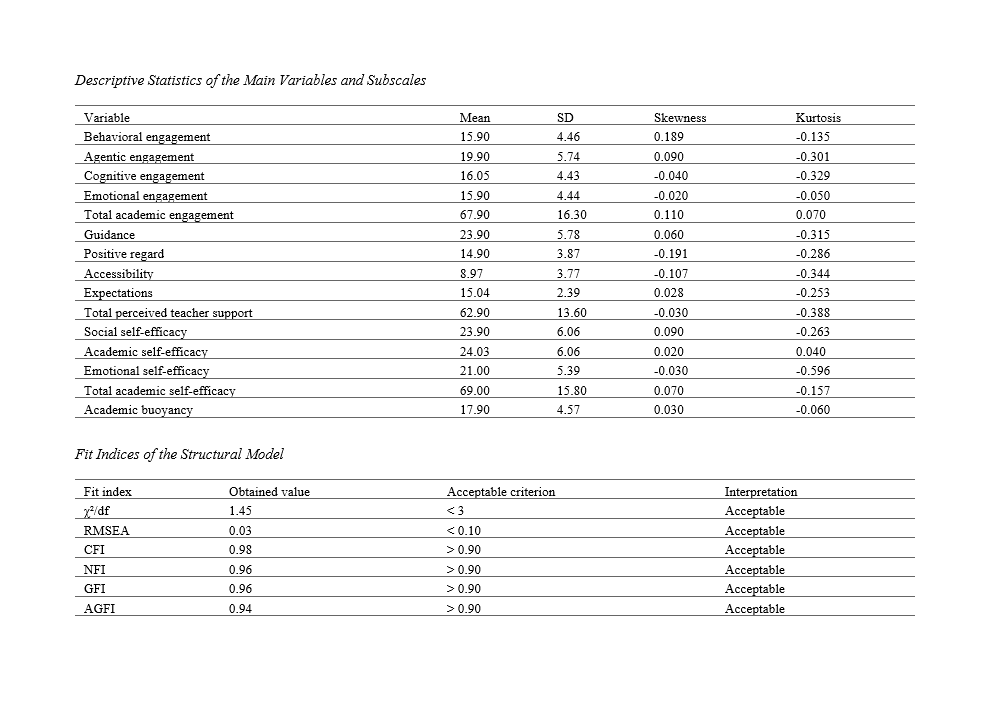
Findings: The proposed structural model showed acceptable fit to the data: χ²/df = 1.45, RMSEA = 0.03, CFI = 0.98, NFI = 0.96, GFI = 0.96, and AGFI = 0.94. Academic engagement had a positive and significant direct effect on academic buoyancy (β = 0.12, p = .02). Perceived teacher support also had a positive and significant direct effect on academic buoyancy (β = 0.17, p = .001). Academic self-efficacy had the strongest direct effect on academic buoyancy (β = 0.32, p = .001). In addition, academic self-efficacy significantly mediated the relationship between academic engagement and academic buoyancy (β = 0.138, p = .001) and the relationship between perceived teacher support and academic buoyancy (β = 0.06, p = .04).
Conclusion: Academic buoyancy among female upper-secondary school students is shaped by behavioral engagement, perceived teacher support, and self-efficacy beliefs. The findings suggest that strengthening students’ engagement in learning, improving supportive teacher-student relationships, and enhancing academic self-efficacy may help students cope more effectively with everyday academic challenges.
Downloads
References
Bostwick, K. C. P., Martin, A. J., Collie, R. J., Burns, E. C., Hare, N., Cox, S., Flesken, A., & McCarthy, I. (2022). Academic buoyancy in high school: A cross-lagged multilevel modeling approach exploring reciprocal effects with perceived school support, motivation, and engagement. Journal of Educational Psychology, 114(8), 1931-1949. https://doi.org/10.1037/edu0000753
Emami Khotbesara, Z., Mahdian, H., & Bakhshipour, A. (2024). Comparing the Effectiveness of Academic Buoyancy and Psychological Capital Training on Academic Procrastination in Female High School Students [Research Article]. Iranian Journal of Educational Sociology, 7(3), 149-160. https://doi.org/10.61838/kman.ijes.7.3.18
Feizi Shirabadi, L., Sharbatian, M. H., & Arab, A. (2024). Predicting academic engagement based on academic hope with the mediating role of students' academic buoyancy from the perspective of secondary school educators in District 7 of Mashhad. Quarterly Journal of Social-Cultural Studies of Khorasan, 19(2), 1-38. https://www.farhangekhorasan.ir/m/article_219162.html
Granziera, H., Liem, G. A. D., Chong, W. H., Martin, A. J., Collie, R. J., Bishop, M., & Tynan, L. (2022). The Role of Teachers' Instrumental and Emotional Support in Students' Academic Buoyancy, Engagement, and Academic Skills: A Study of High School and Elementary School Students in Different National Contexts. Learning and Instruction, 80, 101619. https://doi.org/10.1016/j.learninstruc.2022.101619
Guo, H., Zhou, Z., Ma, F., & Chen, X. (2024). Doctoral students' academic performance: The mediating role of academic motivation, academic buoyancy, and academic self-efficacy. Heliyon, 10(12), e32588. https://doi.org/10.1016/j.heliyon.2024.e32588
Heydarnejad, T., Ibrahim, K. A. A.-A., Abdelrasheed, N. S. G., & Rezvani, E. (2022). The effect of academic emotion regulation on EFL learners’ core of self-assessment and academic buoyancy: a structural equation modeling. Language testing in Asia, 12(1), 57. https://doi.org/10.1186/s40468-022-00207-z
Hou, B., & Phromphithakkul, W. (2024). Relationship between perceived social support and university students' academic engagement in Shanxi, China: the chain mediating effect of academic buoyancy and academic emotion, the moderating effect of proactive personality. 18(1), 269-284. https://so03.tci-thaijo.org/index.php/hsjournalnmc/article/view/274400
Huang, S. (2022). A Review of the Relationship Between EFL Teachers’ Academic Buoyancy, Ambiguity Tolerance, and Hopelessness. Frontiers in psychology, 13. https://doi.org/10.3389/fpsyg.2022.831258
Liu, Y. (2025). Psychological Resources for Academic Buoyancy: The Roles of Growth Mindset and Emotional Intelligence in Chinese University Students. Frontiers in psychology, 16. https://doi.org/10.3389/fpsyg.2025.1580929
Raji, F. (2025). Predicting Academic Buoyancy Based on Academic Self-Efficacy and Assertiveness in Secondary School Students in District One of Kerman City [Master's thesis, University of Kerman].
Rezaei Oshiani, I., Ghasemi, M., Koochak Entezar, R., & Emamipour, S. (2024). A Causal Model of Academic Buoyancy Based on Critical Thinking with the Mediating Role of Academic Self-Efficacy in Gifted Students. Research in Educational Systems, 18(64), 55-70.
Suharsono, Y. (2024). Growth Mindset in Higher Education: Exploring Academic Buoyancy's Mediating Effect on Students' Academic Engagement and Psychological Well-Being. Kne Social Sciences. https://doi.org/10.18502/kss.v9i5.15189
Tammeh, B., Dortaj, F., Seadatee Shamir, A., & Farokhi, N. (2025). Developing a Structural Model for Academic Buoyancy Based on Motivational Factors and Mediator Roles of Grit, Mental Toughness, and Control. Educational Psychology, 20(74), 7-32. https://doi.org/10.22054/jep.2024.33439.2302
Weißenfels, M., Hoffmann, D., Dörrenbächer-Ulrich, L., & Perels, F. (2023). Linking academic buoyancy and math achievement in secondary school students: Does academic self-efficacy play a role? Current Psychology, 42(27), 23422-23436. https://doi.org/10.1007/s12144-022-03488-y
Xiao, G., & Liu, H. (2025). Intrapersonal Strengths and Interpersonal Support: Predicting Academic Buoyancy Through Psychological Capital and Growth Mindset. Frontiers in psychology, 16. https://doi.org/10.3389/fpsyg.2025.1584343
Xu, X., & Wang, B. (2022). EFL Students’ Academic Buoyancy: Does Academic Motivation and Interest Matter? [Mini Review]. Frontiers in psychology, 13. https://doi.org/10.3389/fpsyg.2022.858054
Zhi, R., Wang, Y., & Derakhshan, A. (2023). On the Role of Academic Buoyancy and Self-Efficacy in Predicting Teachers’ Work Engagement: A Case of Chinese English as a Foreign Language Teachers. Perceptual and Motor Skills, 131(2), 612-629. https://doi.org/10.1177/00315125231222398
Downloads
Additional Files
Publication Timeline
- Submitted
- Revised
- Accepted