The Concept of the Good Life in Education and Its Relationship with Adolescent Well-Being: A Qualitative Study
Keywords:
Good Life, Education, Adolescent Well-Being, Educational Flourishing, Psychological Well-Being, Phenomenology, Qualitative ResearchAbstract
Objective: The present study aimed to explore adolescents’ perceptions of the good life in educational contexts and to identify how their lived educational experiences are related to psychological, relational, social, and future-oriented well-being.
Methods and Materials: This qualitative study was conducted using a descriptive phenomenological approach. Participants were 20 adolescents aged 14–18 years who were studying in secondary schools in Tehran, Iran. Participants were selected through purposive sampling with maximum variation in gender, educational grade, school type, academic achievement, and socioeconomic background. Data were collected through in-depth semi-structured individual interviews lasting approximately 45–70 minutes. Interviews explored adolescents’ understandings of the good life, experiences of school, relationships with teachers, peers, and family members, perceptions of autonomy and academic achievement, and expectations for the future. Interviews were audio-recorded, transcribed verbatim, and analyzed using Colaizzi’s phenomenological method. Data collection continued until saturation was reached. Credibility, dependability, confirmability, and transferability were addressed through repeated examination of transcripts, member checking, peer review of codes, documentation of analytical decisions, and detailed description of the research process.
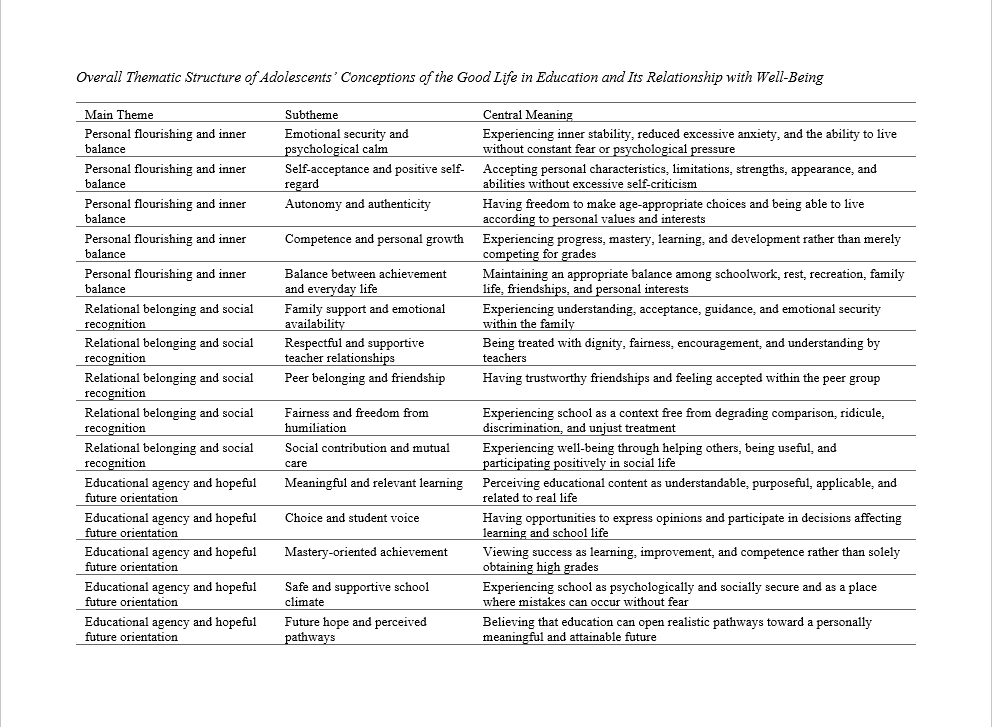
Findings: Analysis of participants’ experiences resulted in three major themes: personal flourishing and inner balance, relational belonging and social recognition, and educational agency and hopeful future orientation. Personal flourishing included emotional security, self-acceptance, autonomy, competence, and balance between academic achievement and everyday life. Relational belonging reflected the importance of family support, respectful teacher relationships, peer acceptance, fairness, dignity, and opportunities for social contribution. Educational agency emphasized meaningful learning, student voice and choice, mastery-oriented achievement, a psychologically safe school climate, and hope for attainable future pathways.
Conclusion: Adolescents conceptualized the good life as a multidimensional form of educational flourishing that extends beyond academic success and includes psychological balance, supportive relationships, personal agency, meaningful learning, dignity, and future hope. Educational environments that integrate these dimensions may contribute more effectively to adolescents’ comprehensive well-being and healthy development.
Downloads
References
Abowitz, K. K., & Hornbeck, D. (2025). The Right to Invite and the Right to Decline: Parental Rights in Public Schools. Theory and Research in Education, 23(2), 142-162. https://doi.org/10.1177/14778785251351377
Adıgüzel, V. (2024). Subjective Well-Being, Mental Health Enhancing Knowledge Level, and Related Factors in Adolescents. Journal of psychiatric nursing, 157-165. https://doi.org/10.14744/phd.2023.65872
Agung, A., Mutia, T., & Syathori, A. (2023). The Role of Parents in Preventing Deviant Behavior (Case Study of Adolescents Aged 13-18 Years in Setu Wetan Village, Weru District, Cirebon Regency). Qalamuna Jurnal Pendidikan Sosial Dan Agama, 15(1), 465-472. https://doi.org/10.37680/qalamuna.v15i1.2486
Avedissian, T., & Alayan, N. (2021). Adolescent Well‐being: A Concept Analysis. International journal of mental health nursing, 30(2), 357-367. https://doi.org/10.1111/inm.12833
Carey, R. L. (2021). “Whatever You Become, Just Be Proud of It.” Uncovering the Ways Families Influence Black and Latino Adolescent Boys’ Postsecondary Future Selves. Journal of Adolescent Research, 37(1), 59-97. https://doi.org/10.1177/07435584211018450
Carvalho, D., Sequeira, C., Querido, A., Tomás, C., Morgado, T., Valentim, O., Moutinho, L., Gomes, J., & Laranjeira, C. (2022). Positive Mental Health Literacy: A Concept Analysis. Frontiers in psychology, 13. https://doi.org/10.3389/fpsyg.2022.877611
Céspedes, C., Rubio, A., Viñas, F., Malo, S., Ordenes, E. L., & Ríos, J. (2021). Relationship Between Self-Concept, Self-Efficacy, and Subjective Well-Being of Native and Migrant Adolescents. Frontiers in psychology, 11. https://doi.org/10.3389/fpsyg.2020.620782
Cezar, G. A. J., & Reis, F. A. d. (2024). Recipes for Happiness: Conversations on Happiness and Well-Being in the School Environment. Advances in Research, 25(3), 40-49. https://doi.org/10.9734/air/2024/v25i31048
Chen, Z. (2023). How to Guarantee the Safety of Adolescent Women: The Manifestation and Origin of Threats. Journal of Education Humanities and Social Sciences, 8, 384-389. https://doi.org/10.54097/ehss.v8i.4277
Chicherina, E. (2023). Adolescents' Migration Aspirations in Kyrgyzstan: A Migration Project as a ‘Collective Project’ of the Family. 197-212. https://doi.org/10.1108/978-1-80382-283-920231013
Christiaens, A. H. T., Nelemans, S. A., Moor, E. L. d., Erentaitė, R., Vosylis, R., & Branje, S. (2022). Psychometric Qualities of the Educational Identity Processes Scale (EIPS). Frontiers in psychology, 13. https://doi.org/10.3389/fpsyg.2022.861220
Cilar, L., Štiglic, G., Barr, O., & Pajnkihar, M. (2025). Adolescents' Mental Well‐Being and Social Support: Mixed Methods Study. International journal of mental health nursing, 34(6). https://doi.org/10.1111/inm.70195
Cilar, L., Štiglic, G., Kmetec, S., Barr, O., & Pajnkihar, M. (2020). Effectiveness of School‐based Mental Well‐being Interventions Among Adolescents: A Systematic Review. Journal of Advanced Nursing, 76(8), 2023-2045. https://doi.org/10.1111/jan.14408
Clarke, T. (2023). Do Scores ‘Define’ Us? Adolescents' Experiences of Wellbeing as ‘Welldoing’ at School in England. Review of Education, 11(1). https://doi.org/10.1002/rev3.3393
Cowper, A., & Teschers, C. (2023). Exploring How Te Whāriki and the New Zealand Curriculum Prepare Children and Students for an Art of Living. Teachers Work, 20(1), 57-72. https://doi.org/10.24135/teacherswork.v20i1.369
Deyra, M., Gay, C., Gerbaud, L., Berland, P., & Pizon, F. (2025). Perceptions of the Determinants of Health and Cancer: Trends in Discourse and Level of Argumentation Between Girls and Boys Aged 6 to 18. Frontiers in Public Health, 13. https://doi.org/10.3389/fpubh.2025.1390084
Fernandes, G., & Lemos, S. M. A. (2022). Quality of Life and Self-Perceived Health of Adolescents in Middle School. Codas, 34(6). https://doi.org/10.1590/2317-1782/20212021046
García, J. E. M., Jiménez, A., Cabaco, A. S., & Eguizábal, J. A. J. (2021). The Role of Physical Activity and School Physical Education in Enhancing School Satisfaction and Life Satisfaction. International journal of environmental research and public health, 18(4), 1689. https://doi.org/10.3390/ijerph18041689
Hastuti, P., Prahesti, Y., & Yunitasari, E. (2021). The Effect of Reproductive Health Education on Knowledge and Attitudes of Adolescent About Premarital Sex in Private Vocational School Surabaya. Pediomaternal Nursing Journal, 7(2), 101. https://doi.org/10.20473/pmnj.v7i2.27498
Haugan, J. A., Frostad, P., & Mjaavatn, P.-E. (2021). Girls Suffer: The Prevalence and Predicting Factors of Emotional Problems Among Adolescents During Upper Secondary School in Norway. Social Psychology of Education, 24(3), 609-634. https://doi.org/10.1007/s11218-021-09626-x
Henzan, H., Takeuchi, R., Njenga, S. M., Gregorio, E. R., Ichinose, Y., Nonaka, D., & Kobayashi, J. (2021). Factors Influencing School Re‐entry Among Adolescents in Kenya. Pediatrics International, 64(1). https://doi.org/10.1111/ped.14866
Horwitz, I. M., Matheny, K. T., Laryea, K., & Schnabel, L. (2022). From Bat Mitzvah to the Bar: Religious Habitus, Self-Concept, and Women’s Educational Outcomes. American Sociological Review, 87(2), 336-372. https://doi.org/10.1177/00031224221076487
Kaur, K. (2021). Role of Family Environment and School Environment in Depression Among Adolescents. Journal of Mental Health Issues and Behavior(12), 9-14. https://doi.org/10.55529/jmhib12.9.14
Lee, S.-M., Yoo, J.-I., & Youn, H.-S. (2021). Changes in Alienation in Physical Education Classes, School Happiness, and Expectations of a Future Healthy Life After the COVID-19 Pandemic in Korean Adolescents. International journal of environmental research and public health, 18(20), 10981. https://doi.org/10.3390/ijerph182010981
Liu, Z. (2021). The Realistic Dilemma and Theoretical Exploration of the Physical Health Promotion of Adolescents in the New Era. Frontiers in Sport Research, 3(4). https://doi.org/10.25236/fsr.2021.030411
Lorinda, R., Ismail, N., & Rahmatullah, A. S. (2023). Self-Concept of Adolescents in Early Marriage and Divorce in Bruno District, Purworejo Regency. International Journal of Social Service and Research, 3(1), 112-121. https://doi.org/10.46799/ijssr.v3i1.241
Martina, N. Z., Kolle, H. A., & Emmanuel, N. (2020). Resilience and Adolescents Educational Advancement Among Secondary School Students in Mbanga Sub Division, Cameroon. Journal of Education Society and Behavioural Science, 1-17. https://doi.org/10.9734/jesbs/2020/v33i630230
Mont’Alvão, A., & Mortimer, J. T. (2025). Diminishing Returns to Psychological Resources in the Attainment Process? A Study of Educational Plans Across Generations. Social psychology quarterly, 88(4), 496-508. https://doi.org/10.1177/01902725251394032
Muhsin, M., Warisno, A., Ansori, A., & Andari, A. A. (2023). Moral Development Strategies in Shaping Adolescent Character Through the Qur'An. Scaffolding Jurnal Pendidikan Islam Dan Multikulturalisme, 4(3), 627-637. https://doi.org/10.37680/scaffolding.v4i3.1996
Park, H. (2024). Can Club Activities Foster Adolescents' Citizenship in Sub‐Saharan Africa?: The Evidence From the Good Neighbors' Club in Malawi. Children & Society, 38(6), 2133-2148. https://doi.org/10.1111/chso.12882
Pollmann‐Schult, M. (2022). Downward Educational Mobility and the Life Satisfaction of Adolescents and Parents. Family Relations, 72(1), 234-252. https://doi.org/10.1111/fare.12666
Rahayu, A. P., & Dong, Y. (2023). The Relationship of Extracurricular Activities With Students' Character Education and Influencing Factors: A Systematic Literature Review. Al-Ishlah Jurnal Pendidikan, 15(1), 459-474. https://doi.org/10.35445/alishlah.v15i1.2968
Ramírez, S., Aldunate, M. P., Arriagada, C., Bueno, M., Cuevas, F., González, X., Araya, R., & Gaete, J. (2021). Brief Research Report: The Association Between Educational Experiences and Covid-19 Pandemic-Related Variables, and Mental Health Among Children and Adolescents. Frontiers in Psychiatry, 12. https://doi.org/10.3389/fpsyt.2021.647456
Saputra, W. N. E., Sudaryani, R. R. S., & Rohmadheny, P. S. (2022). The Attributes of Peace Educators From Sang Pencerah, the Biography of KH Ahmad Dahlan: A Hermeneutic Study. HTS Teologiese Studies / Theological Studies, 78(4). https://doi.org/10.4102/hts.v78i4.7714
Schweiger, G. (2023). Who Cares About Young People? An Ethical Reflection on the Losses Suffered by Adolescents, Beyond Those of School and Education, During the COVID-19 Pandemic. Studies in Philosophy and Education, 42(1), 33-48. https://doi.org/10.1007/s11217-022-09860-6
Varshitha, T. L., Vadlamani, S., Gujjarlapudi, C., Venkata, M. R., & Vijayalakshmi, P. (2026). Knowledge, Attitudes, and Practices Related to the Intergenerational Cycle of Malnutrition Among Adolescent Girls: A School-Based Cross-Sectional Study. Narra J, 6(1), e2993. https://doi.org/10.52225/narra.v6i1.2993
Yusri, N. A., Kibtiyah, M., & Hamim, T. (2020). Emotional Intelligence With Learning Achievements Reviewed From Islamic Education. International Journal of Islamic Educational Psychology, 1(2), 112-125. https://doi.org/10.18196/ijiep.v1i2.9672
Downloads
Additional Files
Publication Timeline
- Submitted
- Revised
- Accepted