Structural Modeling of the Relationship Between Attachment Styles and Expectations of Marriage: The Mediating Role of Gender-Role Orientations Among University Students Approaching Marriage
Keywords:
Attachment Styles, Expectations of Marriage, Gender-Role OrientationAbstract
Objective: The present study aimed to develop and test a structural model of the relationships between secure, avoidant, and anxious attachment styles and realistic, pessimistic, and idealistic expectations of marriage, considering masculine and feminine gender-role orientations as mediating variables among university students approaching marriage.
Methods and Materials: This applied study used a descriptive-correlational design based on structural equation modeling. The statistical population consisted of university students approaching marriage at the Science and Research, Central Tehran, and North Tehran branches of Islamic Azad University during the 2025–2026 academic year. Using convenience sampling, 322 students were selected. Data were collected using the Revised Adult Attachment Scale, the Bem Sex Role Inventory, and the Marriage Expectation Scale. Data were analyzed using SPSS and AMOS version 26 through correlation analysis, structural equation modeling, and bootstrap assessment of indirect effects.
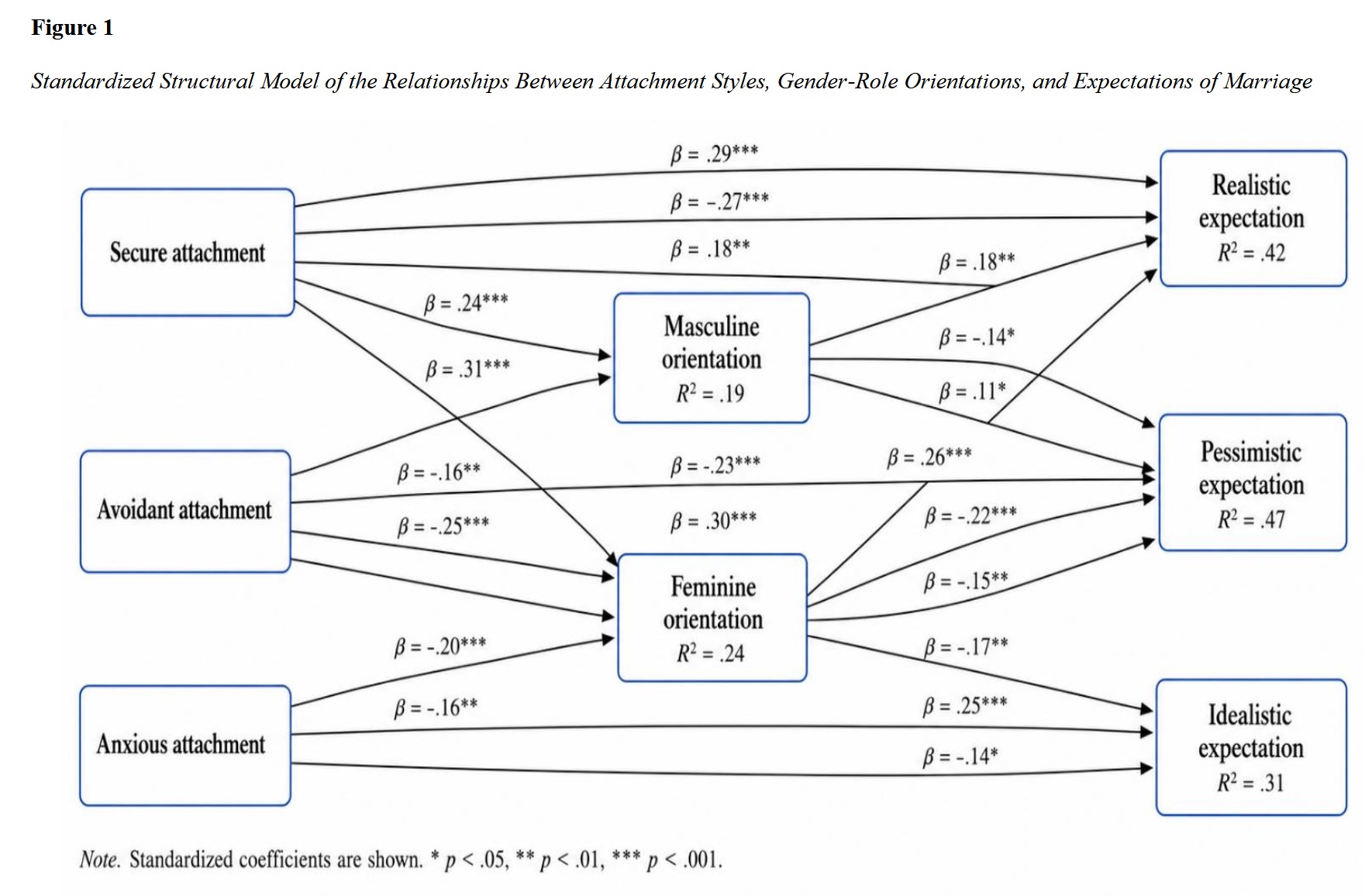
Findings: The proposed structural model showed acceptable fit (χ²/df = 2.25, CFI = .969, TLI = .954, RMSEA = .062, SRMR = .039). Secure attachment positively predicted realistic (β = .29, p < .001) and idealistic expectations (β = .18, p = .001) and negatively predicted pessimistic expectations (β = −.27, p < .001). Avoidant and anxious attachment negatively predicted realistic and idealistic expectations and positively predicted pessimistic expectations (p < .05). Secure attachment positively predicted masculine and feminine orientations, whereas avoidant and anxious attachment negatively predicted both. Masculine and feminine orientations positively predicted realistic and idealistic expectations and negatively predicted pessimistic expectations. Bootstrap analyses indicated significant indirect effects of all attachment styles on each marriage-expectation dimension through both gender-role orientations, supporting partial mediation.
Conclusion: Attachment styles were directly and indirectly associated with distinct expectations of marriage, and masculine and feminine gender-role orientations partially explained these relationships, highlighting the combined contribution of interpersonal attachment patterns and gender-related self-orientations to premarital expectations.
Downloads
References
Al-Kathir, F. (2022). The Role of Psychological Flexibility and Marital Expectations in Predicting Marital Intimacy Among Married Women. Fourth National Congress of the Iranian Scientific Association of Family Psychology: Successful Marriage and Healthy Parenting,
Alshammari, A. K., Momeni, K., & Yazdanbakhsh, K. (2025). The Mediating Role of Emotion Regulation in the Relationship between Attachment Styles and Social Skills and Anxiety in Children with Autism Spectrum Disorder. Journal of Psychological Science, 24(145).
Bolluk UĞUr, G., & ÇAkmak Tolan, Ö. (2024). The examination of mediating role of mindfulness in the relation between marriage role expectations, forgiveness and marital adjustment. Current Psychology, 43(48), 36566-36585. https://doi.org/10.1007/s12144-024-07031-z
Emami, N., Dookanei-Fard, F., & Behboodi, M. (2025). Developing a Predictive Model of Attitudes Toward the Opposite Gender Based on Attachment Styles and Value Systems, Mediated by Attitudes Toward Love in Girls and Boys. Sociology of Education, 10(1), 40-390.
Entezami Roudsari, N., & Khoshkonish, A. (2020). The Relationship Between Sexual Schemas, Gender Role Attitudes, and Body Self-Concept with Marital Boredom in Couples Seeking Divorce at Counseling Centers. Second International Conference on Educational Sciences, Psychology, Counseling, Education, and Research, Tehran.
Ercan, E. U., & Uçar, S. (2021). Gender Roles, Personality Traits and Expectations of Women and Men towards Marriage. Educational Policy Analysis and Strategic Research, 16(7), 7-21. https://doi.org/10.29329/epasr.2020.334.1
Fallahchai, R., & Fallahi, M. (2019). Gender Differences in Expectations, Purposes and Attitudes to Marriage in University Students. University-of-Hormozgan, 1(1), 42-50. https://doi.org/10.29252/IEEPJ.1.1.42
Garza, L. (2020). The Role of Gender and Attitudes toward Infidelity in Therapists' Treatment Decisions for Couples Presenting with Physical Infidelity Fielding Graduate University]. https://search.proquest.com/openview/6d068057112ad31c1654d2426302ad71/1?pq-origsite=gscholar&cbl=18750&diss=y
Habibi, B., Shirmardi, S., Shirali, K., & fathi, k. (2022). The Mediating Role of Marital Expectations in the Relationship between Emotional Divorce and Basic Psychological Needs in Health Network Employees [Research]. Journal of Jiroft University of Medical Sciences, 9(3), 1039-1048. http://journal.jmu.ac.ir/article-1-646-en.html
Lee, M. A., Song, R., & Park, J. (2025). Does Perceived Gender Conflict Shape Young Koreans' Attitudes Toward Marriage and Childbearing? Journal of marriage and family, 87(4), 1816-1832. https://doi.org/10.1111/jomf.13106
Rasheed, A., Amro, A., & Fahad, N. (2021). Investigating the relationship between emotional divorce, marital expectations, and self-efficacy among wives in Saudi Arabia. J Divorce Remarriage, 62(1), 19-40. https://doi.org/10.1080/10502556.2020.1833290
Rezagholiyan, M., Nemati, F., & Hashemi, T. (2025). Development of a Model of Students' Subjective Well-Being Based on Attachment Styles, Self-Compassion, and Emotion Regulation Styles with the Mediating Role of Quality of Life. Journal of Adolescent and Youth Psychological Studies (JAYPS), 6(1), 21-33. https://doi.org/10.61838/
Rezapour, Y., Rabaniayn, H., & Aminjafari, F. (2025). The Mediating Role of Cognitive Emotion Regulation in the Relationship between Attachment Styles and Attitudes Towards Marriage. Journal of Culture of Counseling and Psychotherapy, 16(61), 33-66. https://qccpc.atu.ac.ir/article_18877_en.html
Taheri, Z., & Mahvash Shirazi, M. (2019). The relationship between expectations from marriage and distress tolerance with marital adjustment in women. Women's Research Journal, 10(27), 99-116. https://womenstudy.ihcs.ac.ir/article_4031.html
Tang, X. (2024). The Effects of Attachment Styles on Resilience and Emotion Regulation. Journal of Education Humanities and Social Sciences, 26, 755-759. https://doi.org/10.54097/shp3g660
Vestel, J. D., & Gadeyne, S. (2026). Evolving Gender Attitudes and Fertility Preferences: A Study of Young Women in Five Sub‐Saharan African Countries. Studies in Family Planning, 57(2), 151-169. https://doi.org/10.1111/sifp.70047
Waffa, F. R., & Pitigala, K. (2024). How Attachment Styles Influence Emotional Regulation of Young Adults in Srilanka. British Journal of Multidisciplinary and Advanced Studies, 5(1), 57-84. https://doi.org/10.37745/bjmas.2022.0436
Yan, C. M., Yin, C. N. C., & Qing, C. C. Y. (2024). Exploring the Modern Malaysian Marriage: Understanding the Relationship of Gender Role Attitudes, Attitudes Toward Childbearing, Family Functioning and Attitudes Toward Marriage Among Young Adults in Malaysia. Journal Psychology Malaysia, 38(2), 1-13.
Yang, F., Zheng, J., Li, W., Liu, S., Ya, X., & Gu, L. (2025). Does Gender Matter? The Mediating Role of Gender Attitudes on the Associations Between Grandparenting Styles and Adolescent Depression Among Skipped-Generation Families in Rural China. Youth & Society, 57(2), 279-303. https://doi.org/10.1177/0044118x241312355
Yang, X., Yue, Y., & Ma, J. (2025). Gender Attitudes, Women's Intra‐household Decision‐making Power, and Fertility Intentions. Family Relations. https://doi.org/10.1111/fare.70081
Zhou, J. (2025). A Comparative Analysis of Indian and Chinese Women’s Attitudes Toward Family, Childbearing, and Gender Norms. Journal of Asian and African Studies, 61(2), 1206-1220. https://doi.org/10.1177/00219096251313552
Downloads
Additional Files
Publication Timeline
- Submitted
- Revised
- Accepted