Structural Modeling of Nomophobia Based on Brain–Behavioral Systems and Intolerance of Uncertainty: The Mediating Role of Emotional Self-Efficacy among University Students
Keywords:
Nomophobia, brain–behavioral systems, intolerance of uncertainty, emotional self-efficacy, structural equation modeling, university studentsAbstract
Objective: This study examined a structural model of nomophobia based on brain–behavioral systems and intolerance of uncertainty, with emotional self-efficacy as a mediator.
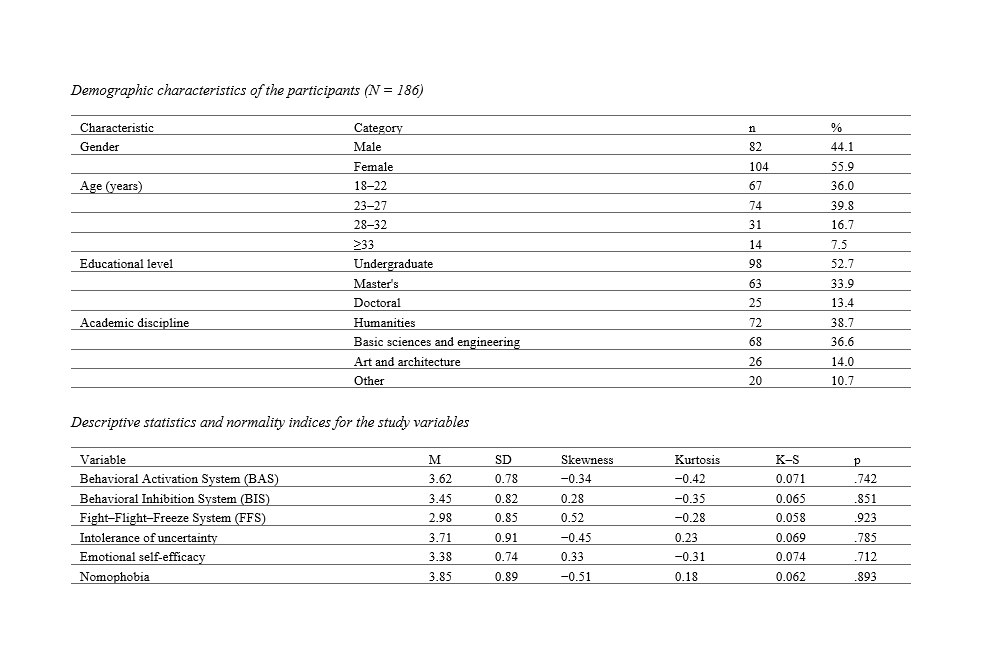
Methods and Materials: A cross-sectional correlational study was conducted among 186 university students. Participants completed measures of the Behavioral Activation System (BAS), Behavioral Inhibition System (BIS), Fight–Flight–Freeze System (FFS), intolerance of uncertainty, emotional self-efficacy, and nomophobia. Data were analyzed using Pearson correlations, multiple regression, and structural equation modeling in SPSS 26 and AMOS 26. Indirect effects were tested using 2,000 bootstrap resamples.
Findings: BAS, BIS, FFS, and intolerance of uncertainty were positively associated with nomophobia, whereas emotional self-efficacy was negatively associated with nomophobia. The predictors collectively explained 52% of the variance in nomophobia. Intolerance of uncertainty was the strongest positive predictor (β = .33 in regression; β = .31 in the structural model), while emotional self-efficacy showed a significant negative effect (β = −.26). The structural model demonstrated acceptable fit (χ²/df = 1.92, GFI = .91, CFI = .92, IFI = .92, RMSEA = .07). Emotional self-efficacy partially mediated the effects of BAS, BIS, FFS, and intolerance of uncertainty on nomophobia; all indirect effects were significant.
Conclusion: Nomophobia appears to reflect the combined influence of neurobehavioral sensitivity, intolerance of uncertainty, and emotional regulatory beliefs. Strengthening emotional self-efficacy and reducing intolerance of uncertainty may represent targets for university-based prevention and counseling programs.
Downloads
References
Al-Mamun, F., Mamun, M. A., Kaggwa, M. M., Mubarak, M., Hossain, M. S., Almerab, M. M., Muhit, M., Gozal, D., Griffiths, M. D., & Sikder, M. T. (2025). The prevalence of nomophobia: A systematic review and meta-analysis. Psychiatry research, 349, 116521. https://doi.org/10.1016/j.psychres.2025.116521
Al-Mamun, F., Mamun, M. A., Prodhan, M. S., Muktarul, M., Griffiths, M. D., Muhit, M., & Sikder, M. T. (2023). Nomophobia among university students: Prevalence, correlates, and the mediating role of smartphone use between Facebook addiction and nomophobia. Heliyon, 9(3), e14284. https://doi.org/10.1016/j.heliyon.2023.e14284
Bai, B., Meng, S., & Zhou, J. (2025). Invalidating environment and smartphone addiction: The chain mediating effect of regulatory emotional self-efficacy and psychache. Humanities and Social Sciences Communications, 12, 1981. https://doi.org/10.1057/s41599-025-06312-7
Caprara, G. V. (2008). Assessing regulatory emotional self-efficacy in three countries. Psychological assessment, 20(3), 227-237.
Carver, C. S., & White, T. L. (1994). Behavioral inhibition, behavioral activation, and affective responses to impending reward and punishment: The BIS/BAS Scales. Journal of personality and social psychology, 67(2), 319-333.
Cui, M., Wang, S., Gao, Y., Hao, Y., & Dai, H. (2024). The effect of emotion regulation strategies on nomophobia in college students: The masking role of resilience. Heliyon, 10(9), e30075. https://doi.org/10.1016/j.heliyon.2024.e30075
Ercengiz, M., Yildiz, B., Savci, M., & Griffiths, M. D. (2024). Differentiation of self, emotion management skills, and nomophobia among smartphone users: The mediating and moderating roles of intolerance of uncertainty. The Social Science Journal, 61(2), 525-539. https://doi.org/10.1080/03623319.2020.1833148
Freeston, M. H., Rhéaume, J., Letarte, H., Dugas, M. J., & Ladouceur, R. (1994). Why do people worry? Personality and individual differences, 17(6), 791-802.
Koç, H. (2023). Higher levels of intolerance of uncertainty predict greater levels of smartphone addiction among college students: The serial mediating roles of death anxiety and cyberchondria. International Online Journal of Education and Teaching, 10(4), 2331-2343.
Kwak, M. J., & Kim, D. J. (2023). Investigating psychological and motivational predictors of problematic smartphone use among smartphone-based social networking service (SNS) users. Addictive Behaviors Reports, 18, 100506. https://doi.org/10.1016/j.abrep.2023.100506
Tuco, K. G., Castro-Diaz, S. D., Soriano-Moreno, D. R., & Benites-Zapata, V. A. (2023). Prevalence of nomophobia in university students: A systematic review and meta-analysis. Healthcare informatics research, 29(1), 40-53. https://doi.org/10.4258/hir.2023.29.1.40
Xiao, Z., & Huang, J. (2022). The relation between college students’ social anxiety and mobile phone addiction: The mediating role of regulatory emotional self-efficacy and subjective well-being. Frontiers in psychology, 13, 861527. https://doi.org/10.3389/fpsyg.2022.861527
Xue, J., Li, Z., Zhang, W., Li, W., Liu, L., & Zhang, Z. (2024). The longitudinal impact of reinforcement sensitivity on internet addiction among college students: The mediating role of self-control. Frontiers in Psychiatry, 14, 1298380. https://doi.org/10.3389/fpsyt.2023.1298380
Yildirim, C., & Correia, A. P. (2015). Exploring the dimensions of nomophobia: Development and validation of a self-reported questionnaire. Computers in human Behavior, 49, 130-137.
Downloads
Additional Files
Publication Timeline
- Submitted
- Revised
- Accepted