Predicting Aggression Among Adolescents Based on Parental Psychological Control and Self-Compassion: The Mediating Role of Emotion Dysregulation
Keywords:
Adolescents, Aggression, Parental Psychological Control, Self-Compassion, Emotion Dysregulation, Mediation, NigeriaAbstract
Objective: This study aimed to predict aggression among Nigerian adolescents based on parental psychological control and self-compassion and to examine the mediating role of emotion dysregulation in these relationships.
Methods and Materials: This cross-sectional predictive-correlational study was conducted among 412 adolescents aged 13–18 years enrolled in public and private secondary schools in Nigeria during the 2025–2026 academic year. Participants were selected using a multistage sampling procedure. Data were collected using the Psychological Control Scale–Youth Self-Report, the 26-item Self-Compassion Scale, the 36-item Difficulties in Emotion Regulation Scale, and the 29-item Buss–Perry Aggression Questionnaire. Data were analyzed using IBM SPSS Statistics version 29 and the PROCESS macro. Pearson correlation coefficients, multiple and hierarchical regression analyses, and mediation analysis using PROCESS Model 4 with 5,000 bootstrap resamples were performed. Statistical significance was set at p < .05.
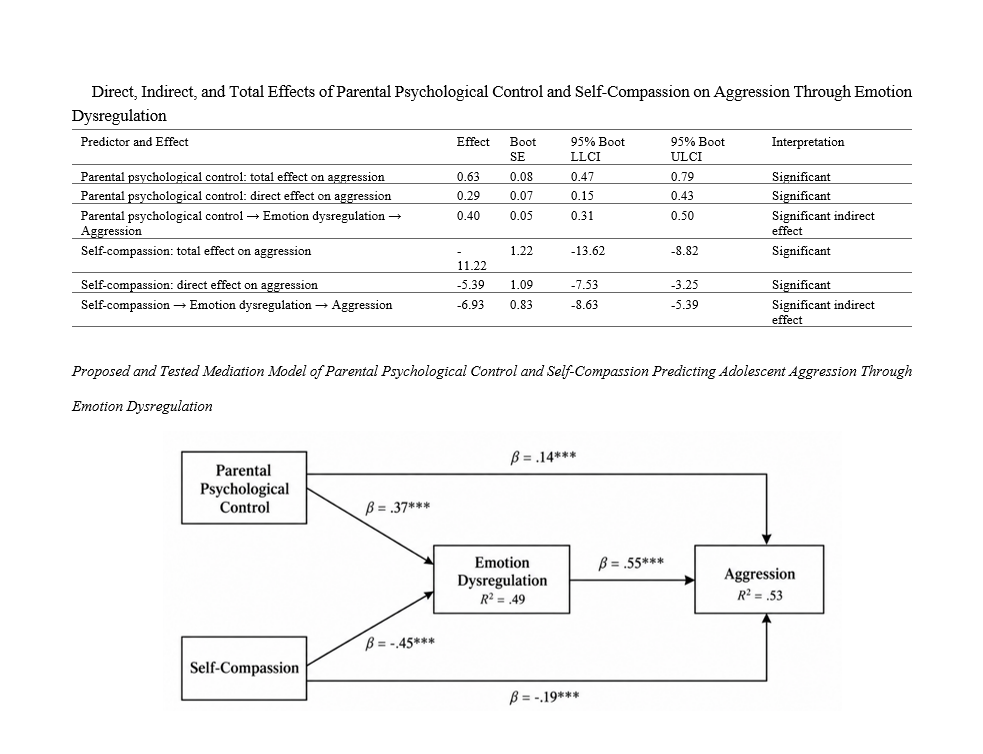
Findings: Parental psychological control significantly and positively predicted emotion dysregulation (β = .37, p < .001) and aggression (β = .14, p < .001), whereas self-compassion significantly and negatively predicted emotion dysregulation (β = -.45, p < .001) and aggression (β = -.19, p < .001). Emotion dysregulation was the strongest predictor of aggression (β = .55, p < .001). Parental psychological control and self-compassion jointly explained 49% of the variance in emotion dysregulation, while the final model explained 53% of the variance in aggression. Bootstrap mediation analysis showed a significant indirect effect of parental psychological control on aggression through emotion dysregulation (B = 0.40, 95% CI [0.31, 0.50]) and a significant indirect effect of self-compassion on aggression through emotion dysregulation (B = -6.93, 95% CI [-8.63, -5.39]), indicating partial mediation.
Conclusion: The findings suggest that parental psychological control increases adolescent aggression partly by intensifying emotion dysregulation, whereas self-compassion reduces aggression partly by promoting more adaptive emotional regulation.
Downloads
References
Cai, R. Y., & Galvin, J. (2025). Self-Compassion Isn’t Always Easy: Helping Autistic Adults Navigate Difficult Responses to Self-Compassion Practices. Neurodiversity, 3. https://doi.org/10.1177/27546330251334425
Chen, K., & Chen, T. (2025). Parental Psychological Control and Depression in University Students: The Chain Mediating Role of Self-Compassion and Emotion Regulation Difficulties. Behavioral Sciences, 15(12), 1726. https://doi.org/10.3390/bs15121726
Cherpe, S., Cunha, M., Xavier, A., Matos, A. P., Arnarson, E. Ö., Craighead, W. E., & Pinto‐Gouveia, J. (2025). Self-Compassion as a Mediator of the Longitudinal Link Between Parent and Adolescent Depressive Symptoms. Adolescents, 5(3), 45. https://doi.org/10.3390/adolescents5030045
Erdinç, B., Akyıl, Y., Okur, S., Deniz, M. E., & Satıcı, S. A. (2026). Self‐Compassion, Difficulties in Emotion Regulation, and Cognitive Flexibility in Parent–Child Relationships in Türkiye: A Dyadic Longitudinal Study. Family Process, 65(2). https://doi.org/10.1111/famp.70147
Jafari, A., & Kiani, Z. (2024). The Effectiveness of Self-Compassion Training on Emotion Regulation and Cognitive Flexibility in Adolescent Girls With Self-Harming Behavior. Jayps, 5(6) 1-17. https://doi.org/10.61838/kman.jayps.5.6.1
Koçak, L., & Terzİ, E. (2023). The Mediating Role of Emotion Regulation in the Relationship Between Self-Compassion and Subjective Well-Being in School in Secondary School Students. Journal of Family Counseling and Education, 8(1), 87-106. https://doi.org/10.32568/jfce.1296134
Kwan, C. K., Ai, Y., & Ma, Y. (2025). Parent-Adolescent Intergenerational Transmission of Distress: The Roles of Family Climate, Adolescents’ Self-Compassion and Mindfulness. Frontiers in psychology, 16. https://doi.org/10.3389/fpsyg.2025.1595515
Liu, A., Wang, W., Wu, X., & Xu, B. (2023). Empathy and Self-Compassion Mediate the Relationships Between Parental Attachment, Prosocial Behavior, and Antisocial Behavior Among Adolescents After the Jiuzhaigou Earthquake. https://doi.org/10.21203/rs.3.rs-2627633/v1
Muris, P., Fernández‐Martínez, I., & Otgaar, H. (2024). On the Edge of Psychopathology: Strong Relations Between Reversed Self-Compassion and Symptoms of Anxiety and Depression in Young People. Clinical Child and Family Psychology Review, 27(2), 407-423. https://doi.org/10.1007/s10567-024-00471-w
Nariswari, A. A., & Muttaqin, D. (2023). Relational Aggression Victimization and Depression: Testing Self-Compassion and Self-Criticism as Moderator and Mediator. Humaniora, 14(1), 59-68. https://doi.org/10.21512/humaniora.v14i1.8318
Pihlaja, S., Jääskeläinen, E., Heikkilä, L., & Hintsanen, M. (2024). Associations of Lipids in Adolescence and Adulthood With Self‐ and Other‐directed Compassion in Adulthood. Scandinavian journal of psychology, 65(6), 1101-1112. https://doi.org/10.1111/sjop.13052
Rech, M., Diaz, G. B., Schaab, B. L., Leães, C. G. S., Calvetti, P. Ü., & Reppold, C. T. (2023). Association of Emotional Self-Regulation With Psychological Distress and Positive Functioning Dimensions in Brazilian University Students During the COVID-19 Pandemic. International journal of environmental research and public health, 20(14), 6428. https://doi.org/10.3390/ijerph20146428
Roberts, G., Parish, N., & Samuel, V. (2026). The Use and Outcomes of Compassion‐Focused Group Interventions With Children and Adolescent Clinical Populations: A Systematic Review and Narrative Synthesis. Clinical Psychology & Psychotherapy, 33(2). https://doi.org/10.1002/cpp.70259
Shamsnajafi, Z. S., Hasanzadeh, R., & Emadian, S. O. (2023). Comparison of the Effectiveness of Compassionate Mind-Based Therapy and Dialectical Behavior Therapy on Cognitive Deficits, Emotional Processing Defects and Impulsivity of Adolescent Soldiers Aged 18 to 20 Years With High-Risk Behaviors. Jayps, 4(5), 59-71. https://doi.org/10.61838/kman.jayps.4.5.6
Syafitri, N., Lubis, R., Indrawan, Y. F., & Choong, T. C. (2024). Self-Compassion: Unveiling Mental Health Through Emotion Regulation in High-School Students. Tazkiya Journal of Psychology, 12(1), 1-16. https://doi.org/10.15408/tazkiya.v12i1.37794
Tomoiagă, C. T., & Iuga, I. A. (2026). Validation and Standardization of the Childhood Trauma Screener Among Romanian Children, Adolescents, and College Students. Journal of Traumatic Stress, 39(2), 330-337. https://doi.org/10.1002/jts.70038
Trivedi‐Bateman, N., & Gadd, V. L. (2024). The Compass Project Intervention Programme: The Application of Moral Theory in Different Youth Contexts. Journal of Criminological Research Policy and Practice, 10(1), 81-94. https://doi.org/10.1108/jcrpp-08-2023-0044
Wang, H., Wang, J., Wei, X., & Lei, L. (2022). Cyber Dating Abuse Victimization and Experiential Avoidance Among Chinese Female Adolescents: The Roles of Self-Compassion and Interpersonal Flexibility. Journal of interpersonal violence, 38(3-4), 4416-4442. https://doi.org/10.1177/08862605221116316
Widyastuti, A., & Savitri, L. S. Y. (2023). Empathy as Mediator in Relationship Between Self-Compassion and Prosocial Behavior Among Adolescents. Jurnal Psikologi, 50(2), 176. https://doi.org/10.22146/jpsi.78312
Wu, Q., Zhou, N., Cao, H., & Wang, S. (2025). Implications of Childhood Psychological Maltreatment and Peer Victimization for COVID-19 PTSD Symptoms Among Adolescents: Mindfulness and Self-Compassion as Explanatory Mechanisms in Trauma Transmission. Psychological Trauma Theory Research Practice and Policy. https://doi.org/10.1037/tra0002004
Xie, K. (2026). Ecological Predictors and Network Patterns of Cyberbullying Victimisation Among Chinese Adolescents: Integrating Machine Learning and Network Analysis. Child Abuse Review, 35(4). https://doi.org/10.1002/car.70161
Xue, S., Lu, A., Zhu, K., & Li, X. (2025). Does Self‐Compassion Moderate the Relationship Between Emotional Problems and Non‐Suicidal Self‐Injury in Adolescence? A Moderated Network Analysis. Journal of adolescence, 97(7), 1795-1806. https://doi.org/10.1002/jad.70002
Yang, Q.-F., Xie, R., Zhang, R., & Ding, W. (2023). Harsh Childhood Discipline and Developmental Changes in Adolescent Aggressive Behavior: The Mediating Role of Self-Compassion. Behavioral Sciences, 13(9), 725. https://doi.org/10.3390/bs13090725
Yue, L., Cui, N., Golfenshtein, N., Cui, N., Hao, Y., & Lyu, P. (2022). The Protective Role of Mindful Parenting Against Child Maltreatment and Aggressive Behavior: An Exploratory Study Among Chinese Parent-Adolescent Dyads. Child and adolescent psychiatry and mental health, 16(1). https://doi.org/10.1186/s13034-022-00507-5
Zoller, B. K., Bögels, S. M., Meppelink, R., & Bruin, E. I. d. (2026). Mechanisms of Change in Mindfulness-Based Family Intervention (MYmind) Versus Methylphenidate for Childhood ADHD: A Randomized Controlled Trial. Children, 13(3), 434. https://doi.org/10.3390/children13030434
Downloads
Additional Files
Publication Timeline
- Submitted
- Revised
- Accepted