Artificial Neural Network Prediction of Psychological Well-Being Among Adolescents Using Family, Peer, School, and Individual Factors
Keywords:
adolescents, psychological well-being, artificial neural network, perceived stress, self-esteem, resilience, family support, school connectednessAbstract
Objective: This study aimed to develop and evaluate an artificial neural network model for predicting psychological well-being among adolescents using family, peer, school, and individual factors.
Methods and Materials: This cross-sectional predictive study was conducted among 612 adolescents aged 13–18 years enrolled in secondary schools in Ontario, Canada, during the 2025–2026 academic year. Participants were selected using multistage sampling. Psychological well-being was assessed using the Warwick–Edinburgh Mental Well-Being Scale. Family-related predictors included family cohesion and family support; peer-related predictors included peer support and friendship quality; school-related predictors included school connectedness, academic engagement, and academic standing; and individual predictors included self-esteem, resilience, emotion regulation difficulties, perceived stress, and selected demographic characteristics. An artificial neural network based on a multilayer perceptron architecture was developed using 70% of the sample for training, 15% for validation, and 15% for independent testing. Model performance was evaluated using mean squared error, root mean squared error, mean absolute error, correlation coefficients, and coefficient of determination. Permutation-based feature importance was used to rank predictors.
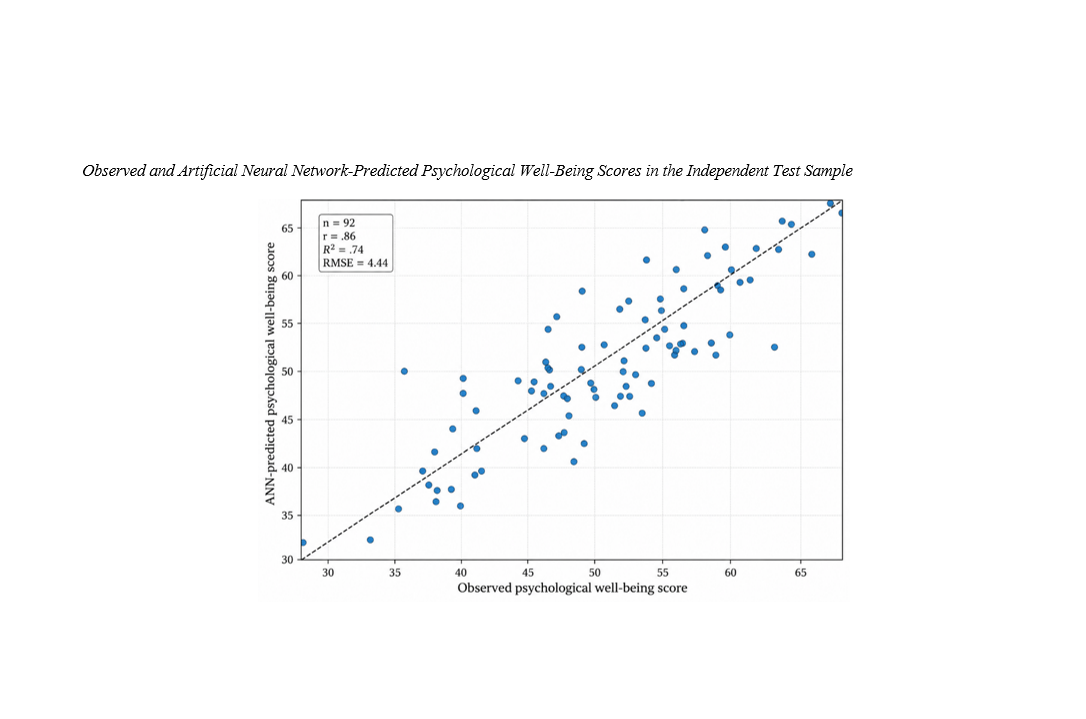
Findings: The artificial neural network demonstrated strong predictive performance, with R² values of .83, .76, and .74 in the training, validation, and test samples, respectively. In the independent test sample, the model achieved R = .86, RMSE = 4.44, MAE = 3.52, and MSE = 19.74. Perceived stress was the most influential predictor, followed by self-esteem, resilience, emotion regulation difficulties, family support, and school connectedness.
Conclusion: Psychological well-being among adolescents can be predicted with substantial accuracy using a multidimensional artificial neural network model, with individual psychological resources and stress-related factors contributing most strongly while family and school contexts also providing meaningful predictive value.
Downloads
References
Chronopoulou, N., Zaravinos-Tsakos, F., Kolaitis, G., & Giannakopoulos, G. (2025). Maternal Psychopathology and Family Functioning as Predictors of Externalizing Behavior in Adolescents: A Cross-Sectional Study in Greece. Adolescents, 5(2), 17. https://doi.org/10.3390/adolescents5020017
Çi̇çek, İ., Korkmaz, Z., Ünsal, F., Gómez‐Salgado, J., & Yıldırım, M. (2025). The Effect of Secure Attachment on Family Relationships and Peer Bullying in Adolescents: The Mediating Role of Positive Childhood Experiences. Frontiers in psychology, 16. https://doi.org/10.3389/fpsyg.2025.1700648
Feng, Y., Zhang, S., Xiao, L., Yang, Y., & Zhang, W. (2024). Association Between Bullying Victimization and Mental Health Problems Among Chinese Left-Behind Children: A Cross-Sectional Study From the Adolescence Mental Health Promotion Cohort. Frontiers in Psychiatry, 15. https://doi.org/10.3389/fpsyt.2024.1440821
Fu, R., Paskewich, B. S., Randolph, J. A., Bradshaw, C. P., & Waasdorp, T. E. (2025). Parent Perceptions of School Relationships: Considerations of Racial–ethnic Differences and Youth’s Peer Victimization. Journal of Family Psychology, 39(2), 252-262. https://doi.org/10.1037/fam0001243
Ganotz‐Steinborn, T., & Schwab, S. (2025). What Makes Students Strong? A Student's Voice Study on Resilience. Journal of Research in Special Educational Needs, 25(4), 647-659. https://doi.org/10.1111/1471-3802.70001
Guan, S. S. A., Nuñez, V., Areba, E., & Forster, M. (2023). Negative Perceived Context of Reception and Sociocultural Resources on Mental Health Among Hispanic and Somali Adolescents. American Journal of Community Psychology, 71(3-4), 480-490. https://doi.org/10.1002/ajcp.12665
Harsono, C. S., & Febriyana, N. (2026). Understanding and Addressing Bullying in Children and Adolescents. Journal of Korean Academy of Child and Adolescent Psychiatry, 37(1), 51-62. https://doi.org/10.5765/jkacap.250040
Hornsby, A. G., Buttler, T. M., Colvin, D. L., Sprenkel, R. E., Dunn, R. A., & Kucharek, T. (2023). School Climate and Adolescents’ Prosocial Behavior: The Mediating Role of Perceived Social Support and Resilience. Frontiers in psychology, 14. https://doi.org/10.3389/fpsyg.2023.1095566
Jia, Z. (2025). To Quit or Stay: The Role of Social Support in Fulfilling Psychological Needs and Reducing Rural Chinese Students' Dropout Intention. Child Care Health and Development, 52(1). https://doi.org/10.1111/cch.70197
Kearney, C. A., Fensken, M., & Dupont, R. (2024). The K-16 Education Movement: Common Themes Across K-12 and Higher Education Systems to Inform Development and Evaluation. Frontiers in Education, 9. https://doi.org/10.3389/feduc.2024.1272297
Kristjánsson, Á. L., Lilly, C. L., Mann, M. J., Smith, M. L., & Kogan, S. M. (2025). Longitudinal Test of Multiple Risk and Protective Factor Domains for Early Substance Use Onset: Implications for Primary Prevention Policy and Practice. Substance Use & Addiction Journal, 47(2), 521-530. https://doi.org/10.1177/29767342251392695
Lampropoulou, A., Lianos, P., & Πούλιος, Α. (2023). Personality, Family Relationships and School Climate Dimensions as Predictors of Dispositional Forgiveness in Adolescence. Psychology the Journal of the Hellenic Psychological Society, 28(1), 176-194. https://doi.org/10.12681/psy_hps.29819
Li, X., Li, Y., & Liao, C. (2025). The Influence of Family Care and Perceived School Climate on the Perception of Security of Left‐Behind Children: A Social Support Perspective. Psychology in the Schools, 63(2), 514-529. https://doi.org/10.1002/pits.70107
Malinowska-Cieślik, M., Kleszczewska, D., Dzielska, A., Ścibor, M., & Mazur, J. (2023). Similarities and Differences Between Psychosocial Determinants of Bullying and Cyberbullying Perpetration Among Polish Adolescents. International journal of environmental research and public health, 20(2), 1358. https://doi.org/10.3390/ijerph20021358
Martinez-Yarza, N., Solabarrieta, J., & Gruber, R. S. (2024). The Impact of Family Involvement on Students’ Social-Emotional Development: The Mediational Role of School Engagement. European Journal of Psychology of Education, 39(4), 4297-4327. https://doi.org/10.1007/s10212-024-00862-1
Martínez, M., Damme, K. S. F., Vargas, T., Yang, B., Rompilla, D., Stephens, J. E., Qu, Y., Mittal, V. A., & Haase, C. M. (2024). Longitudinal Study of Peer Victimization, Social Support, and Mental Health During Early Adolescence. Psychological medicine, 54(9), 1940-1955. https://doi.org/10.1017/s0033291724000035
Murry, V. M., Gonzalez, C. M., Debreaux, M., Coates, E. E., & Berkel, C. (2023). Implications of Built and Social Environments on the Academic Success Among African American Youth: Testing Strong African American Families Intervention Effects on Parental Academic Racial Socialization. Frontiers in psychology, 14. https://doi.org/10.3389/fpsyg.2023.956804
Otmar, C. D. (2026). Disordered Eating Behavior and Adolescent Social Health: Evidence of Interpersonal Disruption Across Time and Relationships. Annals of Behavioral Medicine, 60(1). https://doi.org/10.1093/abm/kaag029
Park, S., & Choi, B. (2025). Trajectory of Cyberbullying and Its Association With the Quality of Social Relationships in Adolescents: A Latent Growth Modeling Approach. Journal of Pacific Rim Psychology, 19. https://doi.org/10.1177/18344909251319620
Peng, A., & Patterson, M. M. (2025). A Review of School Connectedness: Definitions, Antecedents, and Psychological Outcomes. Journal of School Health, 95(9), 741-764. https://doi.org/10.1111/josh.70037
Sezgin, E. (2026). Examining the Relationship Between Adolescent Girls’ Perception of Their Fathers and Father Attachment With Peer Bullying Experiences. Adolescents, 6(4), 57. https://doi.org/10.3390/adolescents6040057
Su, Y. W., Li, D., & Doty, J. (2025). Moderated Mediation Analysis of School Connectedness, Adverse Childhood Experiences, and Bullying: Developmental Implications for Constructing Resilient Spaces. Journal of Counseling & Development, 104(2), 198-213. https://doi.org/10.1002/jcad.70019
Subramanyam, A. A., Somaiya, M., & Sousa, A. D. (2024). Mental Health and Well-Being in Children and Adolescents. Indian Journal of Psychiatry, 66(Suppl 2), S304-S319. https://doi.org/10.4103/indianjpsychiatry.indianjpsychiatry_624_23
Thompson, E. L., Sawi, O., Roy, E., Abad, S., Kaiver, C. M., Lehman, S., Tay, J., Gonzalez, M. R., Rinsveld, A. V., Dowling, G., Brown, S., Jernigan, T., McCandliss, B. D., & Hoffman, E. A. (2026). From School Climate to Brain Development: What the ABCD Study Reveals About the Educational Context of Adolescence. Developmental Cognitive Neuroscience, 80, 101746. https://doi.org/10.1016/j.dcn.2026.101746
Varner, F., Tse, H. W., Charles, A. R., Smith, N. A., & Butler‐Barnes, S. T. (2025). School Climate and Black Adolescents’ Psychological Functioning: The Roles of Parental Self-Efficacy and Parenting Practices. Behavioral Sciences, 15(7), 933. https://doi.org/10.3390/bs15070933
Wang, Y., Berry, T., Bronk, K. C., Li, Y., & Lin, D. (2025). Promoting Positive Development Among Left‐behind Youth in Rural China: A Mixed‐methods Approach to Scale Development. Journal of Research on Adolescence, 35(3). https://doi.org/10.1111/jora.70049
Wang, Y., & Kubo, Y. (2025). Differences in Factors Affecting School Adjustment by School Type in China: Predictions From School Culture. https://doi.org/10.21203/rs.3.rs-6822183/v1
Yıldız, M., & Eldeleklioğlu, J. (2024). Relations Between Perceived Social Support, Attachment and Kindness in High School Students. Journal of Pedagogical Research. https://doi.org/10.33902/jpr.202425168
Downloads
Additional Files
Publication Timeline
- Submitted
- Revised
- Accepted