Classification of Adolescents With High Versus Low Emotion-Regulation Difficulties Using k-Nearest Neighbors and Psychological Indicators
Keywords:
Emotion Regulation Difficulties, Adolescents, k-Nearest Neighbors, Machine Learning, Depression, Anxiety, Perceived Stress, Resilience, Self-EsteemAbstract
Objective: This study aimed to classify adolescents with high versus low emotion-regulation difficulties using a k-nearest neighbors (KNN) machine-learning algorithm based on self-esteem, depressive symptoms, anxiety symptoms, perceived stress, and psychological resilience.
Methods and Materials: This quantitative, cross-sectional predictive classification study was conducted among 684 adolescents aged 13–18 years enrolled in secondary schools in Ontario, Canada. Participants were classified into high and low emotion-regulation difficulty groups based on scores obtained from the Difficulties in Emotion Regulation Scale. Psychological predictors were assessed using the Rosenberg Self-Esteem Scale, Patient Health Questionnaire-9, Generalized Anxiety Disorder-7, Perceived Stress Scale-10, and Brief Resilience Scale. The dataset was divided using stratified sampling into an 80% training set and a 20% independent test set. Predictor variables were standardized before model development. Candidate KNN models with odd values of k ranging from 3 to 25 and both uniform and distance-weighted voting were evaluated using stratified 10-fold cross-validation. The final model was selected according to cross-validated F1 score and balanced accuracy and was subsequently assessed on the independent test set using accuracy, sensitivity, specificity, precision, F1 score, balanced accuracy, ROC-AUC, and confusion-matrix indices.
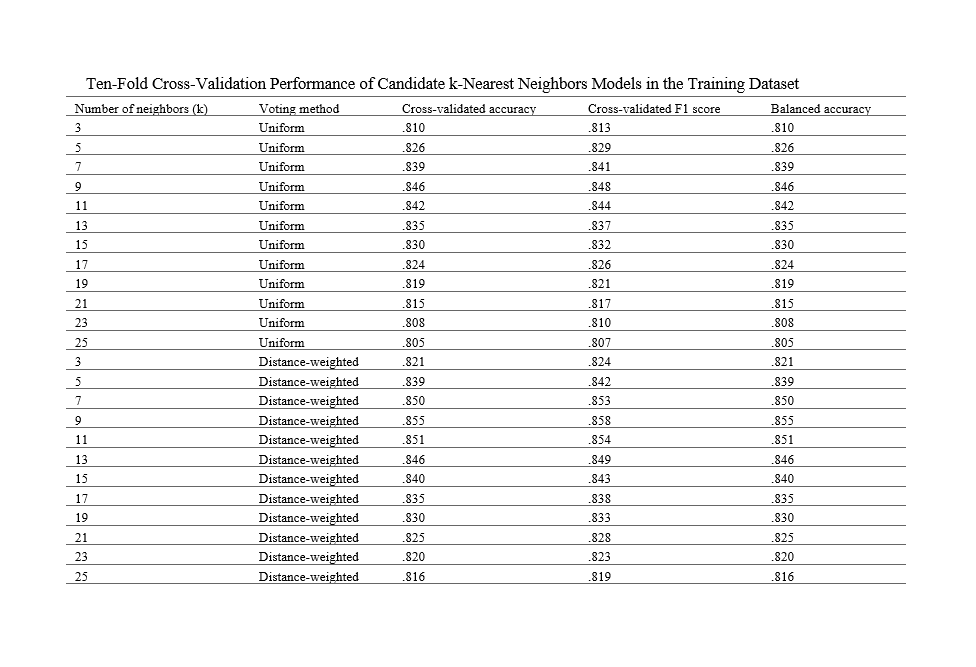
Findings: Adolescents with high emotion-regulation difficulties had significantly lower self-esteem and resilience and significantly higher depressive symptoms, anxiety symptoms, and perceived stress than those with low difficulties (all p < .001), with large effect sizes. The optimal classifier used k = 9 with distance-weighted voting and achieved cross-validated accuracy of .855, F1 = .858, and balanced accuracy = .855. In the independent test sample, the model achieved accuracy = .861, sensitivity = .870, specificity = .853, precision = .857, F1 = .863, balanced accuracy = .861, and ROC-AUC = .923. The classifier correctly identified 60 of 69 adolescents with high difficulties and 58 of 68 adolescents with low difficulties.
Conclusion: A multivariate psychological profile comprising self-esteem, depressive symptoms, anxiety, perceived stress, and resilience can distinguish adolescents with high versus low emotion-regulation difficulties with strong out-of-sample accuracy.
Downloads
References
Bezborodovs, N., & Villeruša, A. (2024). Subjective Health Status, Health Behaviours, and High-Risk Behaviours as Factors Associated With Adolescent Mental Health. SHS Web of Conferences, 184, 02002. https://doi.org/10.1051/shsconf/202418402002
Caqueo‐Urízar, A., M, A. U., Villalonga-Olives, E., Atencio‐Quevedo, D., Irarrázaval, M., Flores, J., & Ramírez, C. (2022). Children’s Mental Health: Discrepancy Between Child Self-Reporting and Parental Reporting. Behavioral Sciences, 12(10), 401. https://doi.org/10.3390/bs12100401
Chiang, S. C., & Chen, W. C. (2025). Linear and Curvilinear Associations Between Emotional Reactivity and the Development of Adolescent Psychopathology. Journal of Research on Adolescence, 35(3). https://doi.org/10.1111/jora.70077
Chiang, S. C., Ting, S. J., Chen, W. C., & Liu, T. H. (2023). Parent and Adolescent Emotional Variability and Adolescent Psychopathology. Journal of Family Psychology, 37(4), 538-546. https://doi.org/10.1037/fam0001069
Devi, S. (2023). The Role of Emotional Regulation in Mental Well-Being of Indian Adolescents. Mind and Society, 12(03), 33-38. https://doi.org/10.56011/mind-mri-123-20235
Farina, E., & Pepe, A. (2024). Metaphors of Adolescence During COVID-19 Pandemic: A Mixed-Method Analysis in Relation to Well-Being and Alexithymia. Frontiers in psychology, 15. https://doi.org/10.3389/fpsyg.2024.1355752
Farley, C. D., & Renshaw, T. L. (2025). Exploring the Validity of Adolescent Responses to a Measure of Psychological Flexibility and Inflexibility. Behavioral Sciences, 15(2), 197. https://doi.org/10.3390/bs15020197
Giannakopoulos, G., Zaravinos-Tsakos, F., Farmakopoulou, I., Pelt, B. J. v., Maras, A., & Kolaitis, G. (2025). Unraveling Youth Trauma and Parental Influence After Twin Earthquakes. Healthcare, 13(11), 1249. https://doi.org/10.3390/healthcare13111249
Gökdağ, C., & Kızıltepe, R. (2023). Risk Factors in Depression and Anxiety Disorders From the Framework of Developmental Psychopathology. Psikiyatride Guncel Yaklasimlar - Current Approaches in Psychiatry, 15(2), 257-274. https://doi.org/10.18863/pgy.1118163
Gosar, D., & Primec, T. (2026). Distinct Associations of Alexithymia Dimensions With Youth Psychopathology and the General Factor of Psychopathology. https://doi.org/10.21203/rs.3.rs-9923709/v1
Isack, E., Ben-David, S., Goltser-Dubner, T., Segman, R., Kianski, E., Giesser, R., Rahmani, S., Weinberg, P. B., Ben-Ari, A., Sela, Y., Nitsan, M. B., Lotan, A., Schechter, T., Daninos, M., Yishai, S., Avraham, Y., Benarroch, F., & Shalev, A. (2026). Emotion Regulation and Attachment Style as Predictors of Psychiatric Hospitalization Duration in Suicidal Adolescents. Children, 13(4), 448. https://doi.org/10.3390/children13040448
Larionow, P., Mazur, M., & Mudło‐Głagolska, K. (2025). A Screening Measure of Emotion Regulation Difficulties: Polish Norms and Psychometrics of the Difficulties in Emotion Regulation Scale-8 (DERS-8). Healthcare, 13(4), 432. https://doi.org/10.3390/healthcare13040432
Latzer, Y., & Stein, D. (2026). The Impact of Recent Collective Trauma in Israel on Eating Disorders and Disordered Eating: An Overview and Clinical Perspective. Healthcare, 14(13), 1908. https://doi.org/10.3390/healthcare14131908
Levkovich, I., Yatzkar, U., & Shenaar‐Golan, V. (2025). Age and Gender Differences in Emotional and Behavioral Functioning Among Youth Referred to a Psychiatric Outpatient Clinic at a Public Hospital. Children, 12(6), 683. https://doi.org/10.3390/children12060683
Mazza, M., Lisci, F. M., Marzo, E. M., Masi, V. D., Abate, F., & Marano, G. (2025). Why Do They Do It? The Psychology Behind Antisocial Behavior in Children and Adolescents. Pediatric Reports, 17(2), 26. https://doi.org/10.3390/pediatric17020026
Poon, J. A., Zelaya, D., Rajasankar, V., Murphy, M. J., Russell, R. A., & Sun, S. (2026). Childhood Threat and Deprivation and Links to Mental Health Behaviors and Health Risk Behaviors Among Young Sexual Minority Men: The Differential Roles of Mindfulness and Emotion Regulation. International journal of environmental research and public health, 23(5), 609. https://doi.org/10.3390/ijerph23050609
Raffagnato, A., Miscioscia, M., Fasolato, R., Iannattone, S., Valentini, P., Sale, E., & Gatta, M. (2023). Symptomatic, Alexithymic, and Suicidality-Related Features in Groups of Adolescent Self-Harmers: A Case-Control Study. European Journal of Investigation in Health Psychology and Education, 13(5), 883-896. https://doi.org/10.3390/ejihpe13050067
Salavou, V., Papanikolaou, Κ., Pehlivanidis, A., & Giannakopoulos, G. (2026). Mentalization and Emotion Regulation in Adolescent Attachment: A Scoping Review. Children, 13(3), 420. https://doi.org/10.3390/children13030420
Scheiner, C., Seis, C., Kleindienst, N., & Buerger, A. (2023). Psychopathology, Protective Factors, and COVID-19 Among Adolescents: A Structural Equation Model. International journal of environmental research and public health, 20(3), 2493. https://doi.org/10.3390/ijerph20032493
Scott, S., Millwood, S. N., & Manczak, E. M. (2023). Adipocytokine Correlates of Childhood and Adolescent Mental Health: A Systematic Review. Developmental Psychobiology, 65(3). https://doi.org/10.1002/dev.22379
Sharma, N., Agrawal, M., Rushi, & Ayyub, S. (2025). Mindfulness-Based Interventions for Emotional Dysregulation in Adolescents: A Systematic Review. Annals of Neurosciences, 33(2), 259-267. https://doi.org/10.1177/09727531251355311
Sharma, P., Sen, M. S., Sinha, U. K., & Kumar, D. (2024). Unveiling Adolescent Struggles: Exploring the Interplay of Childhood Trauma, Emotional Regulation, and Externalizing Symptoms. Journal of Indian Association for Child and Adolescent Mental Health, 21(1), 39-47. https://doi.org/10.1177/09731342241286273
Slegten, D. M. A., Koster, N., William, M. v. d. V., Laceulle, O. M., & Paul, T. v. d. H. (2025). Untying the Knot: Associations Between Personality Functioning and Psychological Distress in an Outpatient Sample of Youth. Personality and Mental Health, 19(3). https://doi.org/10.1002/pmh.70025
Sotomayor-Enriquez, K., Folco, S. D., & Schwannauer, M. (2024). Emotion Regulation Mediates the Association Between Hypermentalizing and Interpersonal Difficulties in Young People. https://doi.org/10.31234/osf.io/65squ
Tizzoni, F., Canella, G., Fave, A. D., Lernia, D. D., Lorusso, M. L., Nobile, M., & D’Angelo, M. G. (2025). Living With Duchenne Muscular Dystrophy Beyond the Physical Implications: Cognitive Features, Psychopathology Aspects, and Psychosocial Resources—A Narrative Review. Brain Sciences, 15(7), 695. https://doi.org/10.3390/brainsci15070695
Vacca, M., Cerolini, S., Zegretti, A., Zagaria, A., & Lombardo, C. (2023). Bullying Victimization and Adolescent Depression, Anxiety and Stress: The Mediation of Cognitive Emotion Regulation. Children, 10(12), 1897. https://doi.org/10.3390/children10121897
Vatandoost, S., Baetens, I., Erjaee, Z., Azadfar, Z., Heel, M. V., & Hove, L. V. (2023). A Comparative Analysis of Emotion Regulation and Maladaptive Symptoms in Adolescents: Insights From Iran and Belgium. https://doi.org/10.20944/preprints202312.0780.v1
Wais, M., Bégin, M., Sharp, C., & Ensink, K. (2024). Trauma-Related Symptoms in Adolescents: The Differential Roles of Sexual Abuse and Mentalizing. Frontiers in psychology, 15. https://doi.org/10.3389/fpsyg.2024.1364001
Wang, P. (2026). Family-Related Experiences, Childhood Trauma, and Cognitive-Emotional Correlates Across Psychopathological Domains in Adolescent Depression. https://doi.org/10.64898/2026.07.27.26358988
Wiedermann, C. J., Barbieri, V., Piccoliori, G., & Doris Hager von Strobele, P. (2026). Behavioral and Psychosocial Correlates of Gender Differences in Adolescent Mental Health: A Regional Cross-Sectional Study in Northern Italy. Behavioral Sciences, 16(5), 812. https://doi.org/10.3390/bs16050812
Yirmiya, K., Constantinou, M., Simes, E., Bateman, A. W., Wason, J. M. S., Yakeley, J., McMurran, M., Crawford, M., Frater, A., Moran, P., Barrett, B. M., Cameron, A., Hoare, Z., Allison, E., Pilling, S., Butler, S., & Fonagy, P. (2024). The Mediating Role of Reflective Functioning and General Psychopathology in the Relationship Between Childhood Conduct Disorder and Adult Aggression Among Offenders. Psychological medicine, 54(10), 2492-2503. https://doi.org/10.1017/s003329172400062x
Zagaria, A., Vacca, M., Cerolini, S., Terrasi, M., Bacaro, V., Ballesio, A., Baglioni, C., Spinhoven, P., & Lombardo, C. (2023). Differential Associations of Cognitive Emotion Regulation Strategies With Depression, Anxiety, and Insomnia in Adolescence and Early Adulthood. International journal of environmental research and public health, 20(10), 5857. https://doi.org/10.3390/ijerph20105857
Downloads
Additional Files
Publication Timeline
- Submitted
- Revised
- Accepted