Identifying Psychological Factors Contributing to Emotional Dependence on Social Media Among Adolescents
Keywords:
Adolescents, Social Media, Emotional Dependence, Social Comparison, Fear of Missing Out, Emotion Regulation, Interpersonal ValidationAbstract
Objective: This study aimed to identify and explain the psychological factors contributing to emotional dependence on social media among adolescents in Qatar.
Methods and Materials: This qualitative exploratory study was conducted among 24 adolescents aged 13–18 years residing in Qatar and selected through purposive sampling with maximum variation in age, sex, school grade, and social media use patterns. Data were collected using a demographic information form and semi-structured individual interviews focusing on emotional reactions to social media, need for approval, fear of exclusion, social comparison, self-evaluation, emotion regulation, boredom, and repetitive checking behaviors. Interviews lasted approximately 40–65 minutes, were audio-recorded with permission, transcribed verbatim, and analyzed using inductive reflexive thematic analysis in MAXQDA. Data collection continued until thematic saturation was achieved. Credibility and dependability were strengthened through iterative coding, team discussion, examination of discrepant cases, analytical memos, and maintenance of an audit trail.
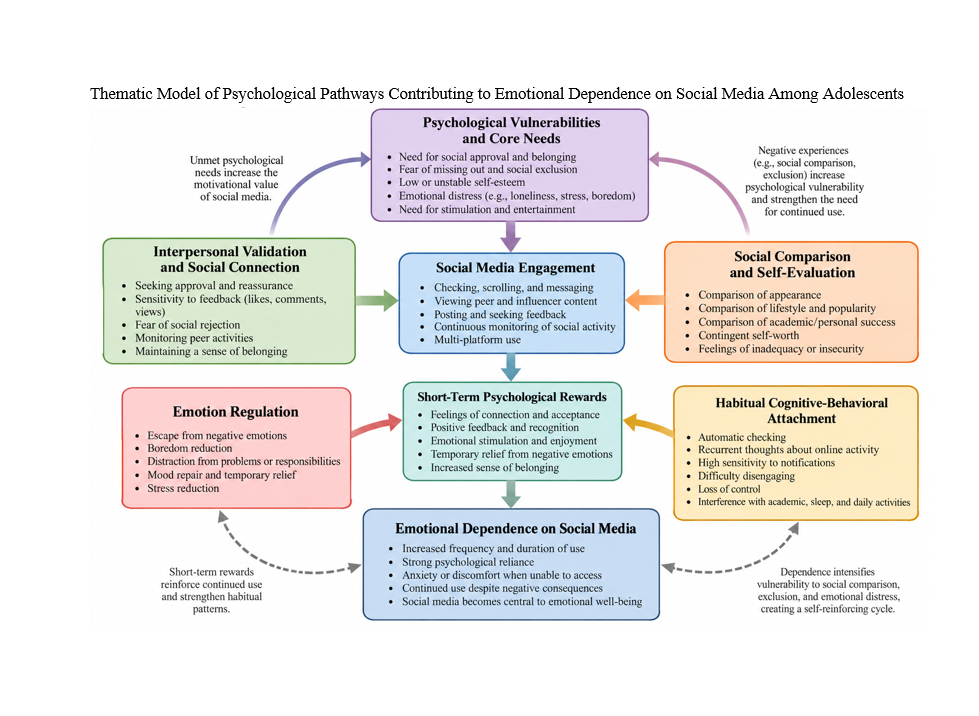
Findings: Thematic analysis generated 186 initial codes, 32 subcategories, 11 intermediate categories, and five overarching themes. The identified psychological factors were dependence on interpersonal validation, social disconnection and fear of exclusion, social comparison and unstable self-evaluation, emotion regulation through social media, and habitual cognitive-behavioral attachment. The findings indicated that emotional dependence developed through reciprocal and self-reinforcing pathways in which adolescents used social media to obtain reassurance, maintain belonging, reduce boredom and distress, regulate mood, and monitor peer activity. At the same time, repeated exposure intensified upward social comparison, insecurity, fear of missing out, sensitivity to feedback, cognitive preoccupation, and automatic checking. The convergence of interpersonal needs, affective regulation, and habitual behavior appeared to distinguish emotionally dependent use from ordinary recreational engagement.
Conclusion: Emotional dependence on social media among adolescents is a multidimensional psychological phenomenon shaped by the interaction of social validation needs, fear of exclusion, unstable self-worth, maladaptive emotion regulation, and habitual digital engagement.
Downloads
References
Akhlaq, B., Iqbal, A., & Ikram, A. (2022). Assessment of Psychosocial Issues Due to Social Media Addiction Among University Students and Their Relationship With Academic Grades. Pakistan Journal of Social Research, 04(03), 1020--1031. https://doi.org/10.52567/pjsr.v4i03.1283
Amirthalingam, J., & Khera, A. (2024). Understanding Social Media Addiction: A Deep Dive. Cureus. https://doi.org/10.7759/cureus.72499
Awopetu, R. G., Olabimitan, B. A., Kolawole, S. O., Newton, R., Odok, A. A., & Awopetu, A. (2024). The Systematic Review of Social Media Addiction and Mental Health of Nigerian University Students: The Good, the Bad and the Ugly. European Journal of Theoretical and Applied Sciences, 2(1), 767-788. https://doi.org/10.59324/ejtas.2024.2(1).69
Bottaro, R., & Faraci, P. (2022). The Use of Social Networking Sites and Its Impact on Adolescents’ Emotional Well-Being: A Scoping Review. Current Addiction Reports, 9(4), 518-539. https://doi.org/10.1007/s40429-022-00445-4
Buecker, S., Petersen, K., Neuber, A., Zheng, Y., Hayes, D., & Qualter, P. (2024). A Systematic Review of Longitudinal Risk and Protective Factors for Loneliness in Youth. Annals of the New York Academy of Sciences, 1542(1), 620-637. https://doi.org/10.1111/nyas.15266
Burgess, K. (2025). The Decline in Adolescents’ Mental Health With the Rise of Social Media: A Narrative Review. Creative Nursing, 31(2), 119-126. https://doi.org/10.1177/10784535251328925
Chaeycharoen, S. (2022). Social Media Affects Emotional and Cognitive Status. International Journal of Current Science Research and Review, 05(07). https://doi.org/10.47191/ijcsrr/v5-i7-47
Dhiman, B. (2024). ≪strong></Strong>A Study of Instagram Dependency on Indian Youth: Assessing Its Impact on Students' Lives. https://doi.org/10.20944/preprints202406.0998.v1
Falcón-Linares, C., González-Yubero, S., Mauri-Medrano, M., & Moreno, M. J. C. (2023). Impact of Social Media on Adolescence: Mapping Emerging Needs to Build Resilient Skills. Societies, 13(11), 238. https://doi.org/10.3390/soc13110238
Fatima, A., Akhter, M. S., Kanekar, A., Roy, S., Imade, B., & Sharma, M. (2025). A Scoping Review of the Use and Determinants of Social Media Among College Students. Healthcare, 13(17), 2234. https://doi.org/10.3390/healthcare13172234
Fioravanti, G., Benucci, S. B., & Ghinassi, S. (2025). Psychological Risk Factors for Problematic Social Network Use: An Overview of Systematic Reviews and Meta-Analyses. Addictive Behaviors Reports, 21, 100600. https://doi.org/10.1016/j.abrep.2025.100600
Haddock, A., Ward, N. L., Yu, R., & O’Dea, N. (2022). Positive Effects of Digital Technology Use by Adolescents: A Scoping Review of the Literature. International journal of environmental research and public health, 19(21), 14009. https://doi.org/10.3390/ijerph192114009
Kusnadi, S. P. A. P., & Kaloeti, M. P. D. p. D. V. S. (2022). Related Factors of Internet Addiction on Adolescents During COVID-19 Pandemic : Systematic Literature Review. Journal of Educational Health and Community Psychology, 11(4), 744. https://doi.org/10.12928/jehcp.v11i4.24674
Lin, J., & Guo, W. (2024). The Research on Risk Factors for Adolescents’ Mental Health. Behavioral Sciences, 14(4), 263. https://doi.org/10.3390/bs14040263
Liu, X., Liu, J., Flores, D. D., & McDonald, C. C. (2024). Family Factors Related to Adolescent Screen Media Use and Mental Health Outcomes: A Systematic Review and Recommendation for Practices. Journal of adolescence, 96(7), 1401-1427. https://doi.org/10.1002/jad.12367
Manjanatha, D., Pippard, N. S., & Bloss, C. S. (2025). Self-Compassion as a Protective Factor Against Adverse Consequences of Social Media Use: A Scoping Review. PLoS One, 20(5), e0322227. https://doi.org/10.1371/journal.pone.0322227
Manvelian, A., Boyd, S., O’Hara, K. L., Watters, C., Liu, Y., & Sbarra, D. A. (2023). Promoting Attachment Security During the Transition to College: A Pilot Study of Emotionally Focused Mentoring. Journal of Social and Personal Relationships, 40(12), 4075-4101. https://doi.org/10.1177/02654075231195530
Marano, G., Lisci, F. M., Rossi, S., Marzo, E. M., Boggio, G., Brisi, C., Traversi, G., Mazza, O., Pola, R., Gaetani, E., & Mazza, M. (2025). Connected but at Risk: Social Media Exposure and Psychiatric and Psychological Outcomes in Youth. Children, 12(10), 1322. https://doi.org/10.3390/children12101322
Marciano, L., Ostroumova, M., Schulz, P. J., & Camerini, A.-L. (2022). Digital Media Use and Adolescents' Mental Health During the Covid-19 Pandemic: A Systematic Review and Meta-Analysis. Frontiers in Public Health, 9. https://doi.org/10.3389/fpubh.2021.793868
Morales, A., Bleda-Cruz, M. J., Espada, J. P., & Orgilés, M. (2026). Exploring Mental Health in Spanish Youth: Insights From Children, Adolescents, Parents, and Professionals. Clinical Child Psychology and Psychiatry, 31(4), 1775-1801. https://doi.org/10.1177/13591045261424541
Munusamy, K. A. P., & Ghazali, A. H. A. (2022). Behaviour Factors and Smartphone Addiction Among Youth in Selected Public Universities in Klang Valley. International Journal of Academic Research in Business and Social Sciences, 12(7). https://doi.org/10.6007/ijarbss/v12-i7/14426
Munusamy, K. A. P., Ghazali, A. H. A., Zawawi, J. W. M., & Razi, S. A. M. (2021). Psychological Predictors of Mobile Phone Use and Addiction Among Youths. International Journal of Academic Research in Business and Social Sciences, 11(15). https://doi.org/10.6007/ijarbss/v11-i15/10633
Nagata, J. M. (2026). Generative Artificial Intelligence Use and Adolescent Mental Health. Current Pediatrics Reports, 14(1). https://doi.org/10.1007/s40124-026-00388-8
Pérez-Jiménez, J. M. (2026). Adolescent Suicide During the COVID-19 Pandemic: Bullying Dynamics, Risk Factors, and Prevention Strategies—A Systematic Review. Healthcare, 14(16), 2582. https://doi.org/10.3390/healthcare14162582
Qi, X., He, J., Wang, Q., Liu, S., Zhang, L., Zhao, J., Ma, D., & Zhao, D. (2026). A Systematic Review of Internet Addiction in Hospitalized Adolescents: Proposing a Hospital-Adapted Moderated Dual Mediation Model of Emotional Dysregulation and Social Compensation. Frontiers in Psychiatry, 17. https://doi.org/10.3389/fpsyt.2026.1830013
Rutte, J. L. d., Findley, A., & Dennis‐Tiwary, T. A. (2024). Living in a Digital World: Understanding the Development of Adolescent Emotional Adjustment in the Context of Digital Technologies. 159-181. https://doi.org/10.1037/0000406-009
Sahu, A., Dhiman, A., & Sharma, M. (2026). Examining the Role of Mobile Phone and Social Media Use in Predicting Psychological Distress Among Young Adults: A Cross-Sectional Study. Cureus. https://doi.org/10.7759/cureus.110232
Socol, A., Andrei, L. E., Dijmarescu, C. M., Dragomir, D., Iotu, A.-D., Mihăilescu, I., & Rad, F. (2026). Navigating the Algorithm: A Narrative Review of Social Media’s Impact on Mental Health in Clinical and Non-Clinical Adolescent Populations. Children, 13(7), 872. https://doi.org/10.3390/children13070872
Yablonska, T., & Li, Y. (2023). Psychological Characteristics of Young Men With Internet Addiction: A Cross-Cultural Study. Scientific Bulletin of Mukachevo State University Series “Pedagogy and Psychology”, 9(3), 91-101. https://doi.org/10.52534/msu-pp3.2023.91
Zhao, S., Lan, J., & Zong, R. (2026). Short-Form Video Addiction and Loneliness Among College Students: The Longitudinal Mediating Role of Social Anxiety in a Three-Wave Cross-Lagged Panel Study. https://doi.org/10.21203/rs.3.rs-9685271/v1
Downloads
Additional Files
Publication Timeline
- Submitted
- Revised
- Accepted