Characterizing the Psychological Patterns Associated With Toxic Peer Relationships During Adolescence
Keywords:
Adolescence, Toxic Peer Relationships, Peer Victimization, Latent Profile Analysis, Emotion Regulation, Self-Esteem, Depression, Anxiety, StressAbstract
Objective: This study aimed to identify distinct latent profiles of toxic peer relationships among adolescents and examine differences among these profiles in emotion-regulation difficulties, self-esteem, depression, anxiety, and stress.
Methods and Materials: This cross-sectional descriptive-analytical study was conducted among 486 adolescents aged 13–18 years enrolled in secondary schools in France during the 2025–2026 academic year. Participants were selected through multistage cluster sampling. Data were collected using measures of peer victimization, relational aggression, friendship conflict, peer trust, peer communication, peer alienation, emotion-regulation difficulties, self-esteem, depression, anxiety, and stress. Data analysis was performed using SPSS 29 and Mplus 8.10. Pearson correlations were calculated, and latent profile analysis was used to identify distinct peer-relationship patterns. Competing models were compared using AIC, BIC, sample-size-adjusted BIC, entropy, the Lo-Mendell-Rubin likelihood ratio test, and the bootstrap likelihood ratio test. Differences in psychological outcomes across profiles were examined using multivariate and univariate analyses with adjusted pairwise comparisons.
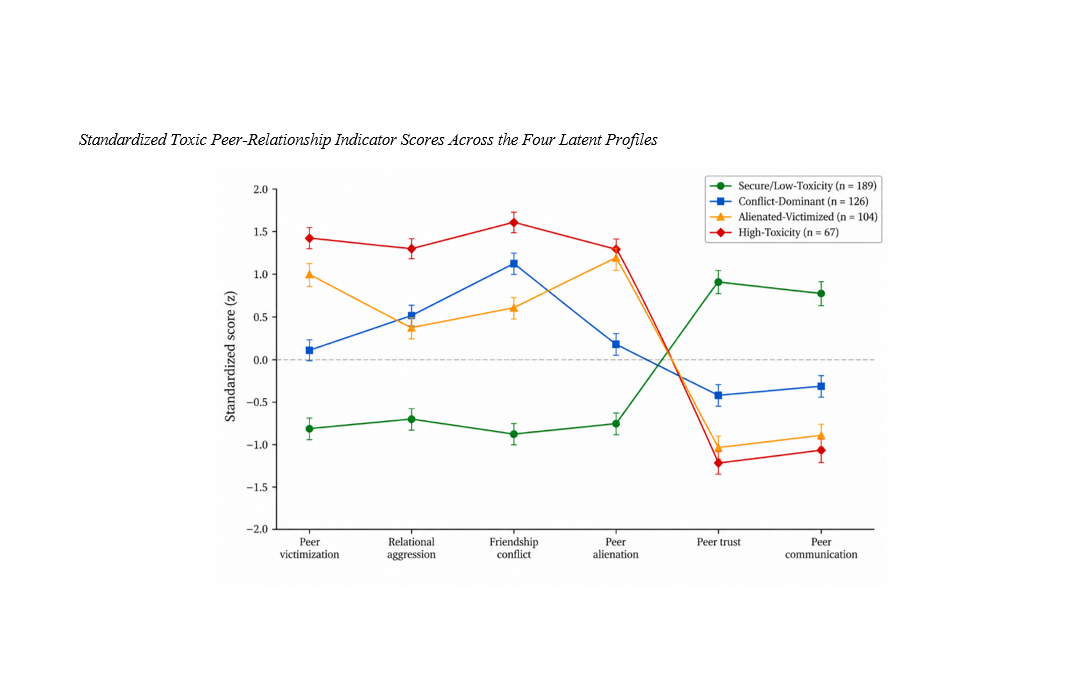
Findings: A four-profile solution provided the most interpretable and statistically adequate representation of the data, yielding Secure/Low-Toxicity, Conflict-Dominant, Alienated-Victimized, and High-Toxicity profiles. Significant between-profile differences were found for emotion-regulation difficulties, F(3, 482) = 102.47, p < .001, η² = .39; self-esteem, F(3, 482) = 95.63, p < .001, η² = .37; depression, F(3, 482) = 116.28, p < .001, η² = .42; anxiety, F(3, 482) = 82.91, p < .001, η² = .34; and stress, F(3, 482) = 101.36, p < .001, η² = .39. The High-Toxicity profile showed the poorest psychological functioning, whereas the Secure/Low-Toxicity profile showed the most favorable outcomes. The overall multivariate effect of profile membership remained significant after adjustment for age and gender, Wilks' Λ = .49, F(15, 1319.62) = 25.84, p < .001, partial η² = .20.
Conclusion: Toxic peer relationships during adolescence are heterogeneous and form distinct psychological profiles that differ substantially in emotional regulation, self-esteem, and psychological distress.
Downloads
References
Akintunde, T. Y., Isangha, S. O., Ssewanyana, D., Adewusi, O. O., Olurin, T. K., Akongnwi, S. N., & Akintunde, O. D. (2025). Modeling the Pathways From Antisocial Media Exposure to Subjective Well-Being Through School-Based Victimization in Nigeria. Cambridge Prisms Global Mental Health, 13. https://doi.org/10.1017/gmh.2025.10116
Ali, S. F., & Khan, A. (2022). Association Between Bullying or Peer Victimization and Psychopathology Symptoms Among Adolescents. Cultural Communication and Socialization Journal, 3(2), 31-33. https://doi.org/10.26480/ccsj.02.2022.31.33
Berger, L., & Möhler, E. (2026). Bullying as an Adverse Childhood Experience?—State of the Art. Children, 13(5), 609. https://doi.org/10.3390/children13050609
Campbell, A., Sarraf, L., Daniels, T., Sharp, R., & Makris, K. (2026). The Moderating Effects of Classroom Social Support on the Relationship Between Peer Victimization and Children’s Emotional-Behavioral Functioning. Canadian Journal of School Psychology, 41(3), 183-206. https://doi.org/10.1177/08295735261471624
Carapeto, M., Agostinho, I., Grácio, L., & Santos, D. L. d. (2025). Between Support and Risk: The Dual Role of Peer Relationships in Adolescents’ Mental Health. Children, 12(11), 1569. https://doi.org/10.3390/children12111569
Çiçek, A. U., Ucuz, İ., Sarı, S. A., Arslan, S. C., & Doğru, H. (2022). Does Involvement in Peer Bullying Invite Self-Injury? The Journal of Nervous and Mental Disease, 211(2), 108-114. https://doi.org/10.1097/nmd.0000000000001574
Çi̇çek, İ., Korkmaz, Z., Ünsal, F., Gómez‐Salgado, J., & Yıldırım, M. (2025). The Effect of Secure Attachment on Family Relationships and Peer Bullying in Adolescents: The Mediating Role of Positive Childhood Experiences. Frontiers in psychology, 16. https://doi.org/10.3389/fpsyg.2025.1700648
Cubillo, A. (2022). Neurobiological Correlates of the Social and Emotional Impact of Peer Victimization: A Review. Frontiers in Psychiatry, 13. https://doi.org/10.3389/fpsyt.2022.866926
Deniz, E., Noret, N., Chow, A. R. W., Baldwin, J. R., & Toseeb, U. (2026). Bullying Trajectories From Childhood to Adolescence: The Relationship With Mental Health Outcomes for Autistic and Neurotypical Youth. Autism Research, 19(5). https://doi.org/10.1002/aur.70227
Garaigordobil, M., Mollo-Torrico, J. P., & Rodríguez-Enríquez, M. (2025). Homophobic Bullying Among Adolescents: Prevalence, Associations With Emotional Factors, Psychopathological Symptoms, and Predictors. Healthcare, 13(23), 3119. https://doi.org/10.3390/healthcare13233119
Gökdağ, C., & Kızıltepe, R. (2023). Risk Factors in Depression and Anxiety Disorders From the Framework of Developmental Psychopathology. Psikiyatride Guncel Yaklasimlar - Current Approaches in Psychiatry, 15(2), 257-274. https://doi.org/10.18863/pgy.1118163
Gupta, N., Gupta, M., Madabushi, J. S., & Zubiar, F. (2023). Integrating Psychosocial Risks With Emerging Evidence for Borderline Personality Disorders in Adolescence: An Update for Clinicians. Cureus. https://doi.org/10.7759/cureus.40295
Iffland, B., Bartsch, L. M., Kley, H., & Neuner, F. (2023). Growing Relevance of Reports of Adolescent Cyberbullying Victimization Among Adult Outpatients. BMC public health, 23(1). https://doi.org/10.1186/s12889-023-16342-y
Iswanti, D. I., Lai, L. L., Saifudin, I. M. M. Y., Kandar, K., Dewi, R. K., & Cahyaningrum, D. D. (2024). The Predictor of Non-Suicidal Self-Injury Behavior Among Adolescents: A Cross-Sectional Study. Jurnal Ners, 19(2), 125-133. https://doi.org/10.20473/jn.v19i2.54610
Kawabata, Y., Kinoshita, M., & Onishi, A. (2025). Trajectories and Latent Classes of School Enjoyment in Adolescence: Associations With Peer Victimization and Mental Health. School Psychology, 40(3), 379-387. https://doi.org/10.1037/spq0000619
Lin, J. (2023). Protective and Risk Factors of Peer Victimization Among Adolescents: A Perspective From Victims. Journal of Education Humanities and Social Sciences, 11, 273-281. https://doi.org/10.54097/ehss.v11i.7674
Lin, J., & Guo, W. (2024). The Research on Risk Factors for Adolescents’ Mental Health. Behavioral Sciences, 14(4), 263. https://doi.org/10.3390/bs14040263
Manvelian, A., Szkody, E., Cohen, K. A., & Schleider, J. L. (2026). Interpersonal Stressors and Adolescent Mental Health During COVID-19: Investigating the Role of Loneliness. https://doi.org/10.21203/rs.3.rs-9544734/v1
Marshall, B. D. (2026). The Impact of Online Toxicity on the School Ecosystem: An Integrative Review and Conceptual Framework. Frontiers in Public Health, 14. https://doi.org/10.3389/fpubh.2026.1783128
Martínez, R. F., Fernández-Pereira, C., Pérez-Rodríguez, D., Salgado‐Barreira, Á., Veiga, C., Teso-Cuesta, S., Prieto-González, J. M., Diez, J. M., & Agís‐Balboa, R. C. (2022). Association Between Peer Victimization (PV) in Childhood/Adolescence and Personality Disorders Among Adult Patients. International Journal of Translational Medicine, 3(1), 12-26. https://doi.org/10.3390/ijtm3010002
Mutmainnah, A., & Hendrawan, D. (2024). “Falling at the First Hurdle” : Phenomenological Analysis of Students Suicide in Indonesia From the Perspective of Developmental Psychopathology and Its Implications for School Counseling. Jurnal Kependidikan Jurnal Hasil Penelitian Dan Kajian Kepustakaan Di Bidang Pendidikan Pengajaran Dan Pembelajaran, 10(2), 498. https://doi.org/10.33394/jk.v10i2.10822
Múzquiz, J., García, A. M. P., & Bermúdez, J. (2022). Relationship Between Direct and Relational Bullying and Emotional Well-Being Among Adolescents: The Role of Self-Compassion. Current Psychology, 42(18), 15874-15882. https://doi.org/10.1007/s12144-022-02924-3
Naeem, S., Gilbert, K., Vogel, A. C., Huntington, C., Tillman, R., Barch, D. M., Luby, J. L., & Whalen, D. J. (2025). Unique Features of Peer Relationships in Specific Developmental Periods Predict Borderline Personality Disorder vs. Major Depressive Disorder in Late Adolescence. https://doi.org/10.21203/rs.3.rs-7983367/v1
Nwanosike, C. L., Ujoatuonu, I. V. N., Kanu, G. C., Ike, O. O., & Okeke, T. J. (2022). Social Bullying Among Undergraduates: The Roles of Internet Gaming Disorder, Risk-Taking Behavior, and Internet Addiction. Frontiers in psychology, 13. https://doi.org/10.3389/fpsyg.2022.830794
Palamarchuk, I., & Vaillancourt, T. (2022). Integrative Brain Dynamics in Childhood Bullying Victimization: Cognitive and Emotional Convergence Associated With Stress Psychopathology. Frontiers in Integrative Neuroscience, 16. https://doi.org/10.3389/fnint.2022.782154
Pasteuning, J., Gathier, A. W., Vinkers, C. H., & Sep, M. S. C. (2024). Resilience Following Childhood Adversity: The Need for a Heuristic Multilevel Dynamic Framework. Neuroscience Applied, 3, 104069. https://doi.org/10.1016/j.nsa.2024.104069
Permana, Z. (2024). Exploring Non-Suicidal Self-Injury Among Young Muslims: An Integrative Study From an Islamic Perspective and Contemporary Mental Health Insights. Ajics, 1(1), 32-38. https://doi.org/10.53893/qjwt5a97
Rosén, L., Scott, S. D., & Paulman, B. (2023). Peer Victimization and Eating Behaviors in College Students: The Mediating Role of Perceived Stress. Journal of Aggression Conflict and Peace Research, 15(4), 260-273. https://doi.org/10.1108/jacpr-05-2022-0719
Tishelman, A. (2026). Gender-Related Trauma. 111-130. https://doi.org/10.1037/0000494-007
Vacca, M., Cerolini, S., Zegretti, A., Zagaria, A., & Lombardo, C. (2023). Bullying Victimization and Adolescent Depression, Anxiety and Stress: The Mediation of Cognitive Emotion Regulation. Children, 10(12), 1897. https://doi.org/10.3390/children10121897
Yang, J. (2024). Childhood Maltreatment, Peer Victimization, Borderline Personality Feature, Suicidal Risk in Adolescents: Direct and Indirect Associations Among Developmental Trajectories. Journal of adolescence, 96(6), 1278-1292. https://doi.org/10.1002/jad.12337
Zhang, J., Liu, Y. D., Zhang, H., Huang, Z. H., Wang, F., Yang, J., Wang, S., Jia, F. J., & Hou, C. L. (2021). Bullying, Present Romantic Relationship and Depression as Predictive Factors of Non-Suicidal Self-Injury in Adolescent Psychiatric Patients. https://doi.org/10.21203/rs.3.rs-1080316/v1
Zhou, Y., Li, Y., Fan, X., & Xie, G. (2025). Relations Between Peer Bullying and Adolescent Depression: The Mediating Effect of Cellphone Usage. Frontiers in Psychiatry, 16. https://doi.org/10.3389/fpsyt.2025.1486628
Μάρκου, Μ., Charalampous, K., Tantaros, S., & Stavrinides, P. (2021). Childhood Peer Victimization, Identity Diffusion and Disordered Eating Behaviors in Emerging Adults. Emerging Adulthood, 10(3), 667-678. https://doi.org/10.1177/21676968211020565
Downloads
Additional Files
Publication Timeline
- Submitted
- Revised
- Accepted