A Moderated Mediation Model of Online Peer Validation, Contingent Self-Worth, Social Comparison, and Adolescent Anxiety
DOI:
https://doi.org/10.61838/kman.jayps.6309Keywords:
online peer validation, contingent self-worth, social comparison, adolescent anxiety, moderated mediation, social mediaAbstract
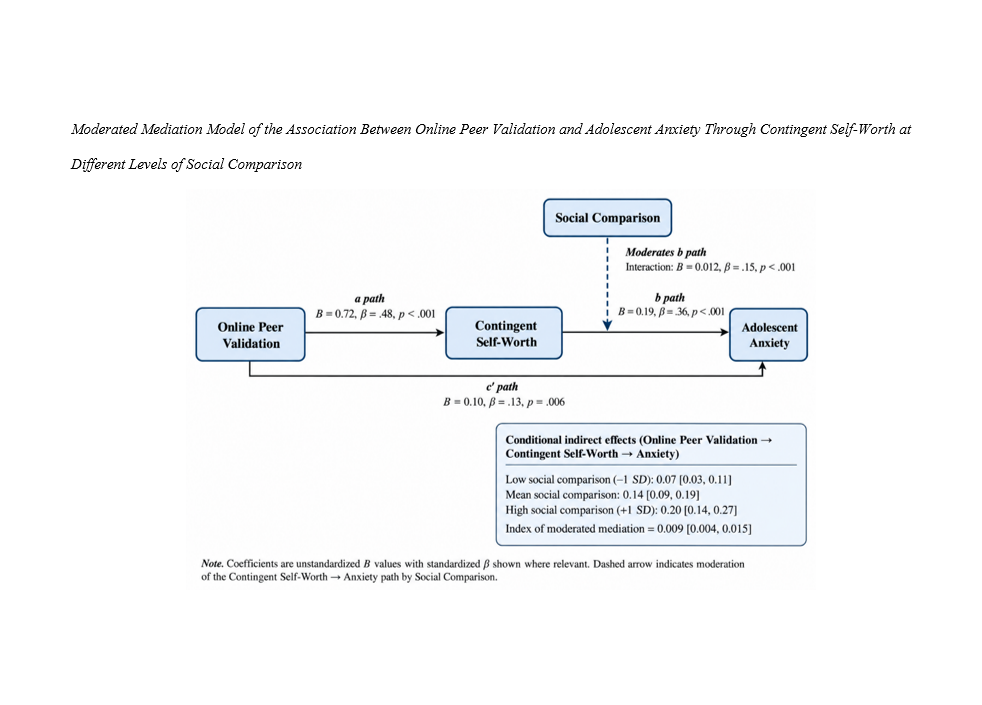
Objective: This study aimed to test whether contingent self-worth mediates the association between online peer validation and adolescent anxiety and whether social comparison moderates the relationship between contingent self-worth and anxiety.
Methods and Materials: A quantitative cross-sectional correlational study was conducted with 428 adolescents aged 13–18 years enrolled in seven public secondary schools in Ontario and British Columbia, Canada. Participants completed measures of online peer validation, contingent self-worth, social comparison orientation, and anxiety, together with a demographic questionnaire. Online peer validation was assessed using an eight-item scale developed for the study, contingent self-worth was measured using externally oriented dimensions of the Contingencies of Self-Worth Scale, social comparison was assessed using the Iowa-Netherlands Comparison Orientation Measure, and anxiety was measured using the Generalized Anxiety Disorder-7 questionnaire. Data were analyzed using Pearson correlations, multiple regression, and second-stage moderated mediation analysis with 5,000 bootstrap resamples. Age, gender, and average daily social-media use were examined as covariates.
Findings: Online peer validation significantly predicted contingent self-worth, B = 0.72, SE = 0.06, β = .48, p < .001. In the anxiety model, online peer validation remained significant, B = 0.10, SE = 0.04, β = .13, p = .006, while contingent self-worth, B = 0.19, SE = 0.02, β = .36, p < .001, and social comparison, B = 0.17, SE = 0.03, β = .27, p < .001, were also significant predictors. The contingent self-worth × social comparison interaction was significant, B = 0.012, SE = 0.003, β = .15, p < .001. Conditional indirect effects increased from 0.07 at low social comparison to 0.14 at the mean and 0.20 at high social comparison. The index of moderated mediation was 0.009, 95% bootstrap CI [0.004, 0.015].
Conclusion: Online peer validation was associated with greater adolescent anxiety partly through contingent self-worth, and this indirect relationship was substantially stronger among adolescents with higher social comparison orientation, highlighting the importance of externally based self-evaluation and comparison processes in understanding digital-context anxiety.
Downloads
References
Agyapong, B., Shalaby, R., Eboreime, E., Hay, K., Pattison, R., Korthuis, M., & Agyapong, V. I. O. (2026). Prevalence and Predictors of PTSD and Low Resilience Symptoms Among Subscribers of the MoreGoodDays Supportive Text Messaging Program: A Cross-Sectional Study. PLoS One, 21(1), e0339662. https://doi.org/10.1371/journal.pone.0339662
Amos, P. M., Ntumi, S., & Amezah, E. O. (2025). Behind the Bet: An Assessment-Informed Counseling Model for Predicting and Addressing Problematic Betting Behavior Among Adolescents in Ghana. https://doi.org/10.21203/rs.3.rs-6645748/v1
Barbieri, V., Wiedermann, C. J., Kaman, A., Erhart, M., Piccoliori, G., Plagg, B., Mahlknecht, A., Ausserhofer, D., Engl, A., & Ravens‐Sieberer, U. (2022). Quality of Life and Mental Health in Children and Adolescents After the First Year of the COVID-19 Pandemic: A Large Population-Based Survey in South Tyrol, Italy. International journal of environmental research and public health, 19(9), 5220. https://doi.org/10.3390/ijerph19095220
Cañas, E., Martínez-Monteagudo, M. C., Delgado, B., Rubio, E., & Aparisi, D. (2026). Relationship Between Cyberbullying and Social Anxiety, School Refusal, and Academic Goals in Adolescents. Cyberpsychology Behavior and Social Networking, 29(10), 723-733. https://doi.org/10.1177/21522715261484676
Çetin, Z., & Ata, S. (2022). Covid-19 Pandemic: A Qualitative Study on Adolescents’ Stress, Anxiety, and Family Communication. https://doi.org/10.21203/rs.3.rs-1313696/v1
Cochran, G., Cohen, Z. P., Paulus, M. P., Tsuchiyagaito, A., & Kirlić, N. (2023). Sustained Increase in Depression and Anxiety Among Psychiatrically Healthy Adolescents During Late Stage COVID-19 Pandemic. Frontiers in Psychiatry, 14. https://doi.org/10.3389/fpsyt.2023.1137842
Geckalan, D. (2026). Psychometric Evaluation of the Turkish Adolescent Version of the Multidimensional Digital Stress Scale: A Cross-Sectional Validation Study. https://doi.org/10.21203/rs.3.rs-10827775/v1
Gorfinkel, L., Snell, G., Long, D., Casal, M. d., Wu, J., Schonert‐Reichl, K. A., Guhn, M., & Samji, H. (2023). Access to Mental Health Support, Unmet Need and Preferences Among Adolescents During the First Year of the COVID-19 Pandemic. Health Promotion and Chronic Disease Prevention in Canada, 43(4), 182-190. https://doi.org/10.24095/hpcdp.43.4.03
Hensler, I. I., & Emmott, E. H. (2025). Performance of Femininity as the Potential Determinant of Lower Well-Being Among Adolescent Girls in London, UK: An Exploratory Discourse Analysis. Qualitative Health Research, 36(7), 658-668. https://doi.org/10.1177/10497323251324385
Hui, y., Huang, J., Xie, Z., & Wang, Y.-X. (2026). The Longitudinal Association Between Peer Victimization and Adolescent Depression: A Moderated Mediation Model. https://doi.org/10.21203/rs.3.rs-8615948/v1
Jones, A., Gandhi, E., O’Gradey‐Lee, M., Francis, D., Robidoux, S., McArthur, G., & Hudson, J. L. (2025). The Validity and Reliability of the Reading Anxiety Test (RAT) for Children and Adolescents. Assessment, 33(3), 483-496. https://doi.org/10.1177/10731911251327480
Kornfield, R., Popowski, S. A., Tack, E., Herrera, M., Nguyen, T., Knapp, A. A., Mohr, D. C., & Meyerhoff, J. (2024). Designing Digital Mental Health Interventions to Meet the Needs of Older Adolescents: Qualitative Interview and Group Discussion Study (Preprint). https://doi.org/10.2196/preprints.68950
Kostyrka‐Allchorne, K., Stoilova, M., Bourgaize, J., Rahali, M., Livingstone, S., & Sonuga-Barke, E. J. S. (2022). Review: Digital Experiences and Their Impact on the Lives of Adolescents With Pre‐existing Anxiety, Depression, Eating and Nonsuicidal Self‐injury Conditions – A Systematic Review. Child and Adolescent Mental Health, 28(1), 22-32. https://doi.org/10.1111/camh.12619
Mackenzie, E., McMaugh, A. L., Bergen, P. V., & Parada, R. H. (2023). Online Support Seeking, Co-Rumination, and Mental Health in Adolescent Girls. Frontiers in Psychiatry, 14. https://doi.org/10.3389/fpsyt.2023.1040636
Marano, G., Lisci, F. M., Rossi, S., Marzo, E. M., Boggio, G., Brisi, C., Traversi, G., Mazza, O., Pola, R., Gaetani, E., & Mazza, M. (2025). Connected but at Risk: Social Media Exposure and Psychiatric and Psychological Outcomes in Youth. Children, 12(10), 1322. https://doi.org/10.3390/children12101322
Mo, J., Roorda, D. L., Ark, L. A. v. d., & Castro, B. O. d. (2024). Is Mistrust in Early Adolescence Referent-Specific? Looking at the Validity of Different Mistrust Referents in Sixth Graders. The Journal of Early Adolescence, 45(6), 724-745. https://doi.org/10.1177/02724316241273344
Mohedo, J. C., Murillo-Llorente, M. T., Pérez-Bermejo, M., Legidos‐Garcia, M. E., & Martínez-Peris, M. (2026). Study of the Relationship Between Cyberbullying and Mental Health in Adolescents—A Systematic Review. Children, 13(3), 367. https://doi.org/10.3390/children13030367
Murray, A. L., Speyer, L. G., Thye, M., Stewart, T. M., Obsuth, I., Kane, J., Devaney, J., Rohde, L. A., Ushakova, A., & Rhodes, S. (2023). Illuminating the Daily Life Experiences of Adolescents With and Without ADHD: Protocol for an Ecological Momentary Assessment Study. https://doi.org/10.31234/osf.io/d28u3
Nagel, A., & Kruse, F. (2026). Measuring Digital Stress in Children: Construct Validity, Model Comparisons, and Measurement Invariance of a Multidimensional Scale (DSS-CH). Children, 13(3), 405. https://doi.org/10.3390/children13030405
Németh, L., & Bernáth, L. (2022). The Mediating Role of Global and Contingent Self-Esteem in the Association Between Emerging Adults’ Perceptions of Family Cohesion and Test Anxiety. Journal of Adult Development, 29(3), 192-204. https://doi.org/10.1007/s10804-022-09396-6
Ngo, T. T. A., Nguyen, N. T. A., La, U. N., Truong, D. N., & Nguyen, H. Q. B. (2024). Impacts of Social Media Experiences on Academically Related Peer Influence and Fear of Missing Out of Secondary and High School Students. International Journal of Engineering Pedagogy (Ijep), 14(2), 112-129. https://doi.org/10.3991/ijep.v14i2.43567
Niu, Y., Li, Z., Pettit, J. W., Buzzell, G. A., & Zhao, J. (2023). Context and Domain Matter: The Error-Related Negativity in Peer Presence Predicts Fear of Negative Evaluation, Not Global Social Anxiety, in Adolescents. Psychological medicine, 53(14), 6899-6909. https://doi.org/10.1017/s0033291723000466
Philip, A. J. v. d. G., Roey, V. L. v., Ombashi, S., Mathijssen, I. M. J., Aebele, B. M. v. d. M., & Versnel, S. L. (2024). Normative CLEFT-Q Data From the General Dutch Population. Journal of Craniofacial Surgery, 36(3), 907-911. https://doi.org/10.1097/scs.0000000000010882
Prochnow, T., Senthil, R., Patterson, M. S., Blake, J. J., & Massey, P. M. (2025). Virtual Bonds; Real Emotions: Systematic Review Exploring Online Social Connections and Adolescent Mental Health. Cyberpsychology Behavior and Social Networking, 28(10), 658-671. https://doi.org/10.1177/21522715251377377
Purificacion, A. J. B., & Vallespin, M. R. (2024). Understanding the Multifaceted Impacts of Social Media Addiction on Minors: A Comprehensive Analysis of Psychological, Behavioral, and Physiological Dimensions. International Journal of Current Science Research and Review, 07(05). https://doi.org/10.47191/ijcsrr/v7-i5-20
Schacter, H. L. (2022). Peer Victimization, Schooling Format, and Adolescent Internalizing Symptoms During the COVID-19 Pandemic: Between- And Within-Person Associations Across Ninth Grade. Development and Psychopathology, 35(2), 823-837. https://doi.org/10.1017/s0954579422000074
Schacter, H. L., Marusak, H. A., Gowatch, L., & Jovanović, T. (2025). Daily Associations Between Peer Victimization and Anxious Affect Among Adolescents: The Role of Social Threat Sensitivity. Development and Psychopathology, 38(1), 431-440. https://doi.org/10.1017/s0954579425100394
Silk, J. S., Scott, L. N., Hutchinson, E., Lu, C., Sequeira, S., McKone, K. M., Quyen, B., & Ladouceur, C. D. (2021). Storm Clouds and Silver Linings: Day-to-Day Life in COVID-19 Lockdown and Emotional Health in Adolescent Girls. Journal of Pediatric Psychology, 47(1), 37-48. https://doi.org/10.1093/jpepsy/jsab107
Skinner, A. T., Ondrušková, T., Klotz, E., Çiftçi, L., Jones, S., & Hoyle, R. H. (2023). Adolescents’ Perceived Changes in Internalizing Symptoms During the COVID-19 Pandemic: The Role of Father Internalizing Symptoms and Parent Support in Germany and Slovakia. Youth, 3(4), 1194-1211. https://doi.org/10.3390/youth3040076
Wang, J., Zhang, Y., Borhi, M., Wei, W., Li, H., Hémono, R., Giorgio, J., Su, J., Ashe, K., Zheng, Z., Deardorff, J., Ji, F., & Zhang, X. (2026). Where Do Adolescent Digital Twins Succeed and Fail? A Multi-Layer Validation of Survey-Anchored Generative Agents With an LLM Backbone. https://doi.org/10.21203/rs.3.rs-8823969/v1
Wolstencroft, J., Kerry, E., Denyer, H., Watkins, A., Mandy, W., & Skuse, D. (2021). New Approaches to Social Skills Training: Blended Group Interventions for Girls With Social Communication Difficulties. Autism Research, 14(5), 1061-1072. https://doi.org/10.1002/aur.2495
Yang, C. c., Hunhoff, P., Lee, Y., & Abrell, J. (2025). Social Media Activities With Different Content Characteristics and Adolescent Mental Health: Cross-Sectional Survey Study. Journal of medical Internet research, 27, e73098. https://doi.org/10.2196/73098
Zhang, W., Duan, R., Li, H., Fang, Y., Zhao, W., Wan, F., & Fan, J. (2026). A Developmental Perspective on Appearance-Related Social Media Use, Body Dissatisfaction, and Competitive Anxiety Among Chinese Adolescent Athletes: A Three-Wave Longitudinal Study. Frontiers in psychology, 17. https://doi.org/10.3389/fpsyg.2026.1805798
Downloads
Additional Files
Publication Timeline
- Submitted
- Revised
- Accepted