Predicting Digital Emotional Dependence From Loneliness, Attachment Anxiety, and Perceived Social Support Among Adolescents: A Hierarchical Multiple Regression Study
DOI:
https://doi.org/10.61838/kman.jayps.6312Keywords:
digital emotional dependence, loneliness, attachment anxiety, perceived social support, adolescents, hierarchical multiple regressionAbstract
Objective: This study aimed to determine whether loneliness, attachment anxiety, and perceived social support predict digital emotional dependence among Canadian adolescents beyond the effects of age, gender, and daily social media use.
Methods and Materials: A cross-sectional descriptive-correlational design was conducted with 412 adolescents aged 13–18 years enrolled in secondary schools in Canada. Digital emotional dependence was assessed using the Social Integration and Emotional Connection dimension of the Social Media Use Integration Scale, loneliness was measured with the UCLA Loneliness Scale Version 3, attachment anxiety was assessed using the anxiety dimension of the Experiences in Close Relationships–Relationship Structures Questionnaire, and perceived social support was measured with the Multidimensional Scale of Perceived Social Support. Data were analyzed in SPSS 29 using Pearson correlations and hierarchical multiple regression. Age, gender, and daily social media use were entered in the first block, followed sequentially by loneliness, attachment anxiety, and perceived social support.
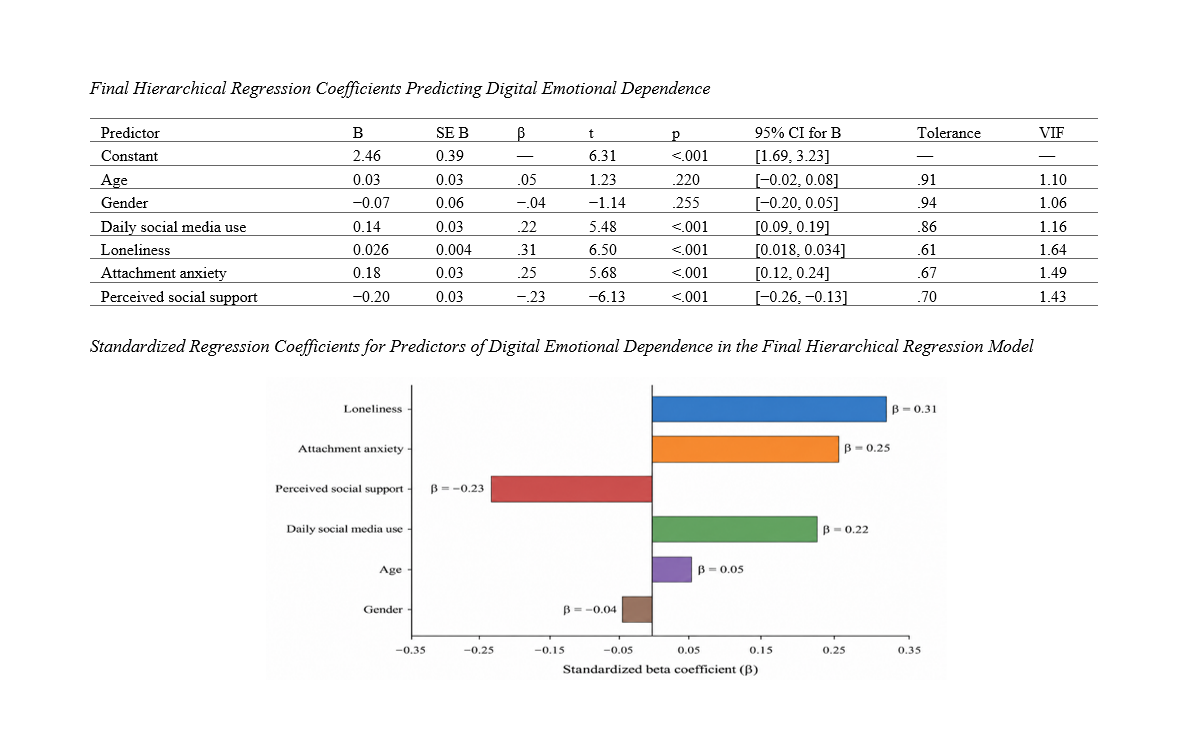
Findings: The final hierarchical regression model was significant, F(6, 405) = 72.54, p < .001, and explained 51.8% of the variance in digital emotional dependence, R² = .518, adjusted R² = .511. Loneliness produced the largest incremental contribution, ΔR² = .225, p < .001, followed by attachment anxiety, ΔR² = .080, p < .001, and perceived social support, ΔR² = .046, p < .001. In the final model, loneliness was the strongest positive predictor, β = .31, p < .001, followed by attachment anxiety, β = .25, p < .001, and daily social media use, β = .22, p < .001. Perceived social support was a significant negative predictor, β = −.23, p < .001. Age and gender were not significant predictors.
Conclusion: Digital emotional dependence among adolescents appears to be shaped more strongly by interpersonal and emotional factors than by demographic characteristics alone, with loneliness and attachment anxiety increasing vulnerability and perceived social support functioning as a protective factor.
Downloads
References
Acharya, S., Adhikari, L., Khadka, S., Paudel, S., & Kaphle, M. (2023). Internet Addiction and Its Associated Factors Among Undergraduate Students in Kathmandu, Nepal. Journal of Addiction, 2023, 1-9. https://doi.org/10.1155/2023/8782527
Bilgin, O., İnce, M., & Çolakoğlu, Ö. M. (2026). Is Loneliness a Bridge to Digital Escape? A Path Analysis on Psychological Symptoms and Internet Addiction. Frontiers in psychology, 17. https://doi.org/10.3389/fpsyg.2026.1816905
Bottaro, R., & Faraci, P. (2022). The Use of Social Networking Sites and Its Impact on Adolescents’ Emotional Well-Being: A Scoping Review. Current Addiction Reports, 9(4), 518-539. https://doi.org/10.1007/s40429-022-00445-4
Büyükşakar, S., & Çeli̇k, E. (2024). Attachment Styles and Loneliness as Predictors of Phubbing Amongst University Students. Sakarya University Journal of Education, 14(1), 18-32. https://doi.org/10.19126/suje.1255291
Chang, R. S., Lee, M., Im, J. J., Choi, K. H., Kim, J., Chey, J., Shin, S.-H., & Ahn, W. Y. (2023). Biopsychosocial Factors of Gaming Disorder: A Systematic Review Employing Screening Tools With Well-Defined Psychometric Properties. Frontiers in Psychiatry, 14. https://doi.org/10.3389/fpsyt.2023.1200230
Ciacchini, R., Orrù, G., Cucurnia, E., Sabbatini, S., Scafuto, F., Lazzarelli, A., Miccoli, M., Gemignani, A., & Conversano, C. (2023). Social Media in Adolescents: A Retrospective Correlational Study on Addiction. Children, 10(2), 278. https://doi.org/10.3390/children10020278
Dey, B. K., & Roy, K. (2025). The Mediating Role of Loneliness in the Relationship Between Insecurity Feelings and Internet Addiction. International Journal of Social Psychiatry, 72(4), 851-863. https://doi.org/10.1177/00207640251383188
Dixon, D., Sharp, C. A., Hughes, K., & Hughes, C. (2023). Parental Technoference and Adolescents’ Mental Health and Deviant Behaviour: A Scoping Review. https://doi.org/10.21203/rs.3.rs-2700352/v1
Dong, R., Yuan, D., Xue, W., Cai, J., Ai, Z., & Zhou, S. (2025). Exploring the Relationship Between Social Media Dependence and Internet Addiction Among College Students From a Bibliometric Perspective. Frontiers in psychology, 16. https://doi.org/10.3389/fpsyg.2025.1463671
Fioravanti, G., Benucci, S. B., & Ghinassi, S. (2025). Psychological Risk Factors for Problematic Social Network Use: An Overview of Systematic Reviews and Meta-Analyses. Addictive Behaviors Reports, 21, 100600. https://doi.org/10.1016/j.abrep.2025.100600
Khatcherian, E., Zullino, D. F., Leo, D. D., & Achab, S. (2022). Feelings of Loneliness: Understanding the Risk of Suicidal Ideation in Adolescents With Internet Addiction. A Theoretical Model to Answer to a Systematic Literature Review, Without Results. International journal of environmental research and public health, 19(4), 2012. https://doi.org/10.3390/ijerph19042012
Kim, E. L., Gentile, D. A., Choo, H., Liau, A. K., Li, D., & Khoo, A. (2023). Differential Predictors of Problematic Internet Use and Problematic Video Gaming Among School Children: A 2-Year Longitudinal Study. Technology Mind and Behavior, 4(2), 195-207. https://doi.org/10.1037/tmb0000109
Kusnadi, S. P. A. P., & Kaloeti, M. P. D. p. D. V. S. (2022). Related Factors of Internet Addiction on Adolescents During COVID-19 Pandemic : Systematic Literature Review. Journal of Educational Health and Community Psychology, 11(4), 744. https://doi.org/10.12928/jehcp.v11i4.24674
Li, H., Peng, K., Wu, Y., Wang, L., & Luo, Z. (2025). Investigating Parental Factors That Lead to Adolescent Internet Gaming Addiction (IGA). PLoS One, 20(4), e0322117. https://doi.org/10.1371/journal.pone.0322117
Li, X. (2026). Machine Learning‐based Risk Warning for Adolescents' Prosocial Behavior. Applied Psychology Health and Well-Being, 18(3). https://doi.org/10.1111/aphw.70156
Liu, X., Liu, J., Flores, D. D., & McDonald, C. C. (2024). Family Factors Related to Adolescent Screen Media Use and Mental Health Outcomes: A Systematic Review and Recommendation for Practices. Journal of adolescence, 96(7), 1401-1427. https://doi.org/10.1002/jad.12367
Luo, Z., & Li, H. (2025). The Double-Edged Perfectionist Parenting: An Examination of Its Impact on Adolescent Internet Gaming Addiction (IGA). BMC psychology, 13(1). https://doi.org/10.1186/s40359-025-03366-9
Munusamy, K. A. P., & Ghazali, A. H. A. (2022). Behaviour Factors and Smartphone Addiction Among Youth in Selected Public Universities in Klang Valley. International Journal of Academic Research in Business and Social Sciences, 12(7). https://doi.org/10.6007/ijarbss/v12-i7/14426
Niazi, A., Gul, M., & Niazi, Y. (2024). The Association Between Loneliness, Social Anxiety, and Gaming Addiction in Male University Students. Bulletin of Business and Economics (BBE), 13(1). https://doi.org/10.61506/01.00304
Nibal, S. (2023). Loneliness as a Predictor of Internet Addiction Among Adolescentes From Arab Society in Israel. Edmetic, 12(2), 2. https://doi.org/10.21071/edmetic.v12i2.15872
Qi, X., He, J., Wang, Q., Liu, S., Zhang, L., Zhao, J., Ma, D., & Zhao, D. (2026). A Systematic Review of Internet Addiction in Hospitalized Adolescents: Proposing a Hospital-Adapted Moderated Dual Mediation Model of Emotional Dysregulation and Social Compensation. Frontiers in Psychiatry, 17. https://doi.org/10.3389/fpsyt.2026.1830013
Shi, X., & Wang, R. (2023). School Victimization and Internet Addiction Among Chinese Adolescents: The Mediating Roles of Life Satisfaction and Loneliness. Frontiers in psychology, 13. https://doi.org/10.3389/fpsyg.2022.1059486
Smith, A., & Alheneidi, H. (2023). The Internet and Loneliness. The Ama Journal of Ethic, 25(11), E833-838. https://doi.org/10.1001/amajethics.2023.833
Suaaree, M. A. H., Ayob, N. H., Ramli, M. S., Musa, N. D., & Roslan, Z. N. (2022). The Influence of Self-Esteem, Perceived Stress and Perceived on Internet Addiction During Pandemic Covid-19. International Journal of Academic Research in Business and Social Sciences, 12(5). https://doi.org/10.6007/ijarbss/v12-i5/13123
Wang, J., Zhang, W., Wang, T., Yao, Y., Lin, H., Yang, X., Song, P., Chen, X., & Fu, C. (2024). Loneliness During the Last Phase of the COVID-19 Pandemic in China: Trajectories, Predictors, and Impact on Adolescent Mental Health. https://doi.org/10.21203/rs.3.rs-4210447/v1
Weinstein, A. (2023). Problematic Social Networking Site Use-Effects on Mental Health and the Brain. Frontiers in Psychiatry, 13. https://doi.org/10.3389/fpsyt.2022.1106004
Wu, D., Liu, M., Li, D., & Yin, H. (2024). The Longitudinal Relationship Between Loneliness and Both Social Anxiety and Mobile Phone Addiction Among Rural Left‐behind Children: A Cross‐lagged Panel Analysis. Journal of adolescence, 96(5), 969-982. https://doi.org/10.1002/jad.12309
Zhao, S., Lan, J., & Zong, R. (2026). Short-Form Video Addiction and Loneliness Among College Students: The Longitudinal Mediating Role of Social Anxiety in a Three-Wave Cross-Lagged Panel Study. https://doi.org/10.21203/rs.3.rs-9685271/v1
Downloads
Additional Files
Publication Timeline
- Submitted
- Revised
- Accepted