Developing an Explanatory Model of Cyberostracism and Psychological Adjustment Among Adolescents
DOI:
https://doi.org/10.61838/kman.jayps.6357Keywords:
cyberostracism, psychological adjustmentpsychological adjustment, adolescents, social exclusion, being ignored, structural equation modeling, MalaysiaAbstract
Objective: This study aimed to develop and empirically test an explanatory model of cyberostracism and psychological adjustment among Malaysian adolescents, with emphasis on the effects of direct exclusion, indirect exclusion, and being ignored.
Methods and Materials: This quantitative cross-sectional correlational study was conducted among 486 adolescents aged 13–17 years who were recruited from public secondary schools in Kuala Lumpur, Selangor, Johor, and Penang, Malaysia, using multistage cluster sampling. Data were collected using a demographic information form, the Cyberostracism Scale, and the Brief Adjustment Scale–6. Cyberostracism was conceptualized as a higher-order construct comprising direct exclusion, indirect exclusion, and being ignored, whereas psychological adjustment was modeled as a latent outcome construct. Data were analyzed using IBM SPSS Statistics and AMOS. Confirmatory factor analysis was used to assess the measurement model, and structural equation modeling was employed to test the explanatory relationships. Model adequacy was evaluated using χ²/df, CFI, TLI, RMSEA, and SRMR.
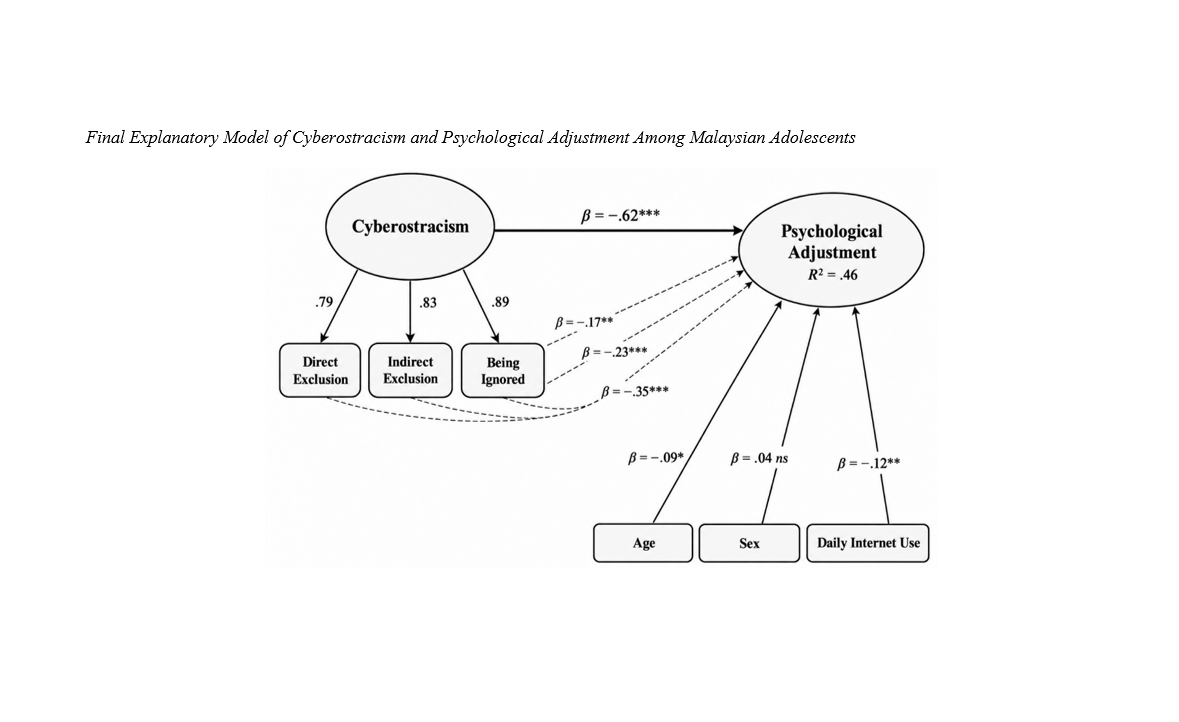
Findings: The measurement model demonstrated acceptable fit, χ²(189) = 421.36, χ²/df = 2.23, CFI = .953, TLI = .944, RMSEA = .050, and SRMR = .043. Cyberostracism significantly and negatively predicted psychological adjustment, β = −.62, p < .001. Among its dimensions, being ignored had the strongest unique negative effect on psychological adjustment, β = −.35, p < .001, followed by indirect exclusion, β = −.23, p < .001, and direct exclusion, β = −.17, p = .003. Age, β = −.09, p = .020, and daily Internet use, β = −.12, p = .006, were also significant negative predictors, whereas sex was not significant, β = .04, p = .318. The final structural model showed acceptable fit, χ²(201) = 447.81, χ²/df = 2.23, CFI = .948, TLI = .939, RMSEA = .050, and SRMR = .047, and explained 46% of the variance in psychological adjustment.
Conclusion: Cyberostracism represents a significant multidimensional digital interpersonal stressor associated with poorer psychological adjustment among Malaysian adolescents, with being ignored emerging as the most influential dimension; therefore, prevention and intervention efforts should address subtle as well as explicit forms of online exclusion.
Downloads
References
Afrashteh, M. Y., & Hasani, F. (2022). Mindfulness and Psychological Well-Being in Adolescents: The Mediating Role of Self-Compassion, Emotional Dysregulation and Cognitive Flexibility. Borderline personality disorder and emotion dysregulation, 9(1). https://doi.org/10.1186/s40479-022-00192-y
Akçay, A., & Kayiş, A. R. (2023). Cyberostracism and Knowledge Sharing: The Mediating Role of Social Anxiety in E-Learning Environments. Journal of Educational Technology and Online Learning, 6(1), 33-47. https://doi.org/10.31681/jetol.1097719
Alkatiri, S., Devy, S. R., & Ubaidillah, N. I. (2024). Parental Interactions and Cyberbullying on Psychological Impact of High School Adolescents in Sumbersari District, Jember. Jurnal Berkala Epidemiologi, 12(1), 26-33. https://doi.org/10.20473/jbe.v12i12024.26-33
Bae, S. M. (2024). Characteristics and Treatment of Cyberviolence Trauma in Children and Adolescents. Journal of Korean Academy of Child and Adolescent Psychiatry, 35(3), 169-174. https://doi.org/10.5765/jkacap.240005
Bosacki, S., Talwar, V., & Lecce, S. (2023). Critical Review: Secondary School Climate and Adolescents’ Emotional Well-Being. Adolescents, 3(3), 508-523. https://doi.org/10.3390/adolescents3030036
Boykina, E. E. (2023). Social Ostracism and Minors’ Antisocial Behavior. Psychology and Law, 13(1), 119-134. https://doi.org/10.17759/psylaw.2023130109
Bruneel, S., Sjöblom, J., Lagerström, M., & Alanko, K. (2025). Exploring the Mediating Role of Social Media and Gaming in the Relationship Between Adolescents’ Feelings of Loneliness, Ostracism and Internalizing and Externalizing Symptoms. https://doi.org/10.21203/rs.3.rs-7944252/v1
Chen, J. K., & Chan, H. C. (2024). International and Interdisciplinary Perspectives on School Violence and Bullying, Cyberbullying, and Cyber Deviance: An Introductory Essay. Behavioral Sciences & the Law, 43(2), 169-172. https://doi.org/10.1002/bsl.2704
Cui, X. (2024). The Association Between Adolescents' Exposure to Violent Content and Bullying Behaviour. International Journal of Education and Humanities, 17(2), 57-59. https://doi.org/10.54097/pr16er83
Ding, H., Zhao, C., Huang, F., Zhu, L., Wei, H., & Lei, L. (2024). Cyber-Ostracism, Depression, and Adolescents’ Cyberbullying Perpetration: A Cross-Lagged Panel Analysis. Youth & Society, 57(2), 351-373. https://doi.org/10.1177/0044118x241301062
Ding, H., Zhu, L., Hua, W., Geng, J., Huang, F., & Lei, L. (2022). The Relationship Between Cyber-Ostracism and Adolescents’ Non-Suicidal Self-Injury: Mediating Roles of Depression and Experiential Avoidance. International journal of environmental research and public health, 19(19), 12236. https://doi.org/10.3390/ijerph191912236
Engelskirchen, L., Asbrand, J., & Tuschen‐Caffier, B. (2025). Investigating Social Exclusion, Affect and Emotion Regulation in Young People Using the Ostracism Online Paradigm. Scientific reports, 15(1). https://doi.org/10.1038/s41598-025-09565-z
Huang, Y., Gan, X., Jin, X., Rao, S., He, Z., & Wei, Z. (2023). The Relationship Between the Dark Triad and Bullying Among Chinese Adolescents: The Role of Social Exclusion and Sense of Control. Frontiers in psychology, 14. https://doi.org/10.3389/fpsyg.2023.1173860
Jun, W. (2020). A Study on the Cause Analysis of Cyberbullying in Korean Adolescents. International journal of environmental research and public health, 17(13), 4648. https://doi.org/10.3390/ijerph17134648
Li, X., Mu, W., Wang, Y., Xie, P., & Liu, T. (2022). Different Roles of Rumination and Mindfulness Among Cyber-Ostracized Adolescents’ Psychological Well-Being. International journal of environmental research and public health, 19(3), 1222. https://doi.org/10.3390/ijerph19031222
Lin, S., Longobardi, C., Fabris, M. A., & Settanni, M. (2024). Being Kicked Out of a WhatsApp Group: Frequency and Association With Adolescents’ Psychosocial Well-Being and School Achievement. Journal of Social and Personal Relationships, 42(1), 318-336. https://doi.org/10.1177/02654075241298148
Lin, S. H. (2022). The Positive Impact of School Bullying Experience Under Social Support——Pro-Social Behavior. 2474-2480. https://doi.org/10.2991/978-2-494069-31-2_290
Lutz, S., & Schneider, F. M. (2020). Is Receiving Dislikes in Social Media Still Better Than Being Ignored? The Effects of Ostracism and Rejection on Need Threat and Coping Responses Online. https://doi.org/10.31234/osf.io/328j4
Mohammadi, M., & Ghanbari, N. (2026). You Are Doubly Excluded: The Interplay of Cyberostracism and Perceived Parental Phubbing in Predicting Problematic Smartphone Use. Addictive Behaviors Reports, 24, 100719. https://doi.org/10.1016/j.abrep.2026.100719
Munini, S., Paglieri, F., Sapienza, A., Negri, M., & Marini, M. (2024). Picking Your Friends Is a Risky Business: Psychological Impacts of Social Exclusion and Teammates Selection in a Cyberball Game With Middle School Students. Youth & Society, 57(8), 1415-1441. https://doi.org/10.1177/0044118x241309356
Navarro, R., Rubio, E. L., Jiménez, S. Y., & Víllora, B. (2020). Psychological Correlates of Ghosting and Breadcrumbing Experiences: A Preliminary Study Among Adults. International journal of environmental research and public health, 17(3), 1116. https://doi.org/10.3390/ijerph17031116
Nesin, S. M., Burghate, K. N., & Anthony, M. (2025). Neurobiology of Emotional Regulation in Cyberbullying Victims. Frontiers in psychology, 16. https://doi.org/10.3389/fpsyg.2025.1473807
Oktar, D., Ünsal, A., Arslantaş, D., Mutlu, A., & Muz, F. N. Ö. (2021). Cyberostracism and Self-Esteem: A Study on Medical Faculty Students in Western Turkey. Osmangazi̇ Journal of Medicine. https://doi.org/10.20515/otd.992587
Partino, P., Chirzin, M., & Suud, F. M. (2023). Bibliometric Analysis: Research on Bullying and Relational Bullying. E3s Web of Conferences, 440, 03016. https://doi.org/10.1051/e3sconf/202344003016
Sambath, I., Sukumar, M. B. A., Chinnaiyan, S., & Kosalram, K. B. (2026). Association Between Ostracism and Digital Addiction: A Systematic Review and Meta‐analysis. International Journal of Social Welfare, 35(3). https://doi.org/10.1111/ijsw.70070
Sarfraz, M., Khawaja, K. F., Ivaşcu, L., & Khalil, M. (2023). An Empirical Study on Cyber Ostracism and Students' Discontinuous Usage Intention of Social Networking Sites During the COVID-19 Pandemic: A Mediated and Moderated Model. Studies in Educational Evaluation, 76, 101235. https://doi.org/10.1016/j.stueduc.2023.101235
Shi, C., Sun, P., & Shi, J. (2025). The Effect of Cyber-Ostracism on Social Anxiety Among Undergraduates: The Mediating Effects of Rejection Sensitivity and Rumination. Behavioral Sciences, 15(1), 37. https://doi.org/10.3390/bs15010037
Shi, L., Li, H., Huang, L., Hou, Y., & Song, L. (2022). Does Cyberostracism Reduce Prosocial Behaviors? The Protective Role of Psychological Resilience. International journal of environmental research and public health, 19(7), 4388. https://doi.org/10.3390/ijerph19074388
Skogen, J. C., Andersen, A. I. O., Finserås, T. R., Ranganath, P., Brunborg, G. S., & Hjetland, G. J. (2023). Commonly Reported Negative Experiences on Social Media Are Associated With Poor Mental Health and Well-Being Among Adolescents: Results From the “LifeOnSoMe”-study. Frontiers in Public Health, 11. https://doi.org/10.3389/fpubh.2023.1192788
Tan, D., Zhang, R., & Yang, L. (2026). How Ostracism in Social Media Drives Aggression to Others and the Self Among Adolescents: The Dual Pathways of Thwarted Belongingness and Perceived Burdensomeness. Aggressive Behavior, 52(3). https://doi.org/10.1002/ab.70068
Urano, Y., Takizawa, R., Ohka, M., & Shimoyama, H. (2020). Cyber Bullying Victimization and Adolescent Mental Health: The Differential Moderating Effects of Intrapersonal and Interpersonal Emotional Competence. Journal of adolescence, 80(1), 182-191. https://doi.org/10.1016/j.adolescence.2020.02.009
Vanherle, R., Trekels, J., Hermans, S., Vranken, P., & Beullens, K. (2023). How It Feels to Be “Left on Read”: Social Surveillance on Snapchat and Young Individuals’ Mental Health. Cyberpsychology Journal of Psychosocial Research on Cyberspace, 17(5). https://doi.org/10.5817/cp2023-5-3
Wang, Z., Cheng, L., Xie, Z., & Jiang, C. (2024). Cyberbullying Victimization and Perpetration: The Influence on Cyberostracism and Youth Anxiety. Behavioral Sciences & the Law, 42(4), 461-473. https://doi.org/10.1002/bsl.2675
Wuryaningsih, E. W., Wahyuni, B., Lusmilasari, L., & Haryanti, F. (2022). Prevention of Bullying Among Adolescents in the Lens of Indonesian Policy and Law: Should Nurses Know? Psychiatry Nursing Journal (Jurnal Keperawatan Jiwa), 4(1). https://doi.org/10.20473/pnj.v4i1.36091
Xing, J., & Kuo, F. (2024). The Effects of Cyber-Ostracism on College Students' Aggressive Behavior: A Moderated Mediation Model. Frontiers in Psychiatry, 15. https://doi.org/10.3389/fpsyt.2024.1393876
Yusainy, C., Putri, I. L., Fadliilah, L. R., Veronica, G. M., Darmawan, I. D. G. N. B., & Wicaksono, W. (2023). Cancelled: Effect of Cyber-Ostracism on the Mental Condition of Instagram Users. Psympathic Jurnal Ilmiah Psikologi, 10(1), 1-10. https://doi.org/10.15575/psy.v10i1.18158
Downloads
Additional Files
Publication Timeline
- Submitted
- Revised
- Accepted