The Relationship Between Attachment Styles and Childhood Trauma and Cyberbullying Among Adolescents
Keywords:
Attachment Styles; Childhood Trauma; Cyberbullying; Cybervictimization; Adolescents; Secondary-School StudentsAbstract
Objective: The present study aimed to investigate the relationship of attachment styles and childhood trauma with cyberbullying among adolescent male secondary-school students in Babol, Iran.
Methods and Materials: This applied study employed a descriptive-correlational design. The statistical population consisted of 4,500 male students enrolled in the second cycle of secondary education in Babol during the 2025–2026 academic year. Based on the Krejcie and Morgan table, 354 students were selected through convenience sampling. Data were collected electronically using the Collins and Read Attachment Scale, the Childhood Trauma Questionnaire developed by Bernstein et al., and the Cyberbullying Questionnaire developed by Antoniadou et al. The questionnaires were administered through the SHAD educational platform. Data were analyzed using descriptive statistics, Pearson’s correlation coefficient, and multiple regression analysis in SPSS version 20, with the significance level set at p < .05.
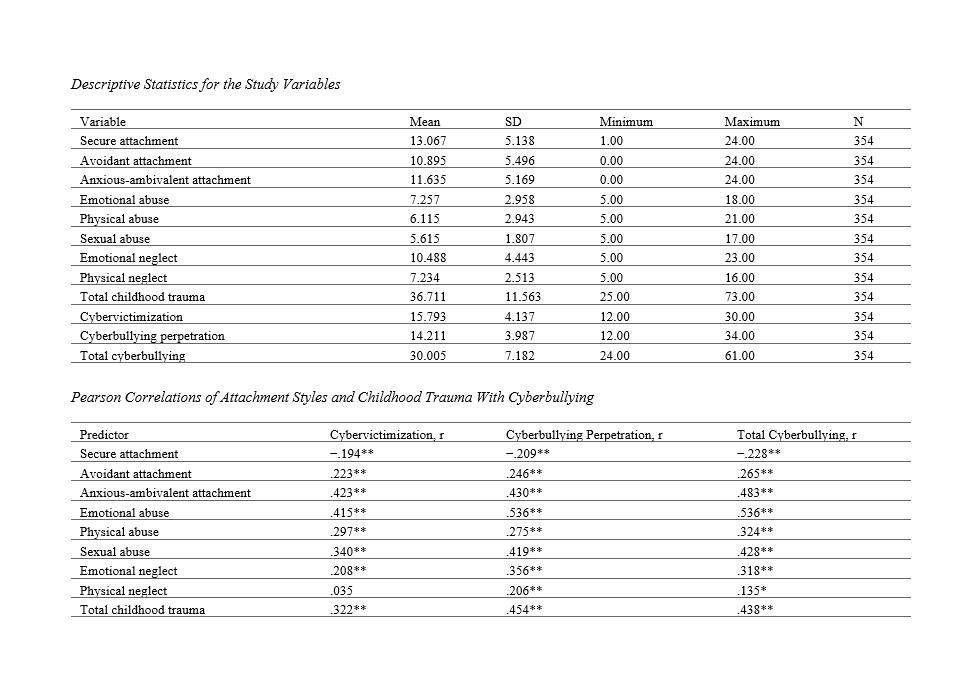
Findings: Secure attachment was negatively correlated with total cyberbullying (r = −.228, p < .01), whereas avoidant attachment (r = .265, p < .01), anxious-ambivalent attachment (r = .483, p < .01), and total childhood trauma (r = .438, p < .01) were positively correlated with cyberbullying. Emotional abuse showed the strongest association among the childhood trauma dimensions with total cyberbullying (r = .536, p < .01). Regression analysis showed that secure attachment significantly and negatively predicted cyberbullying (β = −.090, t = −2.295, p = .020), whereas avoidant attachment (β = .093, t = 2.344, p = .020), anxious-ambivalent attachment (β = .276, t = 6.716, p < .001), and childhood trauma (β = .191, t = 4.577, p < .001) significantly and positively predicted cyberbullying. Among the predictors, anxious-ambivalent attachment had the largest absolute standardized regression coefficient.
Conclusion: These results highlight the importance of relational security and adverse childhood experiences in understanding adolescent cyberbullying and support the development of attachment-informed and trauma-sensitive preventive interventions.
Downloads
References
Abreu, R. L., & Kenny, M. C. (2017). Cyberbullying and LGBTQ Youth: A Systematic Literature Review and Recommendations for Prevention and Intervention. Journal of Child & Adolescent Trauma, 11(1), 81-97. https://doi.org/10.1007/s40653-017-0175-7
Araujo, F. V. d., Lanzarote-Fernández, M. D., Sousa-Gomes, V., & Moreira, D. (2026). Relationship Between Adverse Childhood Experiences, Attachment, and Emotional Regulation: A Review of the Literature. Psychological Trauma Theory Research Practice and Policy. https://doi.org/10.1037/tra0002099
Brochado, S., Soares, S., & Fraga, S. (2017). A Scoping Review on Studies of Cyberbullying Prevalence among Adolescents. Trauma, Violence, & Abuse, 18(5), 523-531. https://doi.org/10.1177/1524838016641668
Cao, G., Wei, X., Liu, J., & Li, X. Y. (2023). The Association Between Childhood Trauma and Adolescent Cyberbullying: Chain Mediating Roles of Emotional Intelligence and Online Social Anxiety. Frontiers in Psychiatry, 14. https://doi.org/10.3389/fpsyt.2023.1184382
Chan, H. C., & Wong, D. S. W. (2017). Coping with cyberbullying victimization: An exploratory study of Chinese adolescents in Hong Kong. International Journal of Law, Crime and Justice, 50, 71-82. https://doi.org/10.1016/j.ijlcj.2017.04.003
Charalampous, K., Demetriou, C., Tricha, L., Ioannou, M., Georgiou, S., Nikiforou, M., & Stavrinides, P. (2018). The effect of parental style on bullying and cyber bullying behaviors and the mediating role of peer attachment relationships: A longitudinal study. J Adolesc, 64, 109-123. https://doi.org/10.1016/j.adolescence.2018.02.003
Duarte, C., Pittman, S., Thorsen, M. M., Cunningham, R. M., & Ranney, M. L. (2018). Correlation of Minority Status, Cyberbullying, and Mental Health: A Cross-Sectional Study of 1031 Adolescents. Journal of Child & Adolescent Trauma, 11(1), 39-48. https://doi.org/10.1007/s40653-018-0201-4
Fang, Y., Fan, C., Cui, J., Zhang, X., & Zhou, T. (2022). Parental attachment and cyberbullying among college students: the mediating role of loneliness and the moderating role of interdependent self. Current Psychology. https://doi.org/10.1007/s12144-022-04046-2
Li, S., Xiaoxian, W., & Nie, Y. (2022). The Relationship Between Parent–Child Attachment, Belief in a Just World, School Climate and Cyberbullying: A Moderated Mediation. International journal of environmental research and public health, 19(10), 6207. https://doi.org/10.3390/ijerph19106207
Ng, E. D., Chua, J. Y. X., & Shorey, S. (2020). The Effectiveness of Educational Interventions on Traditional Bullying and Cyberbullying Among Adolescents: A Systematic Review and Meta-Analysis. Trauma, Violence, & Abuse, 23(1), 132-151. https://doi.org/10.1177/1524838020933867
Topino, E., & Gori, A. (2025). Childhood Neglect and Its Effect on Self-Conception and Attachment in Adulthood: A Structural Equation Model. Psychological Trauma Theory Research Practice and Policy. https://doi.org/10.1037/tra0001921
Yahdi, T. (2025). The Mediating Role of Parenting Styles and Anger Rumination in the Relationship between Childhood Emotional Trauma and Cyberbullying on Social Networks in Adolescents in Rasht Islamic Azad University, Rasht Branch, Faculty of Humanities, Department of Psychology]. Rasht, Iran.
Zhu, Y., Li, W., O’Brien, J. E., & Liu, T. (2021). Parent-Child Attachment Moderates the Associations Between Cyberbullying Victimization and Adolescents’ Health/Mental Health Problems: An Exploration of Cyberbullying Victimization Among Chinese Adolescents. Journal of interpersonal violence, 36(17-18), NP9272-NP9298. https://doi.org/10.1177/0886260519854559
Downloads
Additional Files
Publication Timeline
- Submitted
- Revised
- Accepted