Effectiveness of Mindfulness Training in Reducing Maladaptive Daydreaming and Rumination Among Students With Childhood Trauma
Keywords:
childhood trauma, maladaptive daydreaming, mindfulness, rumination, university studentsAbstract
Objective: The present study aimed to determine the effectiveness of mindfulness training in reducing maladaptive daydreaming and rumination among university students with a history of childhood trauma.
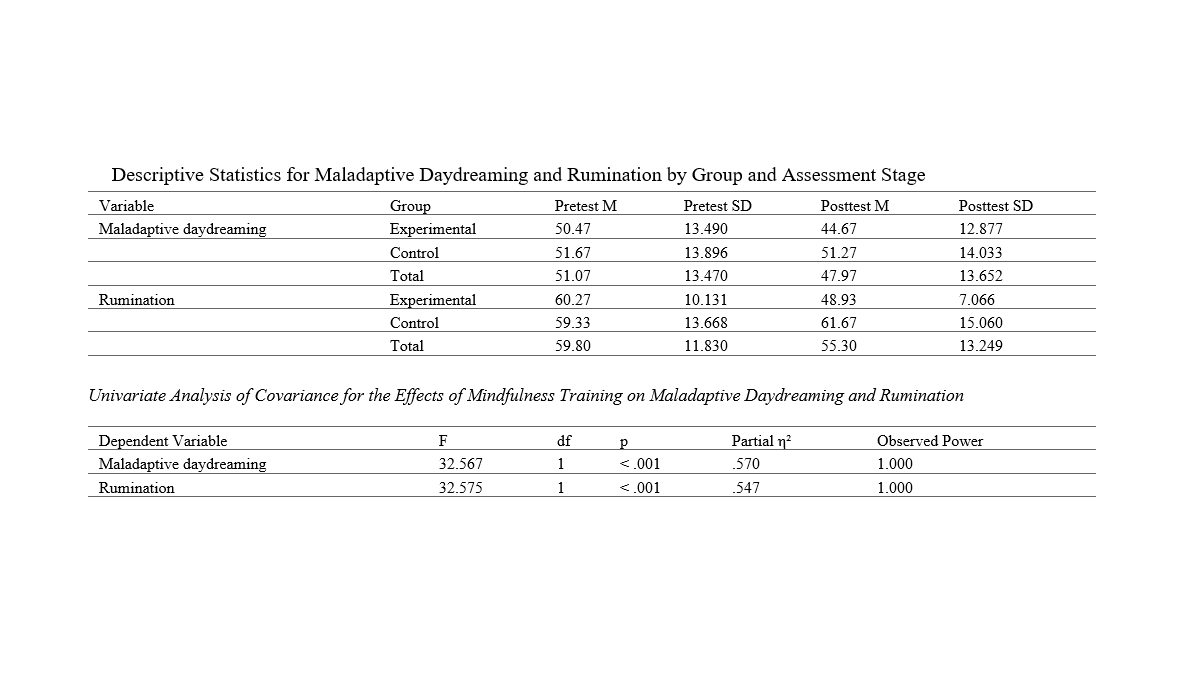
Method and Materials: This study employed a quasi-experimental pretest–posttest design with a control group. The statistical population consisted of all students with a history of childhood trauma enrolled at Islamic Azad University branches in Tehran during the 2023–2024 academic year. Using convenience sampling, 30 eligible participants were selected and randomly assigned to an experimental group (n = 15) and a control group (n = 15). The experimental group received mindfulness training based on the protocol developed by Segal et al. in eight 150-minute sessions, whereas the control group received no intervention. Data were collected at the pretest and posttest stages using the Maladaptive Daydreaming Scale developed by Somer et al. (2016) and the Ruminative Responses Scale developed by Nolen-Hoeksema and Morrow (1991). Data were analyzed using univariate analysis of covariance (ANCOVA) in SPSS, with the significance level set at .05.
Findings: The results of the analysis of covariance indicated that mindfulness training significantly reduced maladaptive daydreaming (p < .001) and rumination (p < .001) in the experimental group compared with the control group.
Conclusion: Mindfulness training, by enhancing moment-to-moment awareness and reducing cognitive engagement with trauma-related thoughts and memories, may constitute an effective intervention for reducing maladaptive daydreaming and rumination among university students with a history of childhood trauma. The application of this approach in university counseling centers and in preventive and therapeutic programs addressing problems associated with childhood trauma is recommended.
Downloads
References
Ahmadi, F., Goudarzi, M., Kazemi Rezaei, A., & Yazdani Mehr, R. (2022). Validity, reliability and factor structure of the 16-item Maladaptive Daydreaming Scale in an Iranian sample. Clinical Psychology, 14(4), 53-63.
Aizik-Reebs, A., Yuval, K., Hadash, Y., Gebreyohans Gebremariam, S., & Bernstein, A. (2021). Mindfulness-based trauma recovery for refugees (MBTR-R): Randomized waitlist-control evidence of efficacy and safety. Clinical Psychological Science, 9(6), 1164-1184. https://doi.org/10.1177/2167702621998641
Barlow, M. R., & Goldsmith, R. E. (2020). Childhood trauma and active mental processes: Dissociation and metacognition influence control of negative thoughts. Child Adolesc Trauma, 7(2), 131-134. https://doi.org/10.1007/s40653-014-0010-3
Barmal, F., Salehi Fadardi, J., & Tabibi, Z. (2018). The effectiveness of mindfulness training on rumination, problem-solving style and cognitive emotion regulation among individuals with depression. Psychological studies, 14(2), 91-109.
Crane. (2018). Mindfulness-based cognitive therapy: From the cognitive-behavioral therapy discussion series (F. Abedi, Trans.). Avaye Noor.
Fani Mohammadabadi, M., Karami, S., Shahheidari, A., & Kamkar, M. (2023). The effect of mindfulness-based cognitive therapy on alexithymia, experiential avoidance and self-compassion among adults with experiences of childhood trauma. Psychiatric Nursing, 4(11), 95-107.
Herscu, O., Somer, E., Federman, A., & Soffer-Dudek, N. (2023). Mindfulness meditation and self-monitoring reduced maladaptive daydreaming symptoms: A randomized controlled trial of a brief self-guided web-based program. Journal of consulting and clinical psychology. https://doi.org/10.1037/ccp0000790
Heshami, S., Bani Jamali, S., Koushki, S., Khalatbari, J., & Nasrollahi, B. (2021). The effectiveness of mindfulness-based stress reduction on self-regulation and disorder symptoms among adolescents with post-traumatic stress disorder. Psychological Research, 13(39), 39-52.
Hoffmann, J. P., & Jones, M. S. (2022). Cumulative stressors and adolescent substance use: A review of 21st-century literature. Trauma, Violence, & Abuse, 23(3), 891-905. https://doi.org/10.1177/1524838020979674
Hosseini, Z., Yousefi Afrashteh, M., & Morovati, Z. (2018). A meta-analysis of the effectiveness of mindfulness-based treatments for depression and anxiety: Research published in Iran between 2001 and 2016. Journal Of Shahid Sadoughi University Of Medical Sciences, 26(8), 646-660.
Kazemi, N., Arjmandnia, A., Moradi, R., Mohammadi, N., & Sadeghifard, M. (2020). The effectiveness of self-compassion training on psychological well-being and rumination among mothers of students with specific learning disorders. Rooyesh Psychology, 9(1).
Kingston, T., Collie, S., Hevey, D., McCormick, M. M., Besani, C., Cooney, J., & O'Dwyer, A. M. (2015). Mindfulness-based cognitive therapy for psycho-oncology patients: An exploratory study. Irish Journal of Psychological Medicine, 32(3), 265-274. https://doi.org/10.1017/ipm.2014.81
Namjou, S., & Nouri, A. (2023). The effectiveness of mindfulness-based cognitive therapy training on psychosomatic symptoms, differentiation of self and attachment styles among women with psychosomatic symptoms. Rooyesh Psychology, 12(4), 128-140.
Nila, K., Holt, D. V., Ditzen, B., & Aguilar-Raab, C. (2016). Mindfulness-based stress reduction (MBSR) enhances distress tolerance and resilience through changes in mindfulness. Mental Health & Prevention, 4(1), 36-41. https://doi.org/10.1016/j.mhp.2016.01.001
Roley, M. E., Claycomb, M. A., Contractor, A. A., Dranger, P., Armour, C., & Elhai, J. D. (2020). The relationship between rumination, PTSD, and depression symptoms. Journal of affective disorders, 15(180), 116-121. https://doi.org/10.1016/j.jad.2015.04.006
Sándor, A., Münnich, Á., & Molnár, J. (2020). Psychometric properties of the Maladaptive Daydreaming Scale in a sample of Hungarian daydreaming-prone individuals. Journal of Behav Addict, 9(3), 853-862. https://doi.org/10.1556/2006.2020.00050
Sattarzadeh, P., Rostampour, S., Ashna, N., & Bahrani, M. (2025). Effectiveness of Mindfulness-Based Cognitive Therapy on Rumination, Self-Criticism, and Feelings of Shame and Guilt in Mothers of Children with Autism Spectrum Disorder. Rooyesh-e-Ravanshenasi, 14(10), 261-270.
Seyed Ebrahimi, A. (2022). The effectiveness of mindfulness-based therapy and positive thinking on emotion regulation and defense mechanisms among individuals with borderline personality disorder in improving trauma following brain injury. Assessment and Research in Counseling and Clinical Psychology, 4(1), 13-22.
Shi, K., Feng, G., Ye, M., Bi, X., Cui, H., Chen, W., Gao, T., Qing, Z., & Ma, Y. (2025). Evaluating the Effectiveness of Mindfulness-Based Interventions on Rumination and Negative Emotions in Chinese University Students: A Randomized Controlled Trial. PLoS One, 20(9), e0331084. https://doi.org/10.1371/journal.pone.0331084
Soltani, N., & Mohammadiforoud, H. (2019). The effectiveness of mindfulness training on rumination and social anxiety among women with obsessive-compulsive symptoms. Journal of Psychological Sciences, 18(77), 617-625.
Somer, E. (2018). Maladaptive daydreaming: Ontological analysis, treatment rationale; a pilot case report. Frontiers in the Psychotherapy of Trauma and Dissociation, 1(2), 1-22.
Somer, E., & Herscu, O. (2017). Childhood Trauma, Social Anxiety, Absorption and Fantasy Dependence: Two Potential Mediated Pathways to Maladaptive Daydreaming. Journal of Addict Behav Ther Rehabil, 6(3).
Taşören, A. B. (2023). Childhood maltreatment and emotional distress: The role of beliefs about emotion and psychological inflexibility. Current Psychology, 42(16), 13276-13287. https://doi.org/10.1007/s12144-021-02594-7
Taylor, J., McLean, L., Korner, A., Stratton, E., & Glozier, N. (2020). Mindfulness and yoga for psychological trauma: systematic review and meta-analysis. Journal of Trauma & Dissociation, 21(5), 536-573. https://doi.org/10.1080/15299732.2020.1760167
Torkaman, M., Davoudi, A., Naziri, G., & Fath, N. (2022). The relationship between childhood trauma and propensity for drug misuse: The mediating roles of cognitive flexibility and rumination among individuals with post-traumatic stress disorder. Modern psychological research, 17(68), 81-91.
Wei, S., Qin, W., Yu, Z., Cao, Y., & Li, P. (2025). The Effectiveness of Mindfulness-Based Cognitive Therapy on Rumination and Related Psychological Indicators: A Systematic Review and Meta-Analysis. BMC psychology, 13(1). https://doi.org/10.1186/s40359-025-03348-x
Wu, Y., Qin, L., Xu, X., Tian, Y., & Jia, Z. (2025). Dual pathways linking mindfulness to life satisfaction and depression: The mediating roles of self-compassion and rumination in university students. BMC psychology, 13(1), 570. https://doi.org/10.1186/s40359-025-02895-7
Zhang, Z. J., Dong, Y., & Sun, Y. (2025). Effect of Mindfulness-Based Cognitive Therapy on Rumination and Post-Traumatic Growth in Patients With Acute Cerebral Infarction: A Randomized Controlled Trial. Medicine, 104(22), e42570. https://doi.org/10.1097/md.0000000000042570
Downloads
Additional Files
Publication Timeline
- Submitted
- Revised
- Accepted