Effectiveness of an Indigenous Life Skills Training Program on Cognitive Emotion Regulation Strategies and the Course of Interpersonal Relationships (Coach–Athlete–Parent) in Adolescent Football Players: A Pretest–Posttest Study with Follow-Up
Keywords:
Life Skills, Cognitive Emotion Regulation, Coach–Athlete–Parent Relationship, Youth Football, Positive Youth DevelopmentAbstract
Objective: This study aimed to determine the effectiveness of an indigenous life skills training program in improving cognitive emotion regulation strategies and the perceived course of interpersonal relationships within the coach–athlete–parent triad among adolescent football players.
Methods and Materials: This applied study employed a longitudinal quasi-experimental design with repeated measurements. The statistical population consisted of 14-year-old football players from a football academy, of whom data from 22 participants meeting the inclusion and exclusion criteria were included in the final analysis. The intervention comprised 12 twenty-minute life skills training sessions developed through a participatory action research approach and delivered immediately before technical and tactical football practices. Data were collected at multiple measurement points using the Cognitive Emotion Regulation Questionnaire and a questionnaire assessing positive and negative processes within coach–athlete–parent relationships. Statistical analyses were conducted using repeated-measures analysis of variance followed by Bonferroni-adjusted pairwise comparisons to examine changes across the pretest, posttest, and follow-up assessments.
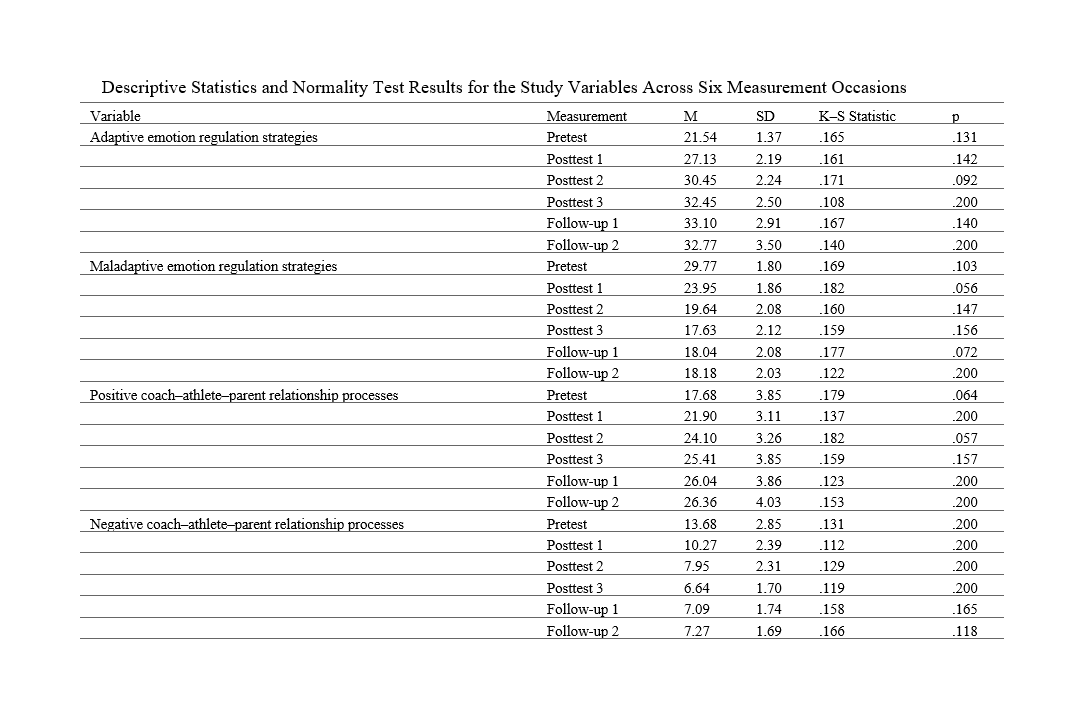
Findings: Repeated-measures analysis revealed a statistically significant effect of time on all study outcomes (p < .001). Adaptive cognitive emotion regulation strategies increased significantly following the intervention, with an effect size of 81.8%, whereas maladaptive emotion regulation strategies decreased significantly, with an effect size of 83.9%. Negative processes within coach–athlete–parent relationships also showed a significant decline across measurement occasions, accounting for 60.5% of the observed variance, and this improvement remained stable during the follow-up period. Positive interpersonal relationship processes increased significantly from pretest to posttest and demonstrated an additional statistically significant improvement between the posttest and follow-up assessments, with an effect size of 72.4%. Overall, the inferential findings indicated both immediate and sustained intervention effects on emotional regulation and interpersonal relationship processes.
Conclusion: Integrating culturally adapted life skills training into routine football practice may provide an effective and sustainable approach to strengthening adaptive emotion regulation, reducing maladaptive cognitive responses, and improving the quality of coach–athlete–parent relationships among adolescent football players. The persistence and continued development of several outcomes during follow-up further support the incorporation of such programs into youth football development systems.
Downloads
References
Alizadeh, M., Akbari, B., & Mehregan, B. (2025). Comparison of the Effectiveness of Compassion-Focused Therapy and Islamic Life Skills Training on Cognitive Emotion Regulation Strategies in Adolescents with Internet Addiction. Rooyesh-e Ravanshenasi, 14(6), 101-110.
Bean, C., Kramers, S., Forneris, T., & Camiré, M. (2018). Systematic Review of Positive Youth Development through Sport Programs. The Sport Psychologist, 32(2), 142-155. https://doi.org/10.1123/tsp.2017-0035
Camiré, M., Trudel, P., & Forneris, T. (2012). Coaching and Life Skills Transfer: Definitions, Mechanisms, and Perspectives. International Journal of Sports Science & Coaching, 7(2), 243-254. https://doi.org/10.1260/1747-9541.7.2.243
Daw, J., & Burton, D. (1994). Evaluation of a Comprehensive Psychological Skills Training Program for Collegiate Tennis Players. The Sport Psychologist, 8(1), 37-57. https://doi.org/10.1123/tsp.8.1.37
Garnefski, N., Kraaij, V., & Spinhoven, P. (2001). Negative Life Events, Cognitive Emotion Regulation and Emotional Problems. Personality and individual differences, 30(8), 1311-1327. https://doi.org/10.1016/S0191-8869(00)00113-6
Gould, D., & Carson, S. (2008). Life Skills Development through Sport: Current Status and Future Directions. International Review of Sport and Exercise Psychology, 1(1), 58-78. https://doi.org/10.1080/17509840701834573
Jacobs, J. M., Wright, P. M., & Richards, K. A. R. (2022). Adolescents’ Sport Participation and Socioemotional Learning: A Systematic Review. Frontiers in Sports and Active Living, 4, 843105.
Khan, S., Khan, S., Raza, H., Abbasi, P., & Munawar, S. (2025). Relationship Between Emotional Intelligence and Life Satisfaction: Mediated by Empathy and Moderated by Conflict Resolution Skills. Jssa, 3(1), 429-439. https://doi.org/10.59075/jssa.v3i1.129
Lisinskiene, A., Lochbaum, M., May, E., & Huml, M. (2019). Quantifying the Coach–Athlete–Parent (C–A–P) Relationship in Youth Sport: Initial Development of the Positive and Negative Processes in the C–A–P Questionnaire (PNPCAP). International journal of environmental research and public health, 16(21), 4140. https://doi.org/10.3390/ijerph16214140
Mosbat Shahjouyi, H., & Hasanvand, K. (2024, January 18). The Impact of Life Skills Training on Increasing Self-Awareness and Emotion Management in Primary School Children. First International Conference on New Developments in Educational Sciences, Psychology, and Education, Urmia.
Obeidavi, A., Mouli, Z., & Boujallali, A. (2024). Teaching Life Skills on the Emotional, Moral, and Academic Development of Students in the Critical Adolescent Period. First International Conference on Modern Developments in Educational Sciences, Psychology, and Education, Urmia, Iran.
Steinberg, L. (2005). Cognitive and Emotional Development in Adolescence. Annual review of psychology, 56, 115-132. https://doi.org/10.1146/annurev.psych.56.091103.070134
Thelwell, R. C., & Greenlees, I. A. (2001). The Effects of a Mental Skills Training Package on Gymnasium Triathlon Performance. The Sport Psychologist, 15(2), 127-141. https://doi.org/10.1123/tsp.15.2.127
World Health, O. (1994). Life Skills Education in Schools.
Zayed, A. M. A., & Mohamed, N. M. A. (2025). The Effectiveness of a Wisdom-Based Training Program in Improving Emotional and Academic Self-Efficacy and Decision-Making Skills among High School Students with Negative Life Orientation. Journal of the Faculty of Education, Sohag University, 131(131), 647-716.
Downloads
Additional Files
Publication Timeline
- Submitted
- Revised
- Accepted