Structural Modeling of Academic Boredom Based on Mindfulness and Spiritual Intelligence: The Mediating Roles of Self-Compassion and Metacognitive Awareness in Male Upper-Secondary Students
Keywords:
academic boredom, mindfulness, spiritual intelligence, self-compassion, metacognitive awarenessAbstract
Objective: This study aimed to develop and test a structural model of academic boredom based on mindfulness and spiritual intelligence, with self-compassion and metacognitive awareness as parallel mediators among male upper-secondary students.
Methods and Materials: A cross-sectional correlational study using structural equation modeling was conducted among 450 male students in Grades 10–12 in Tehran, Iran, during the 2026–2027 academic year. Participants completed measures of academic boredom, mindfulness, spiritual intelligence, self-compassion, and metacognitive awareness. The hypothesized model was evaluated using confirmatory factor analysis and structural equation modeling. Indirect effects were examined using bias-corrected bootstrapping with 5,000 resamples.
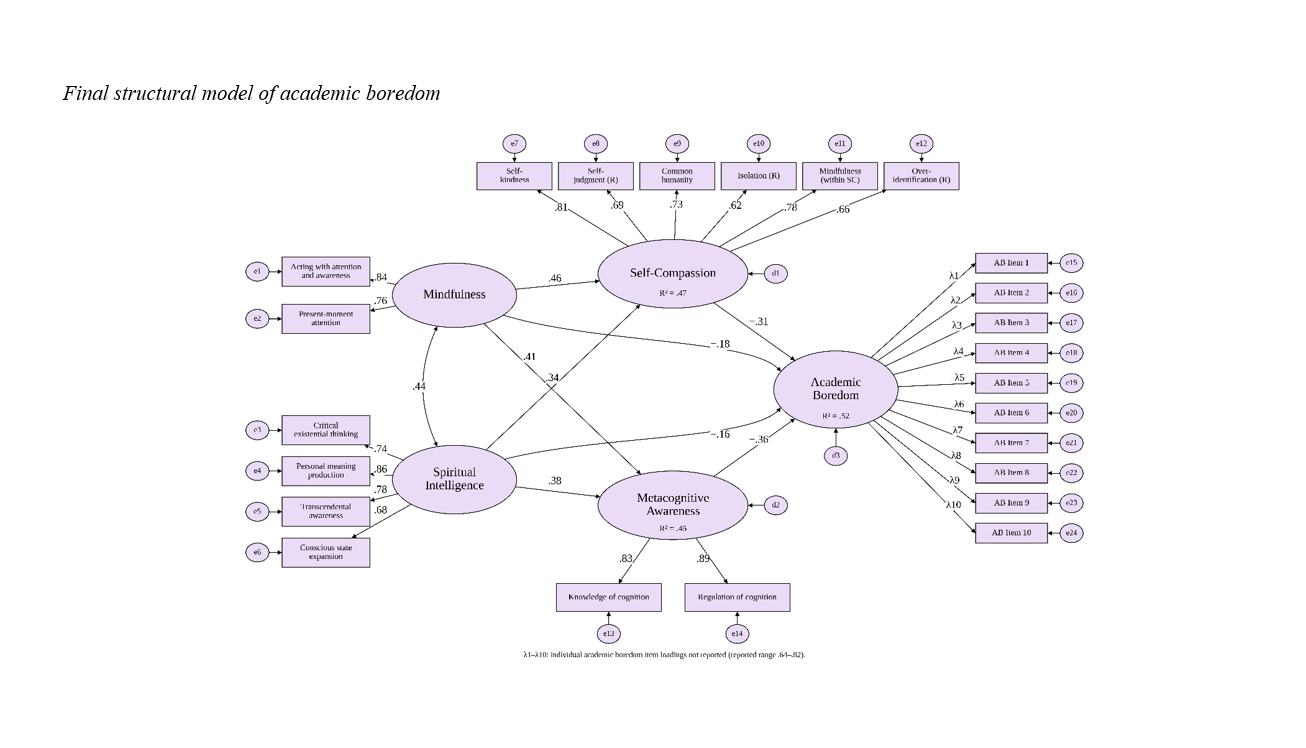
Findings: The structural model demonstrated good fit to the data, χ²(164) = 278.44, χ²/df = 1.70, CFI = .964, TLI = .958, IFI = .965, RMSEA = .039, and SRMR = .043. Mindfulness significantly predicted self-compassion (β = .46), metacognitive awareness (β = .41), and lower academic boredom (β = −.18). Spiritual intelligence predicted self-compassion (β = .34), metacognitive awareness (β = .38), and lower academic boredom (β = −.16). Self-compassion (β = −.31) and metacognitive awareness (β = −.36) were negatively associated with academic boredom. Significant indirect effects supported partial parallel mediation. The model explained 47% of the variance in self-compassion, 45% in metacognitive awareness, and 52% in academic boredom.
Conclusion: Mindfulness and spiritual intelligence may reduce academic boredom both directly and indirectly through greater self-compassion and metacognitive awareness. These findings highlight potentially modifiable psychological processes relevant to reducing academic boredom in upper-secondary students.
Downloads
References
Abdellatif, M. S. (2022). Modeling the relationships between academic boredom, self-compassion, and quality of academic life among university students. Sage Open, 12(4). https://doi.org/10.1177/21582440221141703
Abed, M., Kadivar, P., & Khalatbari, J. (2023). Validation of students' academic boredom questionnaire. Rooyesh-e-Ravanshenasi Journal, 11(12), 67-74.
Chan, C. S., van Tilburg, W. A. P., Igou, E. R., Poon, C. Y. S., Tam, K. Y. Y., Wong, V. U. T., & Cheung, S. K. (2022). Self-compassion predicts less boredom: The role of meaning in life. Personality and individual differences, 186, 111360. https://doi.org/10.1016/j.paid.2021.111360
Galla, B. M., Esposito, M. V., & Fiore, H. M. (2020). Mindfulness predicts academic diligence in the face of boredom. Learning and Individual Differences, 81, 101864. https://doi.org/10.1016/j.lindif.2020.101864
Hahnsson Holen, H. C., Lande, G., Idsoe, T., & Tvedt, M. S. (2026). Academic boredom, autonomy granting and academic achievement in upper secondary school. Scandinavian Journal of Educational Research. https://doi.org/10.1080/00313831.2026.2662242
He, G., Chen, S., Lin, H., & Su, A. (2024). The association between initial metacognition and subsequent academic achievement: A meta-analysis of longitudinal studies. Educational psychology review, 36, 81. https://doi.org/10.1007/s10648-024-09922-w
Khanjani, S., Foroughi, A. A., Sadghi, K., & Bahrainian, S. A. (2016). Psychometric properties of Iranian version of Self-Compassion Scale (short form). Pajoohande, 21(5), 282-289.
Ma, Q., & Wang, F. (2022). The role of students' spiritual intelligence in enhancing their academic engagement: A theoretical review. Frontiers in psychology, 13, 857842. https://doi.org/10.3389/fpsyg.2022.857842
Mahmoudi Mehr, M., Dasht Bozorgi, Z., Jayervand, H., & Talebzadeh Shoushtari, M. (2026). Metacognitive and mindfulness training effects on academic boredom and rumination in procrastinating students. Iranian Journal of Practice in Clinical Psychology, 14(2), 185-196.
Mohsenabadi, H., Shabani, M. J., & Zanjani, Z. (2019). Factor structure and reliability of the Mindfulness Attention Awareness Scale for Adolescents and the relationship between mindfulness and anxiety in adolescents. Iranian journal of psychiatry and behavioral sciences, 13(1), e64097. https://doi.org/10.5812/ijpbs.64097
Nikookar, E., Farrokhi, N., Dortaj, F., & Ghaemi, F. (2025). Testing a causal model of mathematics academic boredom based on metacognitive strategies and achievement goal orientation with the mediating role of academic procrastination. Iranian Journal of Learning and Memory, 8(31), 1-16.
Pekrun, R., Hall, N. C., Goetz, T., & Perry, R. P. (2014). Boredom and academic achievement: Testing a model of reciprocal causation. Journal of Educational Psychology, 106(3), 696-710. https://doi.org/10.1037/a0036006
Ponkosonsirilert, T., Laemsak, O., Pisitsungkagarn, K., Jarukasemthawee, S., Audboon, S., & Leangsuksant, T. (2022). Stress, self-compassion, and school burnout in Thai high school students. International Journal of Adolescent Medicine and Health, 34(5), 343-349. https://doi.org/10.1515/ijamh-2020-0109
Salari, M., Hamzah, R., & Hambali, Z. (2013). Meta-cognitive strategies and nursing students' achievement. Journal of Education and Vocational Research, 4(6), 169-173. https://doi.org/10.22610/jevr.v4i6.116
Sharp, J. G., Zhu, X., Matos, M., & Sharp, J. C. (2021). The Academic Boredom Survey Instrument (ABSI): A measure of trait, state and other characteristic attributes for the exploratory study of student engagement. Journal of Further and Higher Education, 45(9), 1253-1280. https://doi.org/10.1080/0309877X.2021.1947998
Tze, V. M. C., Daniels, L. M., & Klassen, R. M. (2016). Evaluating the relationship between boredom and academic outcomes: A meta-analysis. Educational psychology review, 28(1), 119-144. https://doi.org/10.1007/s10648-015-9301-y
Xie, Y., Zeng, F., & Yang, Y. (2024). A meta-analysis of the relationship between metacognition and academic achievement in mathematics: From preschool to university. Acta Psychologica, 249, 104486. https://doi.org/10.1016/j.actpsy.2024.104486
Zarrinabadi, Z., Isfandyari-Moghaddam, A., Erfani, N., & Ahmadi Tahour Soltani, M. (2020). Formulating a structural model of self-compassion based on the spiritual intelligence of the students of medical library and information sciences in Iranian universities of medical sciences. Journal of education and health promotion, 9, 31. https://doi.org/10.4103/jehp.jehp_422_19
Zhou, J., Cao, Y., Deng, X., & Luo, P. (2026). Perceived academic stress predicts state anxiety via self-compassion in high-achieving junior school students: A daily diary study. Journal of adolescence, 98(5), 1780-1790. https://doi.org/10.1002/jad.70180
Zhou, Z., Tavan, H., Kavarizadeh, F., Sarokhani, M., & Sayehmiri, K. (2024). The relationship between emotional intelligence, spiritual intelligence, and student achievement: A systematic review and meta-analysis. BMC Medical Education, 24, 217. https://doi.org/10.1186/s12909-024-05208-5
Additional Files
Publication Timeline
- Submitted
- Revised
- Accepted