Identifying the Components Influencing the Holistic Health of Adolescents with Emphasis on the Role of the Family
Keywords:
Adolescents, Holistic Health, Family Functioning, Psychological Well-Being, Parenting, Social Support, LamerdAbstract
Objective: This study aimed to identify the components influencing the holistic health of adolescents with particular emphasis on the role of the family.
Methods and Materials: This qualitative study was conducted using an exploratory design. The participants consisted of 20 individuals with relevant knowledge and experience in the fields of education, family, children, and adolescents in Lamerd City, who were selected through purposive sampling. Data were collected through in-depth semi-structured interviews focused on perceptions of adolescent holistic health, family functioning, psychological and behavioral characteristics, lifestyle patterns, educational experiences, peer relationships, and environmental conditions. Interviews were audio-recorded with participants’ consent, transcribed verbatim, and analyzed using conventional qualitative content analysis. Meaning units were identified, condensed, coded, and continuously compared. Similar codes were organized into subcomponents and broader conceptual categories, and the analytical process continued until sufficient conceptual depth and thematic saturation were achieved.
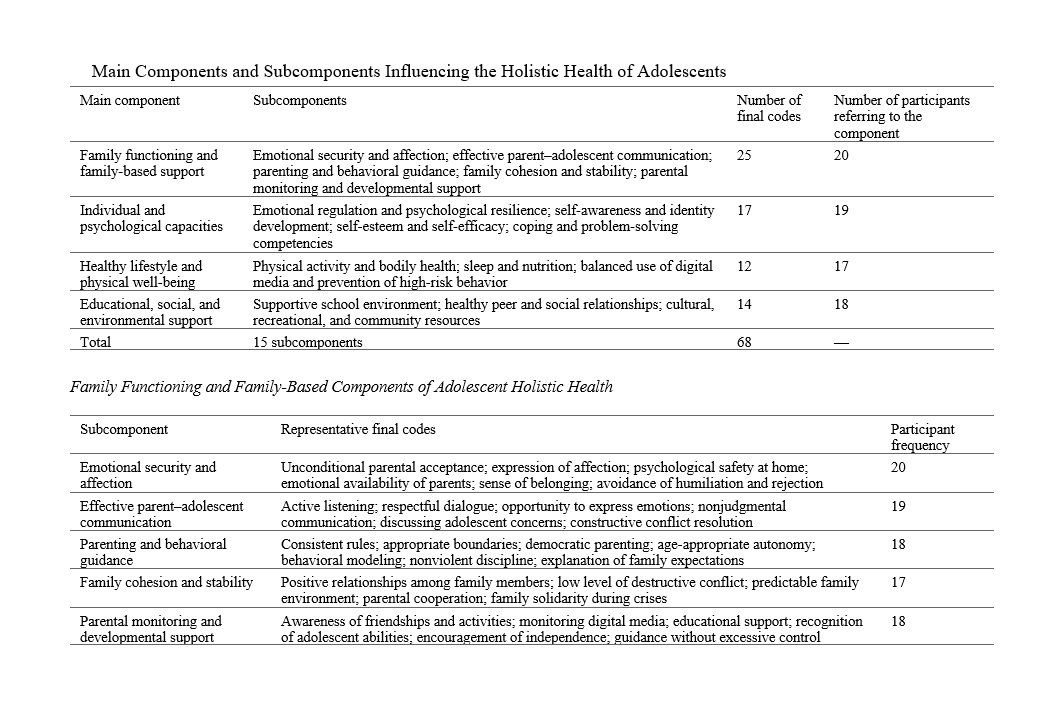
Findings: Analysis of the interviews resulted in 68 final codes organized into 15 subcomponents and four overarching components. The identified components were family functioning and family-based support, individual and psychological capacities, healthy lifestyle and physical well-being, and educational, social, and environmental support. Family functioning emerged as the central component and included emotional security and affection, effective parent–adolescent communication, parenting and behavioral guidance, family cohesion and stability, and parental monitoring and developmental support. Individual and psychological capacities included emotional regulation, resilience, identity development, self-esteem, self-efficacy, coping, and problem-solving. Healthy lifestyle encompassed physical activity, appropriate sleep and nutrition, balanced digital media use, and prevention of high-risk behaviors. Educational and environmental factors included supportive school environments, healthy peer relationships, and access to cultural, recreational, and community resources.
Conclusion: The findings indicate that adolescent holistic health is a multidimensional phenomenon shaped by interacting personal, familial, educational, social, and environmental factors.
Downloads
References
Adefolarin, A. O., & Odubia, J. S. (2026). Determinants of Flourishing, Moderate, and Languishing Patterns of Positive Mental Health Among in-School Adolescents in Ibadan Metropolis. https://doi.org/10.21203/rs.3.rs-11102883/v1
Ahmad, I., & Smetana, J. G. (2021). Palestinian Refugee Youth in Jordan: Parental Practices, Neighborhood Cohesion and Assistance, and Adolescent Wellbeing. International journal of environmental research and public health, 18(7), 3649. https://doi.org/10.3390/ijerph18073649
Armitage, J. M., Wang, R. A. H., Davis, O. S. P., Bowes, L., & Haworth, C. M. A. (2021). Peer Victimisation During Adolescence and Its Impact on Wellbeing in Adulthood: A Prospective Cohort Study. https://doi.org/10.21203/rs.3.rs-59683/v4
Bairwa, K., Gakkhar, S., & Mathur, S. (2021). Psychological and Emotional Response to Lockdown in Children During the Ongoing Pandemic COVID-19 in Urban Areas of Jaipur. Journal of Indian Association for Child and Adolescent Mental Health, 17(4), 85-99. https://doi.org/10.1177/0973134220210406
Basnet, R. (2022). COVID-19 and Its Association With Psychological Health of Children, Adolescents and Young Adults. Journal of Technical and Vocational Education and Training, 1(16), 85-96. https://doi.org/10.3126/tvet.v1i16.45190
Burke, K., Dittman, C. K., Forbes, E., & Eggins, E. (2021). PROTOCOL: A Systematic Review and Meta‐analysis of Randomised Controlled Trials Evaluating the Impact of Parenting Programmes for Parents of Adolescents (10–18 Years) on Adolescent Mental Health Outcomes, Positive Development and the Parent–adolescent Relationship. Campbell Systematic Reviews Better Evidence for a Better World, 17(1). https://doi.org/10.1002/cl2.1146
Chaves, C. (2021). Wellbeing and Flourishing. 273-295. https://doi.org/10.1007/978-3-030-64537-3_11
Cosma, A., Költő, A., Baďura, P., Winkler, P., & Kalman, M. (2021). Time Trends in Adolescent Mental Wellbeing in the Czech Republic Between 2002 and 2018: Gender, Age and Socioeconomic Differences. Central European Journal of Public Health, 29(4), 271-278. https://doi.org/10.21101/cejph.a6717
Deng, X., Cao, J., Li, J., & Kelana, B. W. Y. (2026). Pathways to Meaning: How Family Functioning Shapes Meaning in Life Through School Belonging Among Chinese Adolescents. Frontiers in psychology, 17. https://doi.org/10.3389/fpsyg.2026.1889582
Eugene, D. R. (2021). Connectedness to Family, School, and Neighborhood and Adolescents’ Internalizing Symptoms. International journal of environmental research and public health, 18(23), 12602. https://doi.org/10.3390/ijerph182312602
Farley, C. D., & Renshaw, T. L. (2025). Exploring the Validity of Adolescent Responses to a Measure of Psychological Flexibility and Inflexibility. Behavioral Sciences, 15(2), 197. https://doi.org/10.3390/bs15020197
Herdiansyah, D., Farghobi, I. Y., Azmi, S. M., Khoiriyah, H. S., & Apriliani, D. (2024). Exploring the Relationship Between Religiosity and Mental Health: Towards Psychological Well-Being - A Literature Review. BICC Proceedings, 2, 60-71. https://doi.org/10.30983/bicc.v1i1.108
Jensen, M. R., Navarro, J. L., Chase, G. E., Wyman, K., & Lippold, M. A. (2024). Parenting Styles in Emerging Adulthood. Youth, 4(2), 509-524. https://doi.org/10.3390/youth4020035
Knowles, C., Thornton, E., Mills-Webb, K., Petersen, K., Marquez, J., Stojiljković, S., & Humphrey, N. (2025). Local Landscapes, Evolving Minds: Mechanisms of Neighbourhood Influence on Dual-State Mental Health Trajectories in Adolescence. International journal of environmental research and public health, 22(6), 951. https://doi.org/10.3390/ijerph22060951
Liu, X., Liu, J., Flores, D. D., & McDonald, C. C. (2024). Family Factors Related to Adolescent Screen Media Use and Mental Health Outcomes: A Systematic Review and Recommendation for Practices. Journal of adolescence, 96(7), 1401-1427. https://doi.org/10.1002/jad.12367
Matos, M. G. d., & Wainwright, T. W. (2021). COVID-19 and Mental Health in School-Aged Children and Young People: Thinking Ahead While Preparing the Return to School and to Life “As Usual”. The Psychologist Practice & Research Journal, 4(1). https://doi.org/10.33525/pprj.v4i1.105
Monika, M., Majeed, J., & Sharma, N. (2023). Psychological Well-Being of Adolescents. JRTDD. https://doi.org/10.53555/jrtdd.v6i7s.2157
Mustikawati, E. I., & Ernawaty, E. (2021). Differences in Help-Seeking Behavior in Adolescents With Anxiety Disorder During the COVID-19 Pandemic. Media Kesehatan Masyarakat Indonesia, 17(3), 110-115. https://doi.org/10.30597/mkmi.v17i3.13827
Ni, F.-R., Huang, Z., & Chen, Y. (2025). Mapping the Psychosocial Network of Kenyan Adolescents: The Pivotal Role of Loneliness and Gender-Specific Pathways. Frontiers in Public Health, 13. https://doi.org/10.3389/fpubh.2025.1642144
Nwabueze, K. K., Akubue, N. E., Onakoya, A., Okolieze, S. C., Otaniyen-Igbinoba, I. J., Chukwunonye, C., Okengwu, C. G., Ige, T., Alao, O. J., & Adindu, K. N. (2025). Exploring the Prevalence and Risk Factors of Adolescent Mental Health Issues in the COVID and Post-Covid Era in the U.K.: A Systematic Review. https://doi.org/10.17179/excli2025-8325
O'Brien, J. P. G., Osman, Y., & Sample, D. K. (2023). The Red Herring of Adolescent Mental Health. Family Court Review, 61(3), 496-503. https://doi.org/10.1111/fcre.12733
Parimal, B. S., & Gupta, K. (2022). Social Support as a Predictor of Psychological Well-Being of Transfusion Dependent Thalassemics. International journal of health sciences, 138-149. https://doi.org/10.53730/ijhs.v6ns8.9666
Scaioli, G., Squillacioti, G., Bersia, M., Bellisario, V., Borraccino, A., Bono, R., Dalmasso, P., & Lemma, P. (2023). The Wellbeing of Adolescents and the Role of Greenness: A Cross-Sectional Study Among Italian Students. Frontiers in Public Health, 10. https://doi.org/10.3389/fpubh.2022.1050533
Silan, M. A. A. (2023). Are the Kids Alright? The Impact of COVID-19 Pandemic on the Mental Health and Psychosocial Wellbeing of Filipino Children in Selected Cities in Metro Manila. https://doi.org/10.31234/osf.io/v2ygm
Stevens, S., Maston, K., Bista, S., Brown, L., Godward, J., Khan, A., Batterham, P. J., & Werner‐Seidler, A. (2026). Not All Teens Scroll the Same: Patterns and Variation in Adolescent Social Media Behavior. https://doi.org/10.21203/rs.3.rs-8653667/v1
Tremolada, M., Taverna, L., Chiavetta, I. T., Bonichini, S., Putti, M. C., & Biffi, A. (2020). Psychological Wellbeing in Adolescents With Leukaemia: A Comparative Study With Typical Development Peers. International journal of environmental research and public health, 17(2), 567. https://doi.org/10.3390/ijerph17020567
Turkmani, S., Bista, S., Wang, J. J. J., O'Donnell, A. W., Thomson, C., Radcliffe, N. J., Skattebol, J., Redmond, G., & Brooks, F. M. (2023). Social and Emotional Wellbeing Among Young People; The Mitigating Role of Ecological Domains. Child Indicators Research, 16(3), 941-962. https://doi.org/10.1007/s12187-022-10008-8
Venturo‐Conerly, K. E., Osborn, T. L., Wasil, A. R., Corrigan, E., Wasanga, C., & Weisz, J. R. (2021). Testing the Effects of the Shamiri Intervention and Its Components on Anxiety, Depression, Wellbeing, and Academic Functioning in Kenyan Adolescents: Study Protocol for a Five-Arm Randomized Controlled Trial. Trials, 22(1). https://doi.org/10.1186/s13063-021-05736-1
Verhulst, S., Bustamante, C. M. V., Carvajal-Vélez, L., Cece, F., Requejo, J., Winowatan, M. W., Young, A., & Zahuranec, A. J. (2023). Toward a Demand-Driven, Collaborative Data Agenda for Adolescent Mental Health. Journal of Adolescent Health, 72(1), S20-S26. https://doi.org/10.1016/j.jadohealth.2022.05.027
Wellen, B., Lin, H. C., & Stellway, J. (2022). Psychosocial Considerations in Pediatric Autoimmune Liver Disease. Clinical Liver Disease, 20(4), 124-129. https://doi.org/10.1002/cld.1238
Wilson, D. K., & Prinz, R. J. (2025). Family-Based Interventions in Underserved Populations. 91-103. https://doi.org/10.1037/0000396-006
Xie, Q. W., Lu, S., Luo, X., & Deng, J. (2026). Mechanisms Linking Household Income Trajectories to Adolescent Mental Well‐being: A Longitudinal Study. Family Relations, 75(2), 1084-1101. https://doi.org/10.1111/fare.70068
Yang, Q. (2022). The Mental Health Impact of Quarantine in COVID-19 Pandemic. 637. https://doi.org/10.2991/assehr.k.220131.171
Zaki, N. M., Osman, O. A. B., & Mohamed, H. S. (2022). Effect of Parent-Adolescent Attachment on Their Psychological Wellbeing. Egyptian Journal of Health Care, 13(3), 228-242. https://doi.org/10.21608/ejhc.2022.251529
Downloads
Additional Files
Publication Timeline
- Submitted
- Revised
- Accepted