A Structural Model of Academic Buoyancy Based on Academic Future Orientation and Academic Self-Concept with the Mediating Role of Academic Emotions among Male Lower Secondary School Students
Keywords:
academic buoyancy, academic future orientation, academic self-concept, positive academic emotionsAbstract
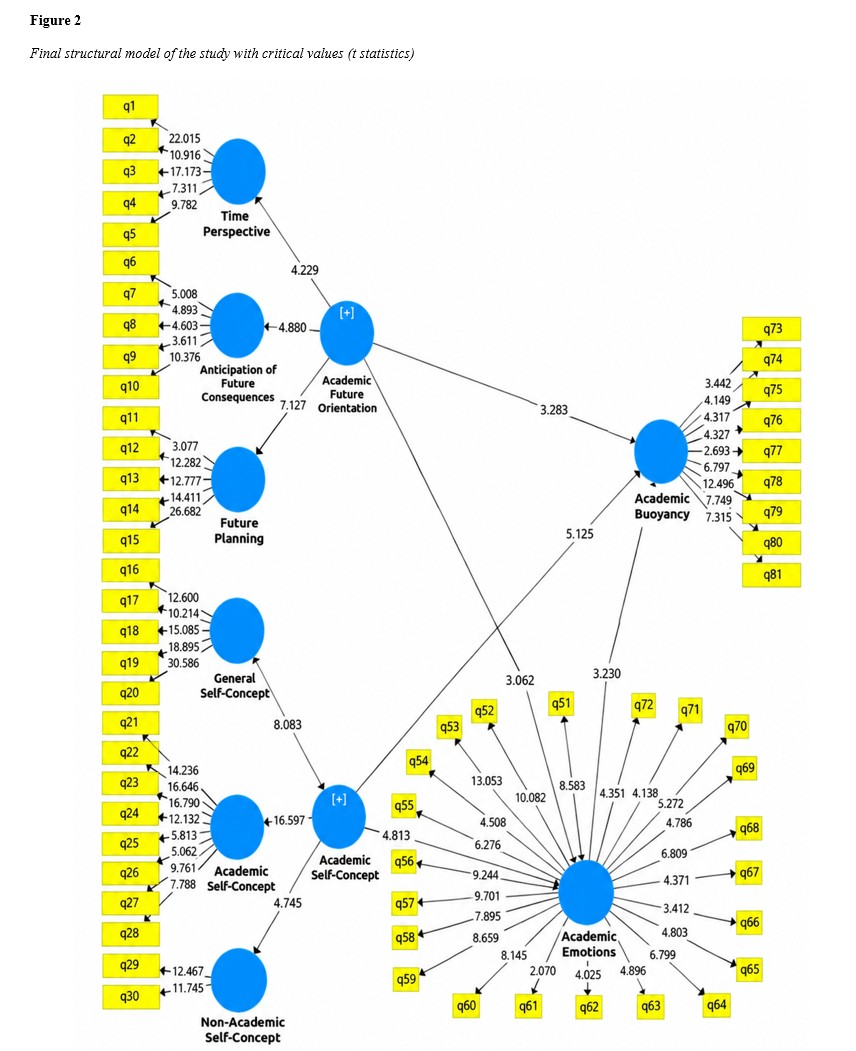
Objective: The present study aimed to develop and test a structural model of academic buoyancy based on academic future orientation and academic self-concept, with the mediating role of academic emotions, among male lower secondary school students.
Methods and Materials: The research employed a descriptive-correlational design using structural equation modeling (SEM). The statistical population consisted of all male lower secondary school students in Islamabad-e Gharb during the 2025–2026 academic year, from whom 325 students were selected using stratified random sampling. The research instruments included the Academic Buoyancy Questionnaire developed by Dehghanizadeh and Hossein Chari (2012), Steinberg’s Academic Future Orientation Questionnaire (2009), Yessen Chen’s Academic Self-Concept Questionnaire (2004), and the positive emotions dimension of the questionnaire developed by Pekrun et al. (2002). Data were analyzed using SmartPLS software and the partial least squares method.
Findings: The findings indicated that the conceptual model of the study demonstrated an acceptable fit (GOF = 0.340). Academic future orientation and academic self-concept had significant direct effects on academic buoyancy (p < .01). Moreover, the results of the bootstrap analysis demonstrated that positive academic emotions played a significant mediating role in the relationships of academic future orientation and academic self-concept with academic buoyancy (p < .01). Overall, the research model explained 36.6% of the variance in academic buoyancy.
Conclusion: The findings indicate that strengthening cognitive-motivational components, including future orientation and self-concept, together with enhancing positive emotions within the educational environment, can provide an appropriate foundation for improving students’ academic buoyancy and their ability to cope with learning-related challenges. It is recommended that educational authorities design intervention programs based on positive emotions and academic goal setting to enhance students’ academic buoyancy.
Downloads
Publication Timeline
- Submitted
- Revised
- Accepted