Predicting Adolescent Depressive Relapse via LSTM Modeling of Smartphone Telemetry
DOI:
https://doi.org/10.61838/kman.jayps.3142Keywords:
Adolescent Depression, Relapse Prediction, Smartphone Telemetry, Long Short-Term Memory (LSTM), Digital Phenotyping, Passive SensingAbstract
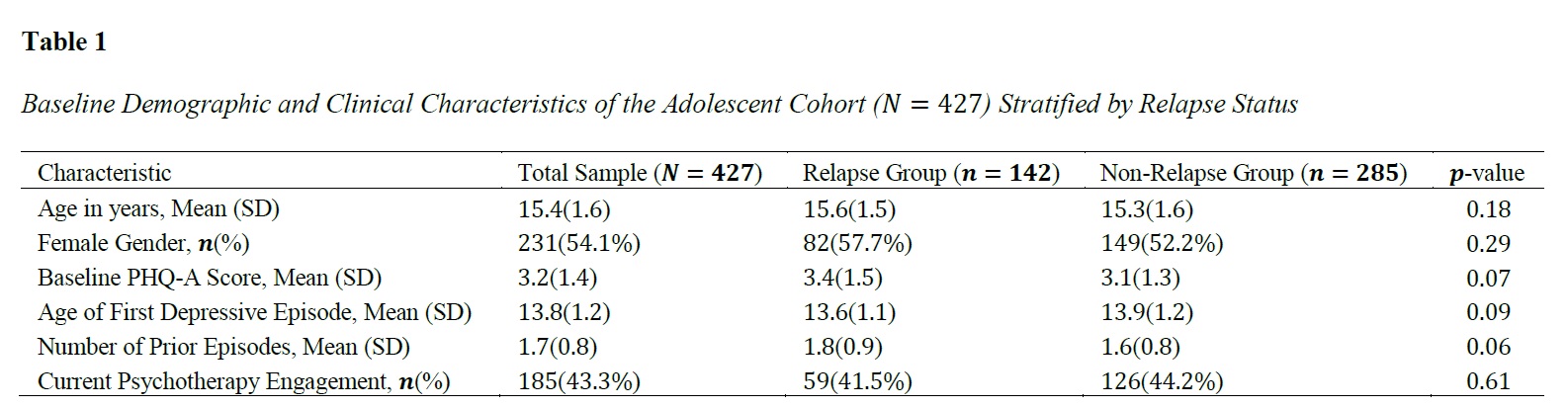
Objective: To evaluate the predictive efficacy of a Long Short-Term Memory (LSTM) neural network in forecasting the likelihood of an impending major depressive relapse among a remitted adolescent cohort using longitudinal, passively collected smartphone behavioral telemetry. Methods and Materials: This longitudinal observational study tracked a cohort of N=427remitted adolescents in Morocco over an eighteen-month period. Behavioral data was continuously and unobtrusively collected using a custom passive sensing smartphone application that recorded high-resolution telemetry, including geospatial mobility (GPS), accelerometer-based physical activity, total screen time, and keystroke dynamics. Clinical mental health status was evaluated bi-weekly via Ecological Momentary Assessment (EMA). An LSTM recurrent neural network, designed to capture temporal dependencies in time-series data, was trained on these sequential behavioral inputs to predict the future probability of a clinical depressive relapse. Findings: During the observation window, N=142adolescents experienced a formal depressive relapse. The LSTM predictive model achieved strong performance metrics, forecasting an impending relapse with an Area Under the Receiver Operating Characteristic Curve (AUC) of 0.88over a 14-day predictive horizon. The model demonstrated a sensitivity of 0.83 and a specificity of 0.81. A subsequent feature ablation analysis revealed that severe reductions in geospatial mobility variance and profound disruptions in circadian sleep patterns—quantified by acute spikes in nocturnal device usage—served as the most significant digital biomarkers driving the algorithm’s predictive accuracy. Conclusion: Passively collected smartphone telemetry contains highly predictive, sequential signals of clinical deterioration that precede self-reported depressive symptoms. Utilizing advanced LSTM architectures to model these digital footprints provides a highly accurate, objective mechanism for forecasting adolescent depressive relapses, offering a critical window for proactive, digitally-augmented preventative psychiatric interventions.
Downloads
References
Ahmadi, F., Dehghan, M. J., Baharvand, V., & Azizi, A. (2023). Designing and Evaluating a Smartphone-Based Cognitive Behavioral Therapy to Control Anxiety and Depression. Frontiers in Health Informatics, 12, 136. https://doi.org/10.30699/fhi.v12i0.410
Arrivillaga, C., Elhai, J. D., Rey, L., & Extremera, N. (2023). Depressive symptomatology is associated with problematic smartphone use severity in adolescents: The mediating role of cognitive emotion regulation strategies. Cyberpsychology: Journal of Psychosocial Research on Cyberspace, 17(3). https://cyberpsychology.eu/article/view/31019
Asare, K. O., Visuri, A., Vega, J., & Ferreira, D. (2022). Me In the Wild: An Exploratory Study Using Smartphones To Detect The Onset Of Depression. 121-145. https://doi.org/10.1007/978-3-031-06368-8_9
Elhai, J. D., Gallinari, E. F., Rozgonjuk, D., & Yang, H. (2020). Depression, anxiety and fear of missing out as correlates of social, non-social and problematic smartphone use. Addictive behaviors, 105, 106335. https://doi.org/10.1016/j.addbeh.2020.106335
Fu, L., Wang, P., Zhao, M., Xie, X., Chen, Y., Nie, J., & Lei, L. (2020). Can emotion regulation difficulty lead to adolescent problematic smartphone use? A moderated mediation model of depression and perceived social support. Children and Youth Services Review, 108. https://doi.org/10.1016/j.childyouth.2019.104660
Ge, J., Liu, Y., Cao, W., & Zhou, S. (2023). The relationship between anxiety and depression with smartphone addiction among college students: the mediating effect of executive dysfunction. Frontiers in psychology, 13, 1033304. https://doi.org/10.3389/fpsyg.2022.1033304
Geng, Y., Gu, J., Wang, J., & Zhang, R. (2021). Smartphone Addiction and Depression, Anxiety: The Role of Bedtime Procrastination and Self-Control. Journal of affective disorders, 293, 415-421. https://doi.org/10.1016/j.jad.2021.06.062
Hong, L., Xu, H., Zheng, J., Lin, X., Wang, L., Zhao, C., Tu, X., Zhang, J., Zhao, K., & Zhang, G. (2024). Latent Profiles and Transitions of Bedtime Procrastination Among Chinese College Students: The Predictive Roles of Anxiety, Depression, Problematic Smartphone Use and Self-Control. Nature and science of sleep, Volume 16, 801-811. https://doi.org/10.2147/nss.s462055
Hong, Y. P., Yeom, Y. O., & Lim, M. H. (2021). Relationships between Smartphone Addiction and Smartphone Usage Types, Depression, ADHD, Stress, Interpersonal Problems, and Parenting Attitude with Middle School Students. J Korean Med Sci, 36(19). https://doi.org/10.3346/jkms.2021.36.e129
Kaya, F., Bostanci Daştan, N., & Durar, E. (2021). Smartphone usage, sleep quality and depression in university students. The International Journal of Social Psychiatry, 67(5), 407-414. https://doi.org/10.1177/0020764020960207
Kim, J. I. (2020). The effects of sociality, life stress, and depression on the smartphone addiction of nursing college students. Journal of Korea Academia-Industrial Cooperation Society, 21(4), 100-108. https://doi.org/10.5762/KAIS.2020.21.4.100
Lai, H., Mei, X., Huang, S., Wu, X., Liang, J. Q., Zhou, L., & Ye, Z. J. (2025). The Relationship Between Smartphone Addiction and Sleep Quality in Older Adults: The Mediating Role of Loneliness and Depression. BMC Nursing, 24(1). https://doi.org/10.1186/s12912-025-02883-7
Li, G. X., Liu, L., Wang, M. Q., Li, Y., & Wu, H. (2024). The longitudinal mediating effect of rumination on the relationship between depressive symptoms and problematic smartphone use in Chinese university students: A three-wave cross-lagged panel analysis. Addict Behav, 150, 107907. https://doi.org/10.1016/j.addbeh.2023.107907
Lim, S.-I., & Jeong, S. (2022). The Relationship Between Korean Parents’ Smartphone Addiction and That of Their Children: The Mediating Effects of Children’s Depression and Social Withdrawal. International journal of environmental research and public health, 19(9), 5593. https://doi.org/10.3390/ijerph19095593
Lin, W., Liang, H., Jiang, H., Nasir, M. A. M., & Zhou, H. (2023). Why Is Smartphone Addiction More Common in Adolescents With Harsh Parenting? Depression and Experiential Avoidance‘s Multiple Mediating Roles. Psychology research and behavior management, Volume 16, 4817-4828. https://doi.org/10.2147/prbm.s428167
Moosivand, M., Hayati, M., & Ramezani Torkamani, M. (2022). Predicting depression, anxiety, stress and academic procrastination based on smartphone addiction with emphasis on gender differences in students. Women's Studies Sociological and Psychological, 20(2), 66-95. https://doi.org/10.22051/jwsps.2022.38225.2529
Mousivand, M., Hayati, M., & Ramazani Torkamani, M. (2023). Predicting depression, anxiety, stress, and academic procrastination based on smartphone addiction with an emphasis on gender differences among students. Psychosocial Studies of Women, 20(2). https://www.noormags.ir/view/en/articlepage/1999272/
Mun, I. B., & Lee, S. (2023). The Impact of Parental Depression on Children’s Smartphone Addiction: A Serial Mediation Model With Parental Neglect and Children’s Self-Esteem. Social Science Computer Review, 41(1), 217-233. https://doi.org/10.1177/08944393211037579
Oh, W.-O., & Heo, Y.-J. (2023). Exploring the Link Between Smartphone Overdependence, Depression, and Suicidal Behaviors Through the Mediating Effect of Lifestyle Risk Behaviors Among South Korean Adolescents: A Cross-sectional Study Using National Big Data. Journal of Pediatric Health Care. https://doi.org/10.1016/j.pedhc.2023.12.011
Pausch, P. (2023). Exploring the Associations Between Problematic Smartphone Use and Academic Stress, Depression, Emotion Regulation, and Self-Regulation among University Students http://essay.utwente.nl/95769/
Sela, Y., Zach, M., Amichay-Hamburger, Y., Mishali, M., & Omer, H. (2020). Family environment and problematic internet use among adolescents: The mediating roles of depression and Fear of Missing Out. Computers in human Behavior, 106, 106226. https://www.sciencedirect.com/science/article/pii/S0747563219304455
Stirnberg, J., Margraf, J., Precht, L.-M., & Brailovskaia, J. (2024). Problematic Smartphone Use, Depression Symptoms, and Fear of Missing Out: Can Reasons for Smartphone Use Mediate the Relationship? A Longitudinal Approach. J. Soc. Media Res., 1(1), 3-13. https://doi.org/10.29329/jsomer.3
Tao, Y., Tang, Q., Zou, X., Wang, S., Ma, Z., Zhang, L., & Liu, X. (2023). Effects of attention to negative information on the bidirectional relationship between fear of missing out (FoMO), depression and smartphone addiction among secondary school students: Evidence from a two-wave moderation network analysis. Computers in human Behavior, 148, 107920. https://doi.org/10.1016/j.chb.2023.107920
Tsai, H. H., Cheng, C. Y., Shieh, W. Y., & Chang, Y. C. (2020). Effects of a Smartphone-Based Videoconferencing Program for Older Nursing Home Residents on Depression, Loneliness, and Quality of Life: A Quasi-Experimental Study. BMC Geriatrics, 20(1). https://doi.org/10.1186/s12877-020-1426-2
Wang, D., Zhou, M., & Hu, Y. (2024). The Relationship Between Harsh Parenting and Smartphone Addiction Among Adolescents: Serial Mediating Role of Depression and Social Pain. Psychology research and behavior management, Volume 17, 735-752. https://doi.org/10.2147/prbm.s438014
Wolniewicz, C. A., Rozgonjuk, D., & Elhai, J. D. (2019). Boredom Proneness and Fear of Missing Out Mediate Relations Between Depression and Anxiety With Problematic Smartphone Use. Human Behavior and Emerging Technologies, 2(1), 61-70. https://doi.org/10.1002/hbe2.159
Yang, J., Fu, X., Liao, X., & Li, Y. (2020). Association of problematic smartphone use with poor sleep quality, depression, and anxiety: A systematic review and meta-analysis. Psychiatry research, 284, 112686. https://doi.org/10.1016/j.psychres.2019.112686
Zhang, W., Pu, J., He, R., Yu, M., Xu, L., He, X., Chen, Z., Gan, Z., Liu, K., Tan, Y., & Xiang, B. (2022). Demographic characteristics, family environment and psychosocial factors affecting internet addiction in Chinese adolescents. Journal of affective disorders, 315, 130-138. https://doi.org/10.1016/j.jad.2022.07.053
Zhao, P., & Lapierre, M. A. (2020). Stress, Dependency, and Depression: An Examination of the Reinforcement Effects of Problematic Smartphone Use on Perceived Stress and Later Depression. Cyberpsychology Journal of Psychosocial Research on Cyberspace, 14(4). https://doi.org/10.5817/cp2020-4-3
Downloads
Additional Files
Publication Timeline
- Submitted
- Revised
- Accepted