Negative Emotion Expression and Lack of Social Support as Predictors of Adolescent Loneliness
DOI:
https://doi.org/10.61838/kman.jayps.6.6.16Keywords:
Adolescent loneliness, negative emotion expression, social supportAbstract
Objective: This study aimed to examine the predictive roles of negative emotion expression and perceived lack of social support in adolescent loneliness.
Methods and Materials: A correlational descriptive design was used to investigate the relationships between the variables among 380 adolescents in Iraq. Participants were selected using stratified random sampling based on the Morgan and Krejcie table. Standardized self-report instruments were used to measure loneliness, negative emotion expression, and social support. Data were analyzed using SPSS-27, employing Pearson correlation coefficients to explore bivariate associations and multiple linear regression to assess the combined predictive power of the independent variables on loneliness. Assumptions for regression analysis—including normality, linearity, multicollinearity, and homoscedasticity—were checked and met prior to analysis.
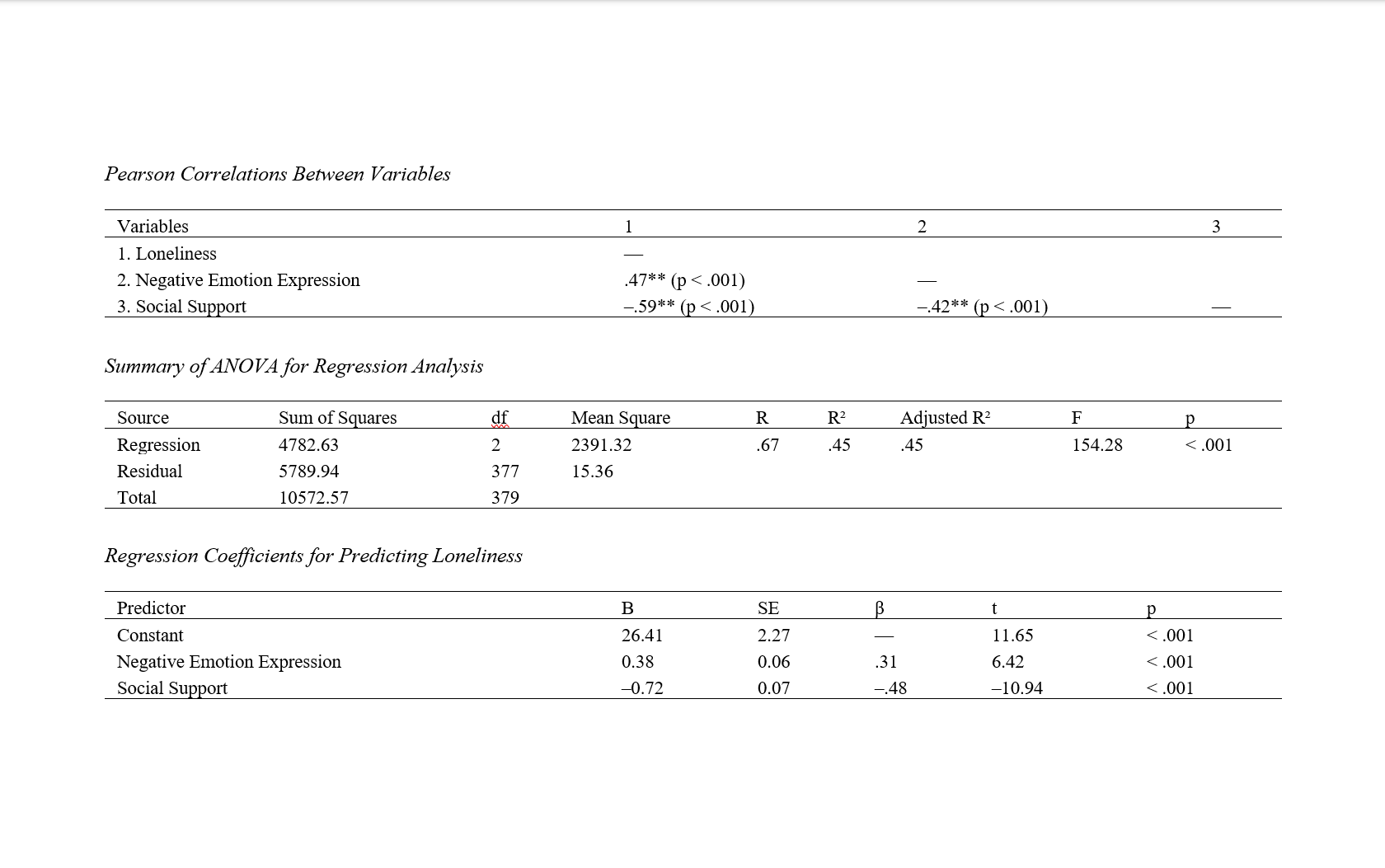
Findings: Descriptive statistics indicated moderate levels of loneliness (M = 47.38, SD = 10.27), high levels of negative emotion expression (M = 51.84, SD = 9.61), and low perceived social support (M = 28.42, SD = 6.83). Pearson correlations revealed that loneliness was positively associated with negative emotion expression (r = .47, p < .001) and negatively associated with social support (r = –.59, p < .001). Multiple regression analysis showed that both predictors significantly explained 45% of the variance in loneliness (R² = .45, F(2, 377) = 154.28, p < .001). Social support (β = –.48, p < .001) emerged as a stronger predictor than negative emotion expression (β = .31, p < .001).
Conclusion: The findings highlight the critical role of both emotional and social factors in adolescent loneliness. Specifically, difficulties in expressing negative emotions and low perceived social support significantly contribute to elevated loneliness. Interventions aimed at enhancing emotion expression skills and strengthening social support networks may reduce loneliness and improve adolescent mental health.
Downloads
References
Ahn, C.-Y., Lee, J.-S., Kim, J., Kim, S., Kim, J.-W., Na, J.-J., & Seo, D. G. (2025). The Impact of Negative Emotions on Adolescents’ Nonsuicidal Self-Injury Thoughts: An Integrated Application of Machine Learning and Multilevel Logistic Models. https://doi.org/10.1101/2025.02.15.25322355
Akçay, E., Çöp, E., Dinç, G. Ş., Göker, Z., Parlakay, A. Ö., Demirel, B. D., Mutlu, M., & Kırmızı, B. (2022). Loneliness, Internalizing Symptoms, and Inflammatory Markers in Adolescent COVID‐19 Survivors. Child Care Health and Development, 48(6), 1112-1121. https://doi.org/10.1111/cch.13043
Benhayoun, A., Olsavsky, A. L., Akard, T. F., Gerhardt, C. A., & Skeens, M. (2024). Predictors of Loneliness Among Middle Childhood and Adolescence During the COVID-19 Pandemic. PLoS One, 19(8), e0308091. https://doi.org/10.1371/journal.pone.0308091
Bui, C., Lemery‐Chalfant, K., Clifford, S., & Doane, L. D. (2025). 0183 Examining the Daily Associations Between Loneliness, Rumination, and Sleep Outcomes in a Community Sample of Adolescents. Sleep, 48(Supplement_1), A82-A82. https://doi.org/10.1093/sleep/zsaf090.0183
Dreslin, B., & Hedrick, M. E. (2023). Finding Friends: The Role of Loneliness on the Formation of Online Friendships Among Adolescents. Journal of Student Research, 12(3). https://doi.org/10.47611/jsrhs.v12i3.5087
Goodfellow, C., Willis, M., Inchley, J., Kharicha, K., Leyland, A. H., Qualter, P., Simpson, S., & Long, E. (2022). Mental Health and Loneliness in Scottish Schools: A Multilevel Analysis of Data From the Health Behaviour in School-Aged Children Study. https://doi.org/10.31235/osf.io/5r8cy
Goodfellow, C., Willis, M., Inchley, J., Kharicha, K., Leyland, A. H., Qualter, P., Simpson, S., & Long, E. (2023). Mental Health and Loneliness in Scottish Schools: A Multilevel Analysis of Data From the Health Behaviour in School‐aged Children Study. British Journal of Educational Psychology, 93(2), 608-625. https://doi.org/10.1111/bjep.12581
Hosozawa, M., Cable, N., Yamasaki, S., Ando, S., Endo, K., Usami, S., Nakanishi, M., Niimura, J., Nakajima, N., Baba, K., Oikawa, N., Stanyon, D., Suzuki, K., Miyashita, M., Iso, H., Hiraiwa‐Hasegawa, M., Kasai, K., & Nishida, A. (2022). Predictors of Chronic Loneliness During Adolescence: A Population-Based Cohort Study. Child and adolescent psychiatry and mental health, 16(1). https://doi.org/10.1186/s13034-022-00545-z
İme, Y. (2024). May Bullying Victimization and Loneliness in Adolescents Be Risk Factors for Psychological Resilience? Türk Psikolojik Danışma Ve Rehberlik Dergisi. https://doi.org/10.17066/tpdrd.1394927yi
Ivanović, M., & Ivanović, U. (2023). Influence of Health Status and Loneliness on Satisfaction With Life, Emotional Dimensions, and Distress in Junior Handball Players. Exercise and Quality of Life, 15(1), 27-35. https://doi.org/10.31382/eqol.230604
Jost, G. M., Hang, S., Wysocki, A., Rhemtulla, M., Robins, R. W., & Hostinar, C. E. (2025). Time Spent Alone and Loneliness in Mexican‐origin Youth: The Role of Social Relationships and Personality. Annals of the New York Academy of Sciences. https://doi.org/10.1111/nyas.15348
Kahan, J., & Žiaková, E. (2021). Loneliness and Predictive Models of Multiple Risk Behavior of Adolescents in the Context of Ecosystem Metatheory and Virtual Internet Space. Proceedings of Cbu in Social Sciences, 2, 172-183. https://doi.org/10.12955/pss.v2.218
Komissarova, O. A., & Милованова, О. А. (2024). Subjective Experience of Loneliness as a Predictor of Substance Use in Adolescents. Психолог(6), 161-173. https://doi.org/10.25136/2409-8701.2024.6.72573
Ma, S., Huang, Y., & Ma, Y. (2020). Childhood Maltreatment and Mobile Phone Addiction Among Chinese Adolescents: Loneliness as a Mediator and Self-Control as a Moderator. Frontiers in psychology, 11. https://doi.org/10.3389/fpsyg.2020.00813
Mihaliková, V., & Dědová, M. (2024). Association Between Internet Gaming Disorder and Loneliness: The Mediating Effect of Suicidal and Self-Injurious Behavior in Adolescents. Journal of Educational Sciences & Psychology, 14 (76)(1), 188-201. https://doi.org/10.51865/jesp.2024.1.18
Mueller, M. K., Richer, A. M., Callina, K. S., & Charmaraman, L. (2021). Companion Animal Relationships and Adolescent Loneliness During COVID-19. Animals, 11(3), 885. https://doi.org/10.3390/ani11030885
Niazi, A., Gul, M., & Niazi, Y. (2024). The Association Between Loneliness, Social Anxiety, and Gaming Addiction in Male University Students. Bbe, 13(1). https://doi.org/10.61506/01.00304
Numanović, A., Smailović, S., Mladenović, Ž., & Murić, N. (2023). Social Loneliness, Emotional Loneliness and Loneliness in Love as Predictors of Life Satisfaction in Adolescents. Zbornik Radova Filozofskog Fakulteta U Pristini, 53(3), 395-410. https://doi.org/10.5937/zrffp53-43458
Raes, F., Bastin, M., Pede, T., Belmans, E., Goossens, L., & Vanhalst, J. (2020). Repetitive Negative Thinking Outperforms Loneliness and Lack of Social Connectedness as a Predictor of Prospective Depressive Symptoms in Adolescents. Scandinavian journal of child and adolescent psychiatry and psychology, 8(1), 149-156. https://doi.org/10.21307/sjcapp-2020-015
Ramos, A., Steenberghs, N., Lavrijsen, J., Goossens, L., & Verschueren, K. (2024). Differences in Loneliness Experiences Among High-Ability Students: Individual and Social Context Predictors. Exceptional Children, 91(1), 93-113. https://doi.org/10.1177/00144029241271927
Riddleston, L., Shukla, M., Lavi, I., Saglio, E., Fuhrmann, D., Pandey, R., Singh, T., Qualter, P., & Lau, J. Y. F. (2023). Identifying Characteristics of Adolescents With Persistent Loneliness During COVID‐19: A Multi‐country Eight‐wave Longitudinal Study. JCPP Advances, 4(1). https://doi.org/10.1002/jcv2.12206
Sedova, N. V., & Shamardina, M. V. (2021). Features of Loneliness Experience Athletes in Young Age. Society and Security Insights, 4(1), 140-145. https://doi.org/10.14258/ssi(2021)1-10
Soest, T. v., Luhmann, M., & Gerstorf, D. (2020). The Development of Loneliness Through Adolescence and Young Adulthood: Its Nature, Correlates, and Midlife Outcomes. Developmental Psychology, 56(10), 1919-1934. https://doi.org/10.1037/dev0001102
Wang, Y., Hawk, S. T., Wong, N., & Zhang, Y. (2023). Lonely, Impulsive, and Seeking Attention: Predictors of Narcissistic Adolescents’ Antisocial and Prosocial Behaviors on Social Media. International Journal of Behavioral Development, 47(6), 540-547. https://doi.org/10.1177/01650254231198034
Zhang, D., You, Y., Cai, L., Zhang, W., Zhang, K., & Wu, Y. (2024). The Relationship Between Family Communication and Adolescent Problematic Internet Use: The Chain Mediation Effects of Loneliness and Depression. Psychology research and behavior management, Volume 17, 4263-4280. https://doi.org/10.2147/prbm.s486192
Downloads
Additional Files
Publication Timeline
- Submitted
- Revised
- Accepted
Issue
Section
License

This work is licensed under a Creative Commons Attribution-NonCommercial 4.0 International License.