Development of a Model of Obsessive–Compulsive Symptoms Based on Thought–Action Fusion and Emotion Regulation: The Mediating Role of Intolerance of Uncertainty among University Students in Kermanshah
DOI:
https://doi.org/10.61838/Keywords:
obsessive–compulsive disorder, thought–action fusion, emotion regulation, intolerance of uncertaintyAbstract
Objective: This study aimed to examine a structural model of obsessive–compulsive symptoms based on thought–action fusion and emotion regulation strategies, with the mediating role of intolerance of uncertainty.
Methods and Materials: The study employed an applied, descriptive–correlational design with a cross-sectional approach. The statistical population comprised all students enrolled in universities in Kermanshah during the second semester of the 2024–2025 academic year. A total of 200 students were selected using convenience sampling. Data were collected using the Padua Inventory for obsessive–compulsive symptoms, the Thought–Action Fusion Questionnaire, the Emotion Regulation Questionnaire (cognitive reappraisal and expressive suppression), and the Intolerance of Uncertainty Scale. Data analysis was conducted using SPSS (version 21) and SmartPLS (version 3). Partial least squares structural equation modeling was applied to evaluate the measurement and structural models, assess model fit, and test direct and indirect relationships among the study variables.
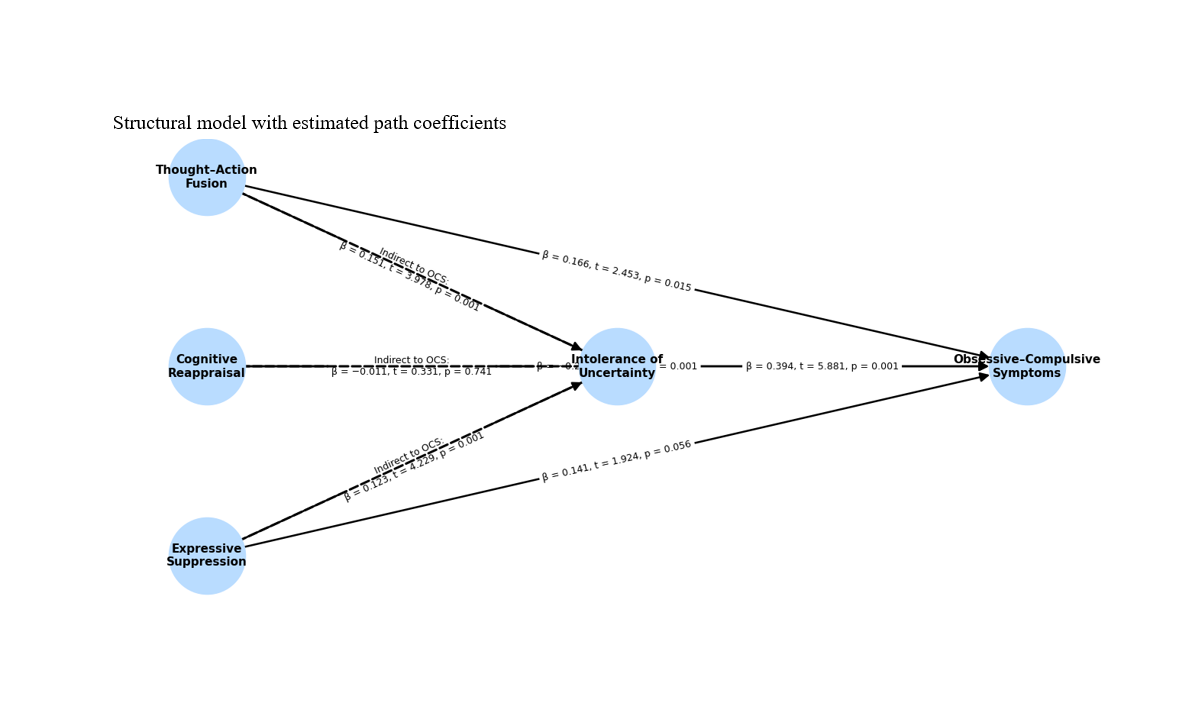
Findings: The results indicated a positive and significant direct effect of thought–action fusion on obsessive–compulsive symptoms (β = 0.17, p < .05) and a negative and significant direct effect of cognitive reappraisal on obsessive–compulsive symptoms (β = −0.26, p < .01). Intolerance of uncertainty showed a strong positive direct effect on obsessive–compulsive symptoms (β = 0.39, p < .01). Mediation analyses revealed that intolerance of uncertainty significantly mediated the relationship between thought–action fusion and obsessive–compulsive symptoms (β = 0.15, p < .01), as well as the relationship between expressive suppression and obsessive–compulsive symptoms (β = 0.12, p < .01). The overall structural model demonstrated acceptable fit and predictive relevance.
Conclusion: The findings support an integrative cognitive–emotional model in which maladaptive thought–action fusion beliefs and emotion regulation patterns contribute to obsessive–compulsive symptoms directly and indirectly through intolerance of uncertainty.
Downloads
References
Abdollahpour, S., Dehghani Arani, F., & Farahani, H. (2025). The relationship between emotional schemas and intolerance of uncertainty with the mediating role of experiential avoidance in women. Journal of Applied Psychological Research, 16(1), 99-113. https://japr.ut.ac.ir/article_100230.html?lang=en
Altakroni, H. S., Alshalwi, N. D. U., Almegbil, N. S., Almalki, A. M., Alzahrani, N. M., Alfattani, A. A., & Alqahtani, M. M. (2023). Emotion regulation: Toward establishing a culturally based model of emotional expression; validation study. IJMDC, 7(3), 487-495. https://doi.org/10.24911/IJMDC.51-1670688244
Amiri, M., & Alipour, A. (2024). The mediating role of metacognitive beliefs in the relationship between ambiguity tolerance, thought-action fusion, and excessive responsibility with the severity of obsessive-compulsive symptoms in female students of Payame Noor University, South Tehran Payame Noor University, Faculty of Psychology].
Arfaie, A., Besharat Qaramaleki, R., Gholizadeh, H., & Hekmati, A. (2011). Intolerance of uncertainty: A comparison of patients with major depression and obsessive-compulsive disorder. Journal of Medical Sciences, Tabriz University of Medical Sciences, 33(5), 17-22. https://mj.tbzmed.ac.ir/fa/Article/7524
Asgharnejad, R., Alivandi Vafa, M., & Abdi, R. (2023). Predicting obsessive-compulsive disorder symptoms based on thought-action fusion and mindfulness in a non-clinical population. Journal of Disability Studies, 13(1), 1-171. https://jdisabilstud.org/article-1-3195-en.html
Bischof, C., Hohensee, N., Dietel, F. A., Doebler, P., Klein, N., & Buhlmann, U. (2024). Emotion regulation in obsessive-compulsive disorder: An ecological momentary assessment study. Behavior therapy, 55(5), 935-949. https://doi.org/10.1016/j.beth.2024.01.011
Brakoulias, V. (2024). Obsessive-compulsive and related disorders, hypochondriasis, and behavioral addictions. In L. Al-Shawaf & T. K. Shackelford (Eds.), The Oxford Handbook of Evolution and the Emotions (pp. 1317-1326). Oxford Academic. https://doi.org/10.1093/oxfordhb/9780197544754.013.66
Buher, K., & Dugas, M. J. (2006). Inves ga the construct validity pf intolerance uncertainty and its unique rela onship with worry. Anxiety Disord, 20, 222-236. https://doi.org/10.1016/j.janxdis.2004.12.004
Carlson, K. W., Smolker, H. R., Smith, L. L., Snyder, H. R., Hankin, B. L., & Banich, M. T. (2025). Individual differences in intolerance of uncertainty is primarily linked to the structure of inferior frontal regions. Cognitive, Affective, & Behavioral Neuroscience. https://doi.org/10.3758/s13415-025-01288-y
Cha, W. J., & Hyun, M. H. (2024). Effect of emotional regulation strategies on psychological distress in obsessive-compulsive tendency. Stress, 32(2), 104-110. https://doi.org/10.17547/kjsr.2024.32.2.104
Ciria, L. F., Quintero, M. J., López, F. J., Luque, D., Cobos, P. L., & Morís, J. (2021). Intolerance of uncertainty and decisions about delayed, probabilistic rewards: A replication and extension of Luhmann, C. C., Ishida, K., & Hajcak, G. (2011). PLoS One, 16(9), e0256210. https://doi.org/10.1371/journal.pone.0256210
DelValle, M. V., Andres, M. L., Urquijo, S., Zamora, E. V., Mehta, A., & Gross, J. J. (2022). Argentinean Adaptation and Psychometric Properties of the Emotion Regulation Questionnaire (ERQ). Psychological Reports, 125(5), 2733-2759. https://doi.org/10.1177/00332941211021343
Elaine, A. D., Henna, J. R. B. S., & Oliveira, L. S. S. (2023). Application of the cognitive fusion questionnaire in patients of the anxiety, serious depression, mood disorders outpatient of "Conjunto Hospitalar de Sorocaba". International journal of health sciences, 3(63), 1-8. https://doi.org/10.22533/at.ed.1593632324088
Fathi Avali Gheshlaqi, A., & Najafi, M. (2023). A comparison of intolerance of uncertainty, cyberchondria, and health anxiety in individuals with obsessive-compulsive disorder, generalized anxiety disorder, depression, and normal individuals. Cultural Psychology Journal, 7(2), 46-64. https://jcp.samt.ac.ir/article_187000.html
Fornell, C., & Larcker, D. F. (1981). Evaluating structural equation models with unobservable variables and measurement error. Journal of Marketing Research, 18(1), 39-50. https://doi.org/10.2307/3151312
Freeston, M. H., Rheaume, J., Letarte, H., Dugas, M. J., & Ladouceur, R. (1994). Why do people worry? Pers Indiv Di er, 17(6), 791-802. https://doi.org/10.1016/0191-8869(94)90048-5
Gross, J. J., & John, O. P. (2003). Individual differences in two emotion regulation processes: Implications for affect, relationships, and well-being. Journal of personality and social psychology, 85(1), 348-362. https://doi.org/10.1037/0022-3514.85.2.348
Henseler, J., Ringle, C., & Sinkovics, R. (2009). The Use of Partial Least Squares Path Modeling in International Marketing. In Advance in International Marketing (Vol. 20, pp. 277-319). https://doi.org/10.1108/S1474-7979(2009)0000020014
Kaçar-Başaran, S., & Gökdağ, C. (2025). From self-compassion to obsessive-compulsive symptoms: The mediator role of intolerance of uncertainty. Current Psychology. https://doi.org/10.1007/s12144-025-07324-x
Karreman, A., & Vingerhoest, A. D. J. (2012). Attachment and well-being: The mediating role of emotion regulation and resilience. Personality and individual differences, 53(7), 821-826. https://doi.org/10.1016/j.paid.2012.06.014
Kaviani, S. (2010). Investigating the relationship between religious-moral obsession with symptoms of obsessive-compulsive disorder and cognitive styles related to obsessive-compulsive disorder Allameh Tabataba'i University]. https://elmnet.ir/doc/10499918-3286
Khadem, S., Emadian, A., & Fakhri, M. (2023). The effectiveness of mindfulness-based cognitive therapy on rumination, perfectionism, and thought-action fusion in women with obsessive-compulsive disorder. Journal of Studies and Innovations in Adolescent and Youth Psychology, 4(4), 148-163. https://doi.org/10.61838/kman.jayps.4.4.11
Knowles, K. A., & Olatunji, B. O. (2023). Intolerance of uncertainty as a cognitive vulnerability for obsessive-compulsive disorder: A qualitative review. Clinical Psychology: Science and Practice, 30(3), 317-330. https://doi.org/10.1037/cps0000150
Kosonogov, V. V., Ntoumanis, I., Hajiyeva, G., & Jääskeläinen, I. P. (2023). Emotion regulation: A study of electroencephalographic correlates. Genes and Cells, 4, 618-621. https://doi.org/10.17816/gc623335
Kousheshi, M., Yousefi, R., & Vagef, L. (2024). Cognitive correlates of obsessive-compulsive disorder: The predictive share of maladaptive threat magnification style, executive function, thought-action fusion, and metacognition. Journal of Cognitive and Behavioral Sciences Research, 14(1), 125-150. https://cbs.ui.ac.ir/article_29255.html?lang=en
Lee, S. W., Jang, T. Y., Kim, S., & Lee, S. J. (2023). Heightened but inefficient thought-action fusion in obsessive-compulsive disorder: New insight from a multiple trial version of the classic thought-action fusion experiment. Psychiatry Investigation, 20(2), 120-129. https://doi.org/10.30773/pi.2022.0262
Lee, S. W., Lee, S. J., & Choi, M. (2025). Psychological inflexibility, cognitive fusion, and thought-action fusion as a transdiagnostic construct: Direct comparisons among major depressive disorder, obsessive-compulsive disorder, and healthy controls. Psychiatry Investigation, 22(1), 93-101. https://doi.org/10.30773/pi.2024.0209
Maheshwari, P., & Tankha, G. (2024). A study of intolerance of uncertainty and trauma in OCD patients. Indian Journal of Science and Technology, 17(44), 4663-4668. https://doi.org/10.17485/IJST/v17i44.415
Mousavi, A., & Najafi, M. (2023). The mediating role of emotion regulation difficulties in the relationship between intolerance of uncertainty and obsessive-compulsive symptoms Semnan University, Faculty of Psychology and Educational Sciences].
Nielsen, S. K. K., Stuart, A. C., Winding, C., Pedersen, M. Ø., Franksdatter Daniel, S. I., Vangkilde, S., Rosenberg, N., & Hageman, I. (2025). Adult attachment style, emotion regulation and obsessive-compulsive disorder-A preliminary cross-sectional mediational investigation of an attachment-based model. Clinical Psychology & Psychotherapy, 32(1), e70031. https://doi.org/10.1002/cpp.70031
Partovi Piroz, L., Jamhari, F., Saadati Shameer, E., & Hassani, J. (2022). A structural model of health anxiety based on intolerance of uncertainty and anxiety sensitivity with the mediation of rumination in students. Psychological Studies of Adolescents and Youth, 3(2), 278-290. https://doi.org/10.61838/kman.jayps.3.2.21
Pilunthanakul, T., Yim, J., Jayaraman, H., Lau, B. J., Ang, D., Wong, S., & Gupta, B. (2024). Effectiveness of a tertiary specialist obsessive-compulsive disorder (OCD) service in improving clinical outcomes for patients with treatment-resistant/complex OCD. Singapore medical journal. https://doi.org/10.4103/singaporemedj.SMJ-2024-033
Pragya, M., Gupta, A., & Sidana, A. (2023). Cognitive retraining in obsessive-compulsive disorder and its effectiveness. Minerva Psychiatry, 64(4), 477-485. https://doi.org/10.23736/S2724-6612.22.02353-3
Rassin, E., Diepstraten, P., Merckelbach, H., & Muris, P. (2001). Thought-action fusion and thought suppression in obsessive-compulsive disorder. Behaviour Research and Therapy, 39(7), 757-764. https://doi.org/10.1016/S0005-7967(00)00051-6
Safaridizaj, S., & Alipanah, A. (2023). The effectiveness of group schema therapy on distress tolerance and obsessive-compulsive symptoms in patients with obsessive-compulsive disorder. Journal of Sabzevar University of Medical Sciences, 30(3), 393-403. https://www.magiran.com/paper/2620574/effectiveness-of-group-schema-therapy-on-distress-tolerance-and-obsessive-compulsive-symptoms-in-patients-with-obsessive-compulsive-disorder?lang=en
Sahib, A., Chen, J., Cárdenas Vélez, D., Calear, A. L., & Wilson, C. (2024). Emotion regulation mediates the relation between intolerance of uncertainty and emotion difficulties: A longitudinal investigation. Journal of affective disorders, 364, 194-204. https://doi.org/10.1016/j.jad.2024.08.056
Sanavio, E. (1988). Obsessions and compulsions: The Padua Inventory. Behaviour Research and Therapy, 26(2), 169-177. https://doi.org/10.1016/0005-7967(88)90116-7
Sayyadi, A., & Janalizadeh, C. (2021). The effectiveness of positive parenting training on dark personality traits, self-conscious affect, and emotion regulation strategies University of Guilan, Faculty of Literature and Humanities].
Shafaei, A., & Jafari, A. (2021). The role of perceived stress, intolerance of uncertainty, and COVID-19 anxiety in predicting the severity of symptoms in patients with obsessive-compulsive disorder Payame Noor University, Guilan Province, Astara Center].
Shafran, R., Watkins, E., & Charman, T. (1996). Guilt in obsessive-compulsive disorder. Journal of anxiety disorders, 10(6), 509-516. https://doi.org/10.1016/S0887-6185(96)00026-6
Shams, G., Kaviani, H., Esmaili Torkanbori, Y., Ebrahimkhani, N., & Amin Manesh, A. (2010). Validation and reliability of the Persian version of the Padua Inventory (Washington State University Revision) in a healthy Iranian student population. Advances in Cognitive Sciences, 12(1), 1-16. https://icssjournal.ir/article-1-77-en.html
Sharmi Alamdari, F., Mirzapur Alamdari, M., & Mirtabar, M. (2023). The role of cognitive emotion regulation strategies and personality traits in predicting obsessive-compulsive disorder during the COVID-19 pandemic. Third National and First International Conference on Research and Innovation in Psychology, with a Special Focus on Transdiagnostic Therapies, Tehran, Iran.
Thoustrup, C. L., Uhre, C., Uhre, V., Ritter, M., Vangkilde, S., Engstrøm, J., Lindschou, J., Gluud, C., Pagsberg, A. K., & Olsen, M. H. (2025). Emotion dysregulation in youths with obsessive-compulsive disorder and its implication for treatment - An exploratory study from the TECTO trial: A protocol and statistical analysis plan. Contemporary Clinical Trials Communications, 43, 101408. https://doi.org/10.1016/j.conctc.2024.101408
Vitolo, E., Diano, M., Giromini, L., & Zennaro, A. (2022). Markers of emotion regulation processes: A neuroimaging and behavioral study of reappraising abilities. Biological Psychology, 171, 108349. https://doi.org/10.1016/j.biopsycho.2022.108349
Wang, L., & Jia, F. (2024). Analysis of the characteristics and influencing factors of perinatal obsessive-compulsive symptoms in elderly parturients. Health Medicine, 85(10), 1-13. https://doi.org/10.47363/JMHC/2024(6)283
Zhu, J. (2023). Research on the characteristics of emotion regulation in obsessive-compulsive disorder. Lecture Notes in Education Psychology and Public Media, 11, 233-237. https://doi.org/10.54254/2753-7048/11/20230747
Downloads
Additional Files
Publication Timeline
- Submitted
- Revised
- Accepted