The Mediating Role of School Belonging and Parental Educational Aspirations in the Relationship Between Goal Congruence and Academic Persistence
DOI:
https://doi.org/10.61838/kman.jayps.5250Keywords:
Goal congruence, school belonging, parental educational aspirations, academic persistence, structural equation modelingAbstract
Objective: The present study aimed to examine the mediating role of school belonging and parental educational aspirations in the relationship between goal congruence and academic persistence among high school students.
Methods and Materials: This study employed a quantitative, cross-sectional correlational design using structural equation modeling. The statistical population consisted of high school students in Tehran during the 2025 academic year, from which a sample of 412 students (209 females and 203 males) was selected through multistage cluster sampling. Data were collected using standardized instruments, including the Goal Congruence Scale, the Psychological Sense of School Membership Scale, the Parental Educational Aspirations Scale, and the Academic Persistence Scale. The validity and reliability of all instruments had been confirmed in previous studies. Data analysis was conducted using SPSS-27 for preliminary analyses and AMOS for structural equation modeling. Model fit was evaluated using indices such as χ²/df, CFI, TLI, NFI, and RMSEA, and mediation effects were tested using bootstrapping procedures.
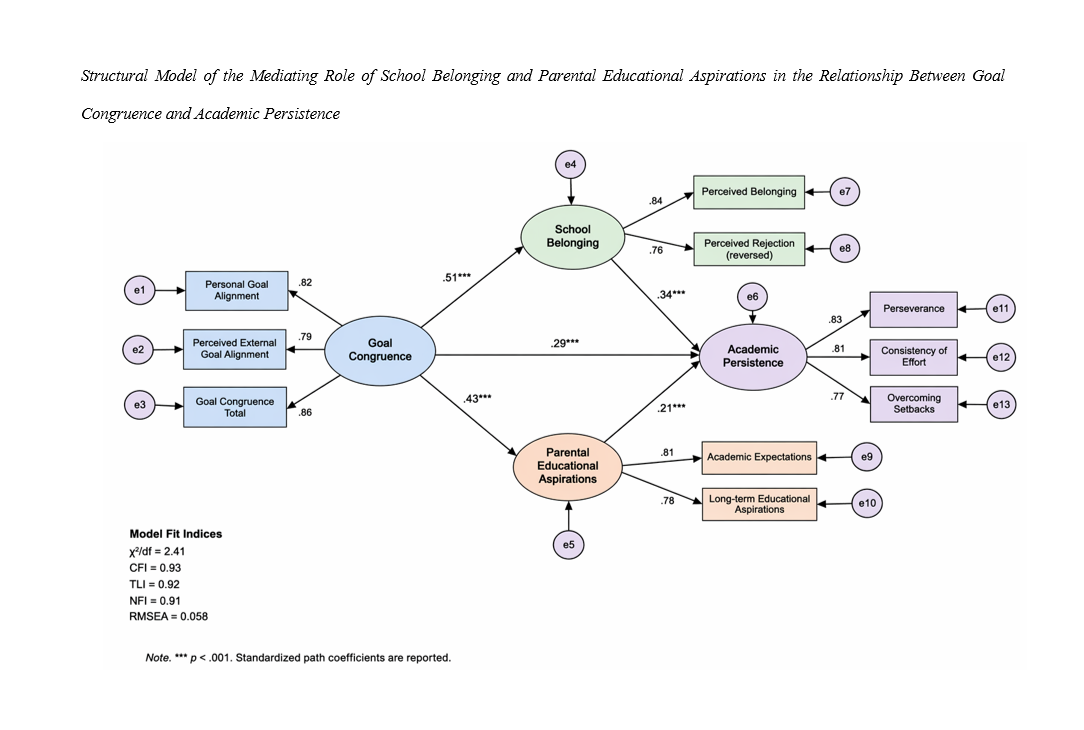
Findings: The results indicated that goal congruence had a significant direct effect on academic persistence (β = 0.29, p < 0.001). Additionally, goal congruence significantly predicted school belonging (β = 0.51, p < 0.001) and parental educational aspirations (β = 0.43, p < 0.001), both of which had significant positive effects on academic persistence (β = 0.34 and β = 0.21, respectively; p < 0.001). Bootstrapping analysis confirmed that both school belonging (β = 0.17, 95% CI [0.11, 0.24]) and parental educational aspirations (β = 0.09, 95% CI [0.05, 0.14]) significantly mediated the relationship between goal congruence and academic persistence, with school belonging demonstrating a stronger mediating effect. The overall model demonstrated good fit to the data (χ²/df = 2.41, CFI = 0.93, TLI = 0.92, NFI = 0.91, RMSEA = 0.058).
Conclusion: The findings highlight the critical role of both individual motivational alignment and relational-contextual factors in shaping academic persistence.
Downloads
References
Antony, J. S., & Schaps, T. L. (2021). The More Things Change, the More They Stay the Same. 383-417. https://doi.org/10.1007/978-3-030-44007-7_9
Carlana, M., Ferrara, E. L., & Pinotti, P. (2022). Goals and Gaps: Educational Careers of Immigrant Children. Econometrica, 90(1), 1-29. https://doi.org/10.3982/ecta17458
Chen, W., Yang, L., Li, L., Shao, K., Wei, W., & Wang, F. (2025). Adolescent–Parent Career Congruence and Career Adaptability in High School Students: Learning Factors’ Mediation. Journal of Career Development, 52(3), 407-422. https://doi.org/10.1177/08948453251323825
Cooper, S. M., Burnett, M., Golden, A. R., Butler‐Barnes, S. T., & Inniss‐Thompson, M. N. (2022). School Discrimination, Discipline Inequities, and Adjustment Among Black Adolescent Girls and Boys: An Intersectionality‐Informed Approach. Journal of Research on Adolescence, 32(1), 170-190. https://doi.org/10.1111/jora.12716
Davis, B. K. (2021). Influences on Academic Talent Development of Black Girls in K-12: A Systematic Review. Journal of Advanced Academics, 32(4), 435-468. https://doi.org/10.1177/1932202x211013806
Eller, C. C., Khanna, K., & Mellon, G. (2024). Intermediate Educational Transitions, Alignment, and Inequality in U.S. Higher Education. Sociology of Education, 97(4), 316-341. https://doi.org/10.1177/00380407241245392
Fraysier, K., & Reschly, A. L. (2022). The Role of High School Student Engagement in Postsecondary Enrollment. Psychology in the Schools, 59(11), 2183-2207. https://doi.org/10.1002/pits.22754
Gil, E., & Parnther, C. (2024). Exploring the Mutual Benefits of Reciprocal Mentorship in a Community-Based Program: Fostering Community Cultural Wealth of Latino Students and Families. Journal of Hispanic Higher Education, 23(3), 155-171. https://doi.org/10.1177/15381927231224451
González-Pérez, S., Martínez, M. M., Paredes, V. R., & Cifré, E. (2022). I Am Done With This! Women Dropping Out of Engineering Majors. Frontiers in psychology, 13. https://doi.org/10.3389/fpsyg.2022.918439
Guzman, L. D., Sullivan, M. A., & McDonald, N. (2025). Cultivating Careers in Agriculture: Exploring the Life Experiences, Career Motivations, and Vocational Identity of Young Australians. Australian Journal of Career Development, 34(1), 81-93. https://doi.org/10.1177/10384162251326167
Labib, N. (2021). Parental Control and Career Decision-Making Among Arab Women in the United Arab Emirates. Gulf Education and Social Policy Review (Gespr), 1(2), 135-154. https://doi.org/10.18502/gespr.v1i2.8459
Liem, G. A. D., & Fredricks, J. A. (2025). Groups, Goals, and Growth: How Peer Acceptance Shapes Student Development in Co‐curricular Activities. British Journal of Educational Psychology, 95(4), 1134-1154. https://doi.org/10.1111/bjep.12753
Moyna, M. I., & Zapata, G. C. (2024). Somos Tejas: A Narrative Project to Document the College Experiences of First‐Generation Latinx Students. Diversity & Inclusion Research, 1(2). https://doi.org/10.1002/dvr2.70003
Nathans, L., Mogbojuri, O., Addai, E. K., Walsh, B. A., Aguirre, M., Lucero, J., & Hambrick, K. (2024). Development and Validation of the Family Involvement in Graduate School (FIGS) Measure. Sage Open, 14(3). https://doi.org/10.1177/21582440241276177
Negrete, A. H., Mouavangsou, K. N., & Caporale, N. (2023). Toward Asset-Based LatCrit Pedagogies in STEM: Centering Latine Students’ Strengths to Reimagine STEM Teaching and Practice. Frontiers in Education, 8. https://doi.org/10.3389/feduc.2023.1176913
Neumann, N., Somoza-Norton, A., & López, L. M. (2024). Recruitment and Retention of Latinx Teachers Is Top Priority: So Why Are New Teachers Saying ¡Adiós!? Journal of Cases in Educational Leadership, 28(2), 3-13. https://doi.org/10.1177/15554589241286805
Noll, L. A. (2021). Accountability and (In)Congruence in a No-Excuses School College-Going Culture. American Educational Research Journal, 59(1), 112-145. https://doi.org/10.3102/00028312211057303
Noman, M. (2023). Reflection on Visioning as a Leadership Practice. Management in Education, 39(4), 193-195. https://doi.org/10.1177/08920206231185935
Norwood, J., Pabon‐Rodriguez, F. M., & Figueroa-Rosado, A. L. (2025). Assessment of Self-Reported Perception and Aspirations of Online Undergraduate Students Regarding STEM Fields. https://doi.org/10.21203/rs.3.rs-5717811/v1
Ovink, S. M., & Veazey, B. D. (2021). More Than “Getting Us Through:” a Case Study in Cultural Capital Enrichment of Underrepresented Minority Undergraduates. https://doi.org/10.31235/osf.io/9urpn
R., B. (2024). Impact of Career Ambitions On College Girls. International Journal for Multidisciplinary Research, 6(2). https://doi.org/10.36948/ijfmr.2024.v06i02.14766
Ravishankar, S., Noakes, T. L. S., Fernandes, I. H., Hayes, M., Coopwood, S., Spencer, I. W. F., & Neal, S. E. (2024). Empowering STEM Students: A University-Wide Mentorship Program Fostering Retention and Belonging. https://doi.org/10.1101/2024.04.02.587784
Rocha, J., Cabral, B., Landeros, J., & Yancy, C. W. (2022). Why Continuity of STEM-Medicine Participation Matters: Exploring a Culture of Transformation and the Optimization of College Socialization. Journal of Advanced Academics, 33(3), 433-468. https://doi.org/10.1177/1932202x221098008
S., N. A. (2024). Career Track and Course Preference of Freshmen Students of MSU Main Campus: Its Influence to Student Monitoring System. International Journal for Multidisciplinary Research, 6(5). https://doi.org/10.36948/ijfmr.2024.v06i05.29744
Schoon, I., & Burger, K. (2022). Incongruence Between Parental and Adolescent Educational Aspirations Hinders Academic Attainment. Longitudinal and Life Course Studies, 13(4), 575-595. https://doi.org/10.1332/175795921x16324800210845
Singh, H. P., & Alhulail, H. (2022). Predicting Student-Teachers Dropout Risk and Early Identification: A Four-Step Logistic Regression Approach. IEEE Access, 10, 6470-6482. https://doi.org/10.1109/access.2022.3141992
Stamou, P., Tsoli, K., & Babalis, T. (2024). The Role of Counseling for Non-Traditional Students in Formal Higher Education: A Scoping Review. Frontiers in Education, 9. https://doi.org/10.3389/feduc.2024.1361410
Turner, S. L., & Pope, M. (2023). Career Psychology and Work in the Native American Context. 367-387. https://doi.org/10.1037/0000339-018
Williams‐Johnson, M., & Cain, E. J. (2020). Looking Toward the Future: The Educational Aspirations of Rural African American Students. New Directions for Student Services, 2020(171-172), 47-55. https://doi.org/10.1002/ss.20364
Yau, P. S., Cho, Y. W., Kay, J., & Heckhausen, J. (2022). The Effect of Motive-Goal Congruence on Adolescents’ Academic Goal Engagement and Disengagement. Motivation and Emotion, 46(4), 447-460. https://doi.org/10.1007/s11031-022-09946-1
Yukhymenko–Lescroart, M. A., & Sharma, G. (2022). Sense of Life Purpose Is Related to Grades of High School Students via Academic Identity. Heliyon, 8(11), e11494. https://doi.org/10.1016/j.heliyon.2022.e11494
Zhao-hui, C., Chebet, Y. M., & Sampene, A. K. (2025). To Continue or to Quit: Investigating the Role of Affective and Cognitive Engagement on Female School Dropout. Psychology in the Schools, 62(9), 3481-3497. https://doi.org/10.1002/pits.23558
Zhou, N. (2024). Perceived Parental Career Expectation and Adolescent Career Development: The Mediating Role of Adolescent Career-Planning and Goal-Setting Self-Efficacy and the Moderating Role of Perceived Parent–adolescent Career Congruence. Journal of counseling psychology, 71(6), 621-632. https://doi.org/10.1037/cou0000736
Downloads
Additional Files
Publication Timeline
- Submitted
- Revised
- Accepted