Development and Validation of an Islamic Logotherapy Training Package and Determining Its Effectiveness on Religious Identity and Academic Self-Efficacy of Female First-Grade Secondary School Students
DOI:
https://doi.org/10.61838/kman.jayps.5291Keywords:
Islamic logotherapy, academic self-efficacy, religious identityAbstract
Objective: The study aimed to develop and validate an Islamic logotherapy training package and to determine its effectiveness on religious identity and academic self-efficacy among female first-grade secondary school students.
Methods and Materials: This study employed a mixed-methods design, combining qualitative content analysis and a quasi-experimental approach. In the qualitative phase, seven volumes of the works of Ayatollah Safaei Haeri were analyzed to extract the core components of Islamic logotherapy, and the training package was developed and validated through expert review, with acceptable content validity ratio and inter-coder reliability (Cohen’s kappa = 0.78). In the quantitative phase, the statistical population included all female students in the first grade of secondary school in District 14 of Tehran during the 2023–2024 academic year. Using convenience sampling, 30 students with low scores on religious identity and academic self-efficacy were selected and randomly assigned to experimental and control groups (n = 15 each). The experimental group received nine sessions (70–90 minutes each) of Islamic logotherapy training, while the control group received no intervention. Data were collected using the Religious Identity Questionnaire and the Academic Self-Efficacy Questionnaire, both demonstrating high reliability (Cronbach’s alpha = 0.95 and 0.96, respectively). Data were analyzed using multivariate analysis of covariance (MANCOVA) in SPSS.
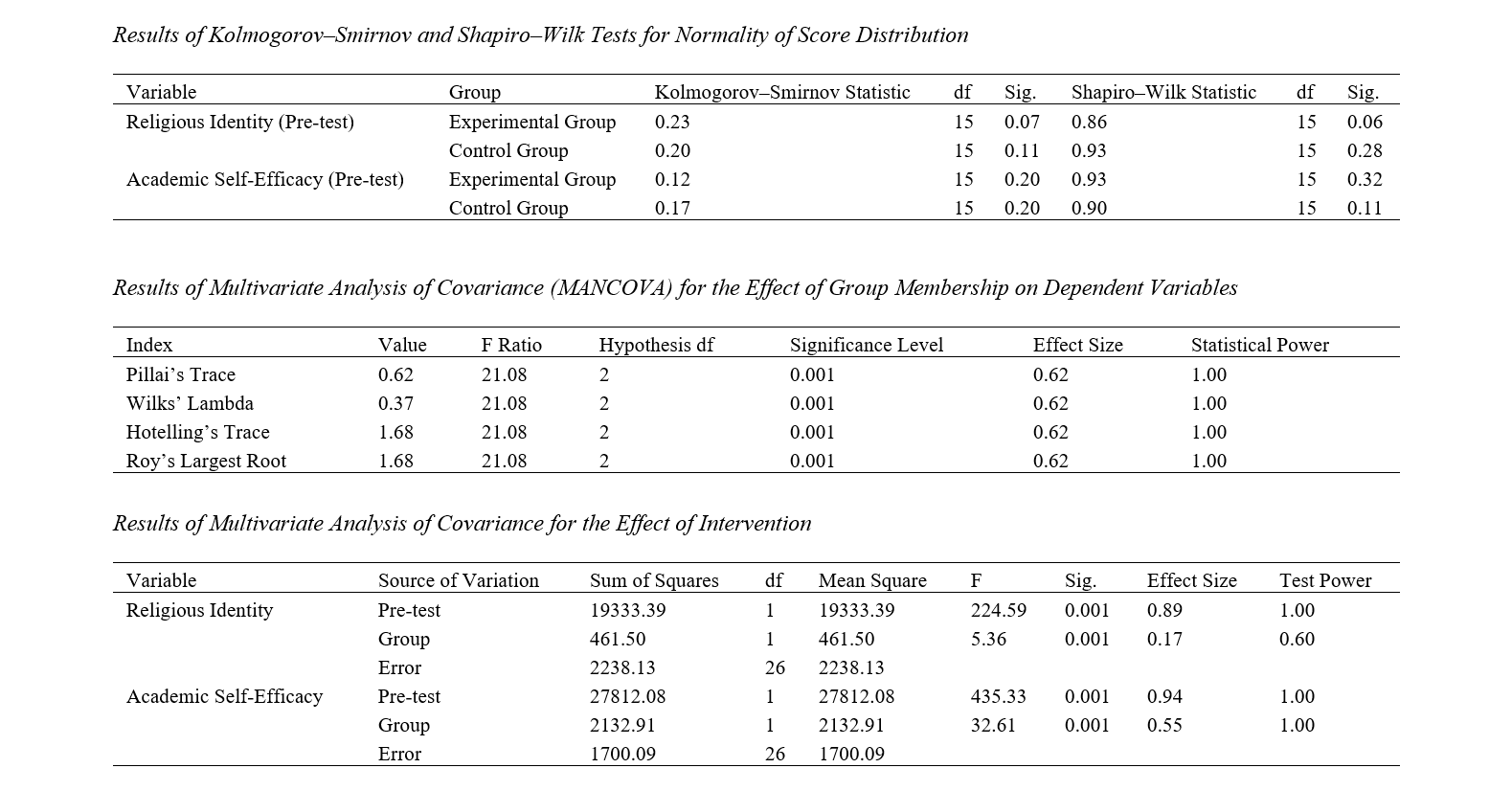
Findings: The results of MANCOVA indicated that the Islamic logotherapy intervention had a statistically significant effect on both religious identity and academic self-efficacy at the post-test stage (p < .05). Group membership accounted for 17% of the variance in religious identity and 55% of the variance in academic self-efficacy. Additionally, repeated measures analysis showed that the improvement in religious identity remained stable at the one-month follow-up, whereas the effect on academic self-efficacy was not sustained over time.
Conclusion: The findings suggest that the Islamic logotherapy training package is an effective intervention for enhancing religious identity and improving academic self-efficacy among adolescents, although sustained effects on self-efficacy may require ongoing reinforcement.
Downloads
References
Aiello-Puchol, A., & Garcia-Alandete, J. A. (2025). Systematic review on the effects of logotherapy and meaning-centered therapy on psychological and existential symptoms in women with breast and gynecological cancer. Supportive Care in Cancer, 33(6), 465. https://doi.org/10.1007/s00520-025-09519-1
Akhavan Moqaddam, Z., Mohammadi Ashnanei, A., & Khani Oshani, L. (2021). Causes, symptoms and consequences of loneliness in religious and psychological teachings. Pazhouhesh Dini, 21(43), 5-29.
Alborz, A., Jafari, M., & Poormokhtar, M. (2022). Happiness and welfare in Jami's poems. Ethical Research, 12(3), 5-26. https://doi.org/20.1001.1.23833279.1401.12.47.14.6
Badsar, M. S. (2023). Investigating the mediating role of academic optimism in the relationship between academic self-efficacy and academic performance among students of Kavian Higher Education Institute Kavian Higher Education Institute].
Banahan, M., & Tarazmonfared, F. (2022). Death awareness and its educational implications in increasing calmness relying on narrations of the Infallibles. Research in Islamic Education Issues, 29(53), 31-64.
Barroso, D. C., Madeira, T. M., Marinho, A. D., Teixeira Filho, A. V., Freita, M. A. A., & Pirez, J. (2023). Effect of logotherapy on anxiety in patients with cancer: A systematic review and meta-analysis. Annals of Oncology. https://doi.org/10.1016/j.annonc.2023.09.2803
Danesh, J. (2024). A study of the concept of moral responsibility. Naqd va Nazar, 28(4), 32-56. https://doi.org/10.22081/jpt.2024.68601.2109
Derikvand, M., & Dezhpasand, A. (2021). A comparative study on the philosophy of suffering from the perspective of the Quran and the paradigm of logotherapy. Islamic Psychology Research, 4(1), 29-48.
Eskigulek, Y., & Kav, S. (2024). Effect of logotherapy counseling program on chronic sorrow, dignity, and meaning in life of palliative care patients: A randomized controlled trial. Supportive Care in Cancer, 32, 587. https://doi.org/10.1007/s00520-024-08792-w
Esmaeilpour Dilmaghani, R., Panahali, A., Aghdasi, A., & Khademi, A. (2022). The effectiveness of group logotherapy on death anxiety, loneliness and meaning of life in elderly women with fear of coronavirus. Aging Psychology, 8(2), 135-147. https://doi.org/10.22126/JAP.2022.7755.1622
Faraji, F., Nouhi, S., Piadekouhsar, A., & Janbozorgi, M. (2021). The effectiveness of God-inclined spiritually multidimensional psychotherapy in improving symptoms of psychological disorders and post-traumatic stress disorder. Assessment and Research in Counseling and Psychology, 3(1), 1-16. https://doi.org/10.52547/jarcp.3.1.1
Hasani, Z., Hosseini-Niya, S. M. R., & Akbarnejad, M. (2021). The fundamentals of thinking about death in the teachings of the Quran and Hadith. Religious Research, 42, 73-105.
Hosseinpour Tonekaboni, R., Masoudi, J., & Hosseini-Shahrudi, S. M. (2022). Making meanings or discovering meanings? A study and reconciliation of the views of Irvin Yalom and Viktor Frankl about the meaningfulness of life. Naqd va Nazar, 27(3), 9-31. https://doi.org/10.22081/jpt.2021.60425.1828
Jafari, Z., Heydari-Noori, R., & Namvar, H. (2022). The effectiveness of meaning and purpose in positive psychology according to Seligman and its adaptation to Attar's poems. Persian Language and Literature, 14(51), 69-94. https://doi.org/10.30495/farsij.2022.692899
Janbozorgi, A., & Janbozorgi, M. (2021). Therapeutic lifestyle regulation: A short-term intervention to prevent and treat anxiety based on multidimensional God-oriented spiritual therapy. Lifestyle, 6(11), 125-141.
Janbozorgi, M., Noori, N., Heydarizad, M., Janbozorgi, A., Janbozorgi, A., & Nazari, M. (2020). The effectiveness of God-oriented spiritual therapy and non-spiritual therapies on stress management during the coronavirus crisis and preliminary design of a spiritual model of psychological crisis intervention. Clinical Psychology and Personality, 18(1), 201-214. https://doi.org/10.22070/cpap.2020.2932
Julaeiha, N., Janbozorgi, M., Alipour, A., & Pasandideh, A. (2021). Comparison of the effectiveness of God-oriented multidimensional spiritual parenting and positive parenting on self-esteem, self-efficacy and self-control of children with stressed parents. Research in Behavioral Sciences, 19(2), 276-292. https://doi.org/10.29252/rbs.19.2.276
Khani-Oshani, L., Mohammadi-Ashnani, A., & Nabavi, S. M. (2021). The lexical domain of loneliness in the Holy Quran and its comparison with psychological expressions. Knowledge and Teachings of Quran and Hadith, 3(12), 81-100.
Lisna, I., & Kovalchuk, O. (2024). Freedom and responsibility in the context of logotherapy. The Teaching, Learning, Medical and Psychological Support as Challenges of 21st Century, Warsaw, Poland.
Mohammadi-Monfared, B., & Kakavand, M. (2020). The nature and components of happiness in the doctrine of Mahdism with emphasis on hope. Mahdism Studies, 11(49), 85-114.
Moosavian, E. (2020). A theoretical review of the concept of loneliness from the perspective of psychological approaches. Rooyesh, 9(9), 195-204.
Moradi, A. (2022). The role of moral identity in predicting students' academic adjustment and academic self-efficacy University of Sistan and Baluchestan].
Naghdi, M., Taher, M., Aghaei, H., & Heidari, S. A. (2023). Comparing the effectiveness of logotherapy and acceptance and commitment therapy on the loneliness of the elderly. Journal of Psychological Science, 22(128), 1663-1678.
Nikan, A., Torabi, A., Mohseninasab, Z., Bahadori, A., Javanmard, Z., & Hosinirad, M. (2023). Comparing the effectiveness of schema therapy and mindfulness-based cognitive therapy on stress, resilience, emotion regulation and psychological well-being of cardiovascular patients. Research in Psychological Health, 17(1), 46-60.
Rahimi, M. (2024). The role of academic self-efficacy in students' achievement and perseverance. Educational Psychology, 20(4), 123-145.
Rahmani, R., & Enayat, H. (2025). The role of spiritual health in predicting general health and its three dimensions among female adolescents in Jahrom. Social Sciences Journal of Ferdowsi University of Mashhad, 22(1), 97-129. https://doi.org/10.22067/social.2025.88944.1532
Rezaee, S. (2021). The effectiveness of academic resilience training on self-concept and academic self-efficacy of students at Payam Noor University of Hamedan Payam Noor University of Hamedan].
Schmees, P., Braig, J., & Kilinc, Y. (2024). Religious identity and its relation to health-related quality of life and COVID-related stress of refugee children and adolescents in Germany. Journal of religion and health, 63, 765-787. https://doi.org/10.1007/s10943-023-01966-6
Seghati, T., Shafiabadi, A., Sodani, M., & Gholamzadeh Jafreh, M. (2022). Comparison of the effectiveness of group logotherapy and group cognitive behavioral counseling on loneliness and hope in life among students with depression. Knowledge and research in applied psychology, 23(2), 25-39.
Seidy, M., & Pashaei, M. (2021). Joy and sorrow from Ibn Sina's point of view. Avicennian Philosophy, 45(65), 177-193. https://doi.org/10.30497/ap.2021.241288.1537
Shokri, S., Rostami, R., & Mozaffari, F. (2021). Sustainable development of the neighborhood in the direction of social happiness and public happiness. Ethical Research, 12(2), 171-192.
Sohrabifar, V., & Fanaei, A. (2022). Religious spirituality and the meaning of life: The challenge of absurdity. Philosophy of Religion Research, 19(2), 1-22. https://doi.org/10.30497/prr.2022.240880.1675
Sun, M., Xia, P., Yunyi, W., Zheng, L., & Xiao, W. (2024). Effects of meaning therapy on spirituality, psychological health, and quality of life in patients with cancer: A systematic review and meta-analysis of randomized controlled trials. Asia-Pacific Journal of Oncology Nursing, 11. https://doi.org/10.1016/j.apjon.2024.100388
World Health Organization. (2021). Mental health of adolescents. https://www.who.int/news-room/fact-sheets/detail/adolescent-mental-health
Yokoyama, S. (2024). Impact of academic self-efficacy on online learning outcomes: A recent literature review. EXCLI journal, 23, 960-966. https://doi.org/10.17179/excli2024-7502
Zangi-Abadi, M., Sadeghi, M., & Ghadampour, E. (2019). Comparing the effectiveness of emotion-focused processing strategies, self-regulation strategies, and logotherapy on academic emotions, academic adjustment, and academic self-efficacy in female high school students of Kerman Lorestan University].
Downloads
Additional Files
Publication Timeline
- Submitted
- Revised
- Accepted