Health on the Way to School: A Comparison of High-Risk Behaviors Among Students Across Different Modes of School Transportation
DOI:
https://doi.org/10.61838/Keywords:
High-risk behaviors, transportation, students, school routeAbstract
Objective: The manner in which students commute to school and its psychological implications have received limited attention from parents and psychologists. Although observational learning (modeling) during students’ daily journeys to and from school plays a significant role in shaping their behaviors and everyday learning experiences, relatively little research has been conducted in this area. The present study aimed to examine the tendency toward high-risk behaviors among secondary school students across different modes of school transportation.
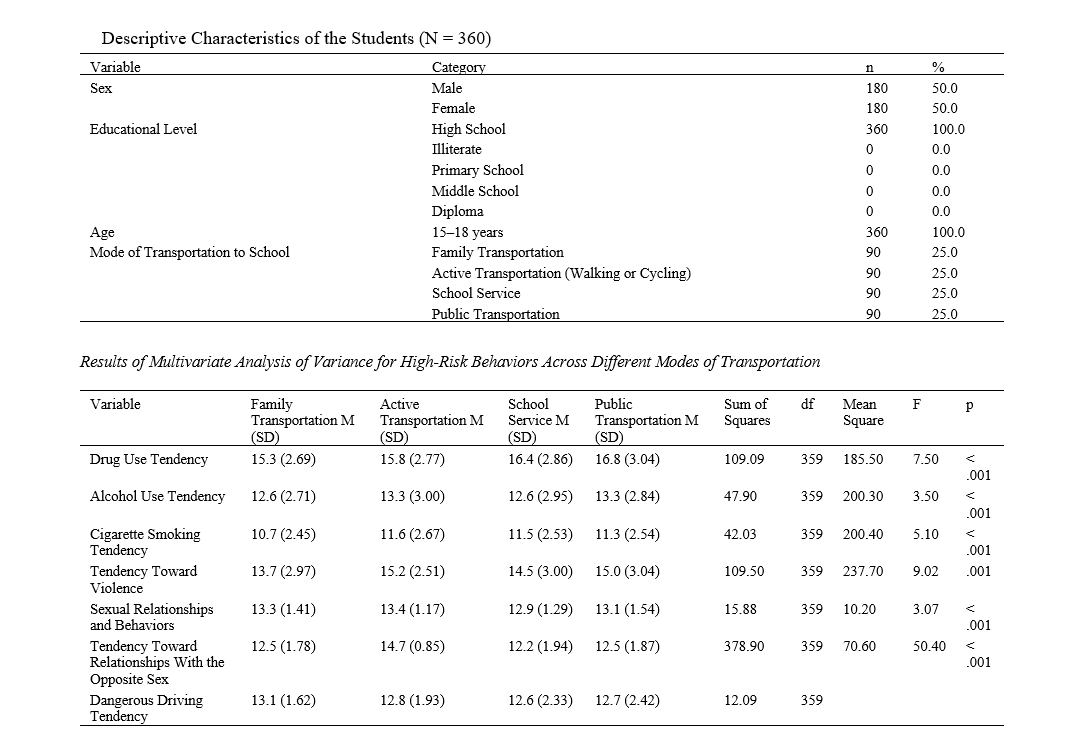
Methods and Materials: The present research employed an ex post facto (causal-comparative) design. The sample consisted of 360 students, including 180 female and 180 male students. Participants were selected using a combination of cluster and stratified sampling methods. Data were collected using the Iranian Adolescents Risk-Taking Scale (IARS) developed by Zadeh Mohammadi et al. (2011).
Findings: The results of multivariate analysis of variance (MANOVA) indicated a statistically significant difference between school transportation methods and students’ tendencies toward high-risk behaviors. Except for two cases in which female students demonstrated higher mean scores than males on tendencies toward high-risk behaviors, male students generally exhibited higher mean scores across different school transportation methods. Female students reported higher mean scores for sexual relationships and sexual behaviors in the active transportation group compared to male students. Furthermore, female students demonstrated higher mean scores for relationships with the opposite sex in the family transportation group than their male counterparts. In addition, the mean tendency toward substance use was higher among students who used public transportation.
Conclusion: Although students’ commuting patterns constitute an important component of their daily activities, peer and community modeling—whether positive or negative—also represents an inseparable aspect of every culture and remains a recurring concern for parents. Therefore, greater attention should be paid to this issue and its psychological effects on both female and male students.
Downloads
References
Allen, C. W., Diamond-Myrsten, S., & Rollins, L. K. (2018). School Absenteeism in Children and Adolescents. American family physician, 98(12), 738-744. https://doi.org/10.1162/edfp_a_00382
Aranda-Balboa, M. J., Huertas-Delgado, F. J., Herrador-Colmenero, M., Cardon, G., & Chillon, P. (2020). Parental Barriers to Active Transport to School: A Systematic Review. International Journal of Public Health, 65(1), 87-98. https://doi.org/10.1007/s00038-019-01313-1
Basso, J., & Suzuki, W. A. (2016). The Effects of Acute Exercise on Mood, Cognition, Neurophysiology, and Neurochemical Pathways: A Review. Brain Plasticity, 2(1), 127-152. https://doi.org/10.3233/BPL-160040
Burdick-Will, J., Stein, M. L., & Grigg, J. (2019). Danger on the Way to School: Exposure to Violent Crime, Public Transportation, and Absenteeism. Sociological Science, 6(1), 118-142. https://doi.org/10.15195/v6.a5
Champion, K. E., Parmenter, B., McGowan, C., Spring, P. B., Wafford, Q. E., & Gardner, L. A. (2019). Effectiveness of School-Based eHealth Interventions to Prevent Multiple Lifestyle Risk Behaviours among Adolescents: A Systematic Review and Meta-Analysis. The Lancet Digital Health, 1(5), 206-221. https://doi.org/10.1016/S2589-7500(19)30088-3
Chan, L. Y., Senserrick, T., & Saggers, B. (2024). Behind the Wheel: Systematic Review of Factors Associated with Safe School Bus Transportation for Children with Neurodevelopmental Disorders. Journal of Autism and Developmental Disorders, 11(2), 343-360. https://doi.org/10.1007/s40489-022-00341-7
Chang, K., Souvenir, B., & Doyle, H. (2024). School Transportation Data Safety Trends. Transportation Research Interdisciplinary Perspectives, 2. https://doi.org/10.1016/j.trip.2024.101089
Coombes, E., & Jones, A. (2016). Gamification of Active Travel to School: A Pilot Evaluation of the Beat the Street Physical Activity Intervention. Health & Place, 39(2), 62-69. https://doi.org/10.1016/j.healthplace.2016.03.001
Cox, E. P. (2016). Relationship between Physical Activity and Cognitive Function in Apparently Healthy Young to Middle-Aged Adults: A Systematic Review. Journal of Science and Medicine in Sport, 19(8), 616-628. https://doi.org/10.1016/j.jsams.2015.09.003
Galvez Casas, A., Rodriguez Garcia, P., Garcia-Canto, E., Rosa Guillamon, A., Perez-Soto, J., & Tarraga Marcos, L. (2015). Aerobic Capacity and Quality of Life in School Children from 8 to 12. Clinica e Investigacion en Arteriosclerosis, 27(5), 239-245. https://doi.org/10.1016/j.arteri.2015.01.001
Gekoski, A., Gray, J. M., Adler, J. R., & Horvath, M. A. (2017). The Prevalence and Nature of Sexual Harassment and Assault against Women and Girls on Public Transport: An International Review. Journal of Criminological Research, Policy and Practice, 3(1), 3-16. https://doi.org/10.1108/JCRPP-08-2016-0016
Graham, B. C., Keys, C. B., & McMahon, S. D. (2014). Transportation and Socioemotional Well-Being of Urban Students with and without Disabilities. Journal of Prevention & Intervention in the Community, 42(1). https://doi.org/10.1080/10852352.2014.855056
Huertas-Delgado, F. J., Herrador-Colmenero, M., Villa-Gonzalez, E., Aranda-Balboa, M. J., Caceres, M. V., & Mandic, M. (2017). Parental Perceptions of Barriers to Active Commuting to School in Spanish Children and Adolescents. European journal of public health, 27(3), 416-421. https://doi.org/10.1093/eurpub/ckw249
Humberto, M., Moura, F., & Giannotti, M. (2021). Can Outdoor Activities and Inquiry Sessions Change the Travel Behavior of Children and Their Caregivers? Empirical Research in Public Preschools in Sao Paulo (Brazil). Journal of Transport Geography, 90(3). https://doi.org/10.1016/j.jtrangeo.2020.102922
Khan, N. A., & Hillman, C. H. (2014). The Relation of Childhood Physical Activity and Aerobic Fitness to Brain Function and Cognition: A Review. Pediatric Exercise Science, 26(2), 138-146. https://doi.org/10.1123/pes.2013-0125
Kordi Haji, A., Hajitabar Firozjaee, H., & Kalantari, K. (2022). Risk Factors and Prevention of Delinquency in Children and Adolescents from the Perspectives of Judges, Social Workers and School Principals of Mazandaran Province. 22(84), 229-265. https://dor.isc.ac/dor/20.1001.1.17358191.1401.22.84.17.3
Loo, B. P., Leung, K. Y., & Chan, F. C. H. (2019). How Short-Term Cycling Training Promotes Cycling among Schoolchildren in High-Density Cities. Journal of Sustainable Transportation, 14(11), 872-885. https://doi.org/10.1080/15568318.2019.1642971
Mairena Carrellan, J. A., Abad Robles, M. T., Gimenez-Fuentes-Guerra, F. J., & Rodriguez Macias, M. (2025). Educational Interventions through Physical Activity for Addiction Prevention in Adolescent Students: A Systematic Review. Education Sciences, 15(3), 348. https://doi.org/10.3390/educsci15030348
Mandic, S., Barra, S. L., Garcia Bengoechea, E., Stevens, E., Flaherty, C., & Moore, A. (2015). Personal, Social and Environmental Correlates of Active Transport to School among Adolescents in Otago, New Zealand. Journal of Science and Medicine in Sport, 18(4), 432-437. https://doi.org/10.1016/j.jsams.2014.06.012
Messing, S., Rutten, A., Abu-Omar, K., Ungerer-Rohrich, U., Goodwin, L., & Burlacu, I. (2019). How Can Physical Activity Be Promoted among Children and Adolescents? A Systematic Review of Reviews across Settings. Frontiers in Public Health, 7(1). https://doi.org/10.3389/fpubh.2019.00055
Poitras, V. J., Gray, C. E., Borghese, M., Carson, V., Chaput, J. P., & Janssen, I. (2016). Systematic Review of the Relationships between Objectively Measured Physical Activity and Health Indicators in School-Aged Children and Youth. Applied Physiology, Nutrition, and Metabolism, 41(6). https://doi.org/10.1139/apnm-2015-0663
Ramanathan, S., O'Brien, C., Faulkner, G., & Stone, M. (2014). Happiness in Motion: Emotions, Well-Being, and Active School Travel. Journal of School Health, 84(8), 516-523. https://doi.org/10.1111/josh.12172
Ross, T., Bilas, P., Buliung, R., & El-Geneidy, A. (2020). A Scoping Review of Accessible Student Transport Services for Children with Disabilities. Transport Policy, 95(3), 57-67. https://doi.org/10.1016/j.tranpol.2020.06.002
Sahin-Ilkorkor, Z., & Brubaker, S. J. (2025). Similarities and Differences between Bullying and Sexual Harassment in Schools: A Social-Ecological Review of Risk and Protective Factors. Behavioral Sciences, 15(1). https://doi.org/10.3390/bs15010061
Schonbach, D. M. I., Altenburg, T. M., Marques, A., Chinapaw, M. J. M., & Demetriou, Y. (2019). Strategies and Effects of Promising School-Based Interventions to Promote Active School Transportation by Bicycle among Children and Adolescents: Protocol for a Systematic Review. Systematic Reviews, 8(296). https://doi.org/10.1186/s13643-019-1216-0
Scrivano, L., Tessari, A., Marcora, S. M., & Manners, D. N. (2023). Active Mobility and Mental Health: A Scoping Review towards a Healthier World. Cambridge Prisms: Global Mental Health, 11(1). https://doi.org/10.1017/gmh.2023.74
Stein, M. L., & Grigg, J. A. (2019). Missing Bus, Missing School: Establishing the Relationship between Public Transit Use and Student Absenteeism. American Educational Research Journal, 56(5). https://doi.org/10.3102/0002831219833917
Westman, J., Olsson, L. E., Garling, T., & Friman, M. (2017). Children's Travel to School: Satisfaction, Current Mood, and Cognitive Performance. Transportation, 44(3), 1362-1365. https://doi.org/10.1007/s11116-016-9705-7
Yang, Y., Lu, Y., Yang, L., Gou, Z., & Zhang, X. (2019). Urban Greenery, Active School Transport, and Body Weight among Hong Kong Children. Travel Behaviour and Society, 20(2), 104-113. https://doi.org/10.1016/j.tbs.2020.03.001
Downloads
Additional Files
Publication Timeline
- Submitted
- Revised
- Accepted