A Comparison of the Effectiveness of Solution-Focused Therapy and Compassion-Focused Therapy on Rumination and Intolerance of Uncertainty among Adolescents with Inadequate Parental Care
DOI:
https://doi.org/10.61838/Keywords:
Intolerance of Uncertainty, Solution-Focused Therapy, Compassion-Focused Therapy, Rumination, Adolescents with Inadequate Parental Care.Abstract
Objective: The present study aimed to compare the effectiveness of Solution-Focused Therapy (SFT) and Compassion-Focused Therapy (CFT) on reducing rumination and intolerance of uncertainty among adolescents with inadequate parental care.
Methods and Materials: This applied, quasi-experimental study employed a pretest–posttest control group design with a 9-month follow-up period. The study population consisted of adolescents with inadequate parental care who were under the supervision of welfare centers in Mashhad, Iran, during 2025. A total of 45 participants were selected through convenience sampling and randomly assigned to three groups: Solution-Focused Therapy (n = 15), Compassion-Focused Therapy (n = 15), and a control group (n = 15). Data were collected using the Ruminative Responses Scale (RRS) developed by Treynor et al. (2003) and the Intolerance of Uncertainty Scale (IUS) developed by Carleton et al. (2007). Participants in the intervention groups received the respective therapeutic protocols, while the control group received no intervention during the study period. Data were analyzed using repeated-measures analysis of variance in SPSS-26.
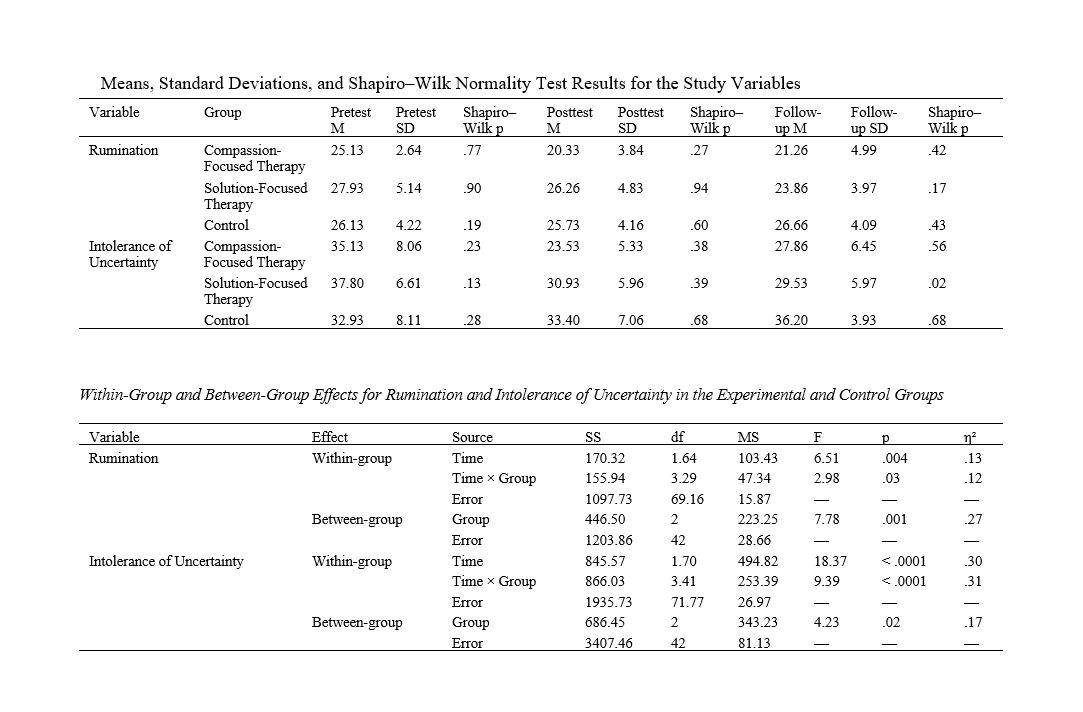
Findings: The results revealed significant differences among the study groups over time. Compassion-Focused Therapy demonstrated superior effectiveness in reducing rumination compared with both Solution-Focused Therapy and the control group. Furthermore, Compassion-Focused Therapy produced a statistically significant reduction in intolerance of uncertainty compared with the control group. However, no significant difference was observed between Compassion-Focused Therapy and Solution-Focused Therapy regarding intolerance of uncertainty. In contrast, Solution-Focused Therapy did not produce statistically significant improvements in either rumination or intolerance of uncertainty when compared with the control group. The therapeutic gains associated with Compassion-Focused Therapy remained stable throughout the 9-month follow-up period.
Conclusion: The findings suggest that Compassion-Focused Therapy is a more effective intervention than Solution-Focused Therapy for addressing maladaptive cognitive-emotional processes, particularly rumination, among adolescents with inadequate parental care.
Downloads
References
Carleton, R. N. (2016). Into the Unknown: A Review and Synthesis of Contemporary Models Involving Uncertainty. Journal of anxiety disorders, 39, 30-43. https://doi.org/10.1016/j.janxdis.2016.02.007
De Shazer, S., & Dolan, Y. (2012). More than Miracles: The State of the Art of Solution-Focused Brief Therapy. Routledge. https://doi.org/10.4324/9780203837825
Dugas, M. J., & Robichaud, M. (2024). Intolerance of Uncertainty and Its Role in Emotional Disorders: Advances in Theory and Clinical Applications. Journal of anxiety disorders, 98, 102742. https://doi.org/10.1016/j.janxdis.2024.102742
Ferrari, M., Hunt, C., Harrysunker, A., Abbott, M. J., Beath, A. P., & Einstein, D. A. (2019). Self-Compassion Interventions and Psychosocial Outcomes: A Meta-Analysis of RCTs. Mindfulness, 10, 1455-1473. https://doi.org/10.1007/s12671-019-01134-6
Fortin Delisle, I., & Dugas, M. J. (2025). Tolerating Uncertainty: Short- and Long-Term Effects of Sudden Gains in Behavioral Experiments for Generalized Anxiety Disorder. Cognitive therapy and research, 1-14. https://doi.org/10.1007/s10608-025-10598-x
Franklin, C., Trepper, T. S., McCollum, E. E., & Gingerich, W. J. (2012). Solution-Focused Brief Therapy: A Handbook of Evidence-Based Practice. Oxford University Press.
Gilbert, P. (2010). Compassion Focused Therapy: Distinctive Features. Routledge. https://doi.org/10.4324/9780203851197
Halamova, J., Kanovsky, M., Strnádelová, B., & Riečanský, I. (2024). Compassion Focused Therapy Reduces Self-Criticism and Improves Emotion Regulation: A Randomized Controlled Trial. Mindfulness, 15(2), 455-468. https://doi.org/10.1007/s12671-023-02175-9
Hsu, K., Eads, R., & Wen, Z. (2021). Solution Focused Brief Therapy for Behavior Problems in Children and Adolescents: A Meta-Analysis of Treatment Effectiveness and Family Involvement. Children and Youth Services Review, 120, 105620. https://doi.org/10.1016/j.childyouth.2020.105620
Kim, J., Jordan, S. S., Franklin, C., & Froerer, A. (2019). Is Solution Focused Brief Therapy Evidence Based? An Update 10 Years Later. Families in Society, 100(2), 127-138. https://doi.org/10.1177/1044389419841688
Kim, J. S. (2008). Examining the Effectiveness of Solution Focused Brief Therapy: A Meta-Analysis. Research on Social Work Practice, 18(2), 107-116. https://doi.org/10.1177/1049731507307807
Malihi, S., Mohammadian, H., & Heydari, M. (2025). Predicting Adolescent Anxiety Disorder Based on Rumination, Threat Sensitivity, and Negative Metacognitive Beliefs. Fourth National Conference on New Findings in Developmental and Educational Psychology,
Mansouri, A., Mansouri, M., & Mansouri, S. (2014). The Mediating Role of Rumination in the Relationship between Social Anxiety and Depression with Early Maladaptive Schemas. https://www.ensani.ir/fa/article/377268
Marvati Ardakani, A., & Aflaki Fard, H. (2016). The Effect of Solution-Focused Counseling on Academic Achievement and Resilience of Students. Applied Psychological Research. https://psychologyj.tabrizu.ac.ir/article_11059.html
Matos, M., Duarte, C., Pinto-Gouveia, J., & Gilbert, P. (2023). Compassion-Focused Therapy for Emotional Regulation and Self-Criticism: Mechanisms of Change and Clinical Outcomes in a Randomized Controlled Trial. Behaviour Research and Therapy, 166, 104324. https://doi.org/10.1016/j.brat.2023.104324
Neff, K. D., & Germer, C. K. (2022). The Role of Self-Compassion in Psychotherapy. World Psychiatry, 21(1), 58-58. https://doi.org/10.1002/wps.20944
Nolen-Hoeksema, S., Gilbert, K., & Hilt, L. M. (2015). Rumination and Self-Regulation in Adolescence. In G. Oettingen & P. M. Gollwitzer (Eds.), Self-Regulation in Adolescence (pp. 311). Cambridge University Press. https://doi.org/10.1017/CBO9781139565790
Nolen-Hoeksema, S., Wisco, B. E., & Lyubomirsky, S. (2008). Rethinking Rumination. Perspectives on Psychological Science, 3(5), 400-424. https://doi.org/10.1111/j.1745-6924.2008.00088.x
Saeedi, M., Khalatbari, J., Ghorban-Shiroudi, S., & Abolghasemi, S. (2020). Comparing the Effectiveness of Cognitive-Behavioral Therapy and Compassion-Focused Therapy on Impulsivity in Women on the Verge of Divorce. Journal of Community Health, 14(1), 73-83. https://civilica.com/doc/1221426/
Sajadinejad, M., Harami, A., & Azarkish, M. (2024). The Effect of Forgiveness-Based Training on Perceived Competence, Rumination, and Empathy among Maltreated Adolescent Boys in Ardabil. https://rd.araku.ac.ir/~MarSajadinejad/
Seydaei Golsafidi, Z., & Pourseyed Aghaei, Z. S. (2025). The Effect of Solution-Focused Therapy on Interpersonal Emotional Regulation and Self-Control in Elementary School Students. Child Mental Health Quarterly, 9(3), 93-105. https://doi.org/10.52547/jcmh.9.3.9
Sharaf, A., Lachine, O., & Thompson, E. (2018). Rumination, Social Problem Solving and Suicide Intent among Egyptians with a Recent Suicide Attempt. Archives of Psychiatric Nursing, 32(1), 86-92. https://doi.org/10.1016/j.apnu.2017.10.008
Spinhoven, P., Drost, J., van Hemert, A. M., & Penninx, B. W. J. H. (2023). Common Vulnerability Factors in Anxiety and Depression: The Role of Rumination and Intolerance of Uncertainty. Journal of affective disorders, 325, 646-653. https://doi.org/10.1016/j.jad.2023.01.041
Wang, C., & Chen, T. (2022). Effectiveness of Solution-Focused Group Counseling on Depression and Cognition among Chinese Older Adults: A Cluster Randomized Controlled Trial. Clinical Gerontologist, 45(5), 1107-1118. https://doi.org/10.1080/07317115.2021.1929630
Downloads
Additional Files
Publication Timeline
- Submitted
- Revised
- Accepted