



























Identifying Digital Behavior Profiles via Usage Patterns, Reward Sensitivity, and Social Reinforcement with Machine Learning Analysis
|
Objective: The present study aimed to identify and classify distinct digital behavior profiles based on usage patterns, reward sensitivity, and social reinforcement using machine learning techniques. Methods and Materials: This study employed a cross-sectional, correlational design with an embedded machine learning approach. A total of 412 adult participants from Canada were recruited through stratified online sampling. Data were collected using standardized self-report instruments assessing digital usage patterns, Behavioral Activation System (BAS) components for reward sensitivity, and a social reinforcement scale adapted for online environments. After preprocessing, including normalization and missing data handling, descriptive statistics and correlation analyses were conducted. Unsupervised machine learning techniques, specifically K-means and hierarchical clustering, were applied to identify latent behavioral profiles, with optimal cluster selection based on silhouette coefficients and Davies–Bouldin index values. Principal component analysis (PCA) was used for dimensionality reduction and visualization. Additionally, supervised learning models, including random forest and support vector machine algorithms, were implemented to evaluate the predictive accuracy of cluster membership. Findings: The analysis revealed a three-cluster solution representing distinct digital behavior profiles: Low Engagement, Balanced Users, and High Reinforcement Seekers. Significant differences were observed across clusters in terms of screen time, multitasking behavior, reward sensitivity, and social reinforcement indicators, with the High Reinforcement Seekers cluster demonstrating the highest levels across all variables. The clustering structure showed strong separation and internal consistency, as confirmed by PCA visualization. Supervised classification models achieved high predictive performance, with the random forest model demonstrating superior accuracy, precision, recall, and F1-score compared to the support vector machine model, indicating robust classification of behavioral profiles based on the selected features. Conclusion: The findings highlight the multidimensional nature of digital behavior and demonstrate the effectiveness of machine learning techniques in identifying meaningful behavioral profiles. The results underscore the importance of integrating psychological constructs such as reward sensitivity and social reinforcement with behavioral data to better understand digital engagement patterns. This approach provides a foundation for developing targeted interventions and personalized digital well-being strategies, particularly for individuals at risk of excessive or maladaptive digital use. |
Modeling Parenting Outcomes Using Educational Attainment, Cognitive Stimulation, and Parenting Efficacy with Machine Learning
|
Objective: The present study aimed to model parenting outcomes based on educational attainment, cognitive stimulation, and parenting efficacy using machine learning techniques to determine their relative predictive power and interactions. Methods and Materials: This study employed a cross-sectional predictive correlational design with a sample of 412 parents from Indonesia selected through stratified random sampling. Data were collected using standardized instruments, including measures of cognitive stimulation (HOME Inventory), parenting efficacy (Parenting Sense of Competence Scale), and parenting outcomes (Alabama Parenting Questionnaire), alongside a demographic measure of educational attainment. Data analysis involved both traditional statistical methods and machine learning approaches. Initial analyses were conducted using SPSS-27 to examine descriptive statistics and correlations. Subsequently, supervised machine learning models, including linear regression, random forest, support vector machine, and gradient boosting, were implemented using Python-based libraries. Model evaluation was performed using 10-fold cross-validation, and performance metrics included mean squared error (MSE), root mean squared error (RMSE), and coefficient of determination (R²). Feature importance analysis was also conducted to determine the relative contribution of predictors. Findings: Results indicated that all predictors significantly contributed to parenting outcomes (p < 0.001), with parenting efficacy demonstrating the strongest standardized effect (β = 0.44), followed by cognitive stimulation (β = 0.38) and educational attainment (β = 0.21). The regression model explained 53% of the variance in parenting outcomes (R² = 0.53). Machine learning analyses revealed that gradient boosting achieved the highest predictive performance (R² = 0.67), outperforming random forest (R² = 0.64), support vector machine (R² = 0.59), and linear regression (R² = 0.52). Feature importance scores confirmed parenting efficacy as the most influential predictor, followed by cognitive stimulation and educational attainment. Conclusion: The findings highlight the critical role of parenting efficacy and cognitive stimulation as primary determinants of parenting outcomes, while educational attainment exerts a significant but indirect influence. The superior performance of machine learning models underscores the complexity and nonlinear nature of these relationships, suggesting that advanced analytical approaches provide more accurate and comprehensive insights. These results have important implications for the development of targeted interventions and policies aimed at enhancing parenting practices and promoting child development. |
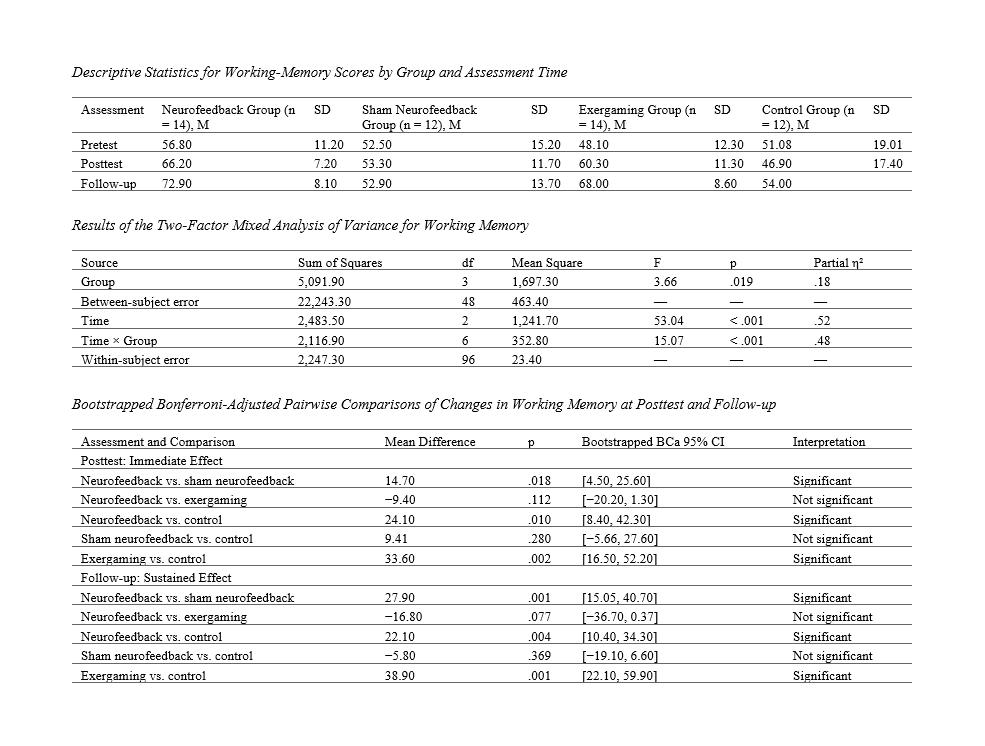
Comparison of the Effectiveness of Transcranial Electrical Brain Stimulation and Cognitive Rehabilitation on Working Memory in Students Aged 7–13 Years with Specific Reading Learning Disorder
The overall objective of the present study was to compare the effectiveness of transcranial electrical brain stimulation and cognitive rehabilitation on the working memory of students aged 7–13 years with specific reading learning disorder. In terms of purpose, the present study was applied research, and in terms of methodology, it was a quasi-experimental study with a pretest–posttest design and a control group. The statistical population consisted of all 7–13-year-old students with reading learning disabilities in Districts 7 and 10 of Tehran, totaling 1,500 individuals. A total of 45 participants (15 in the experimental group receiving transcranial electrical brain stimulation, 15 in the experimental group receiving cognitive rehabilitation, and 15 in the control group) were selected as the sample using simple random sampling. Data were collected using the N-back test to assess working memory. Multivariate analysis of covariance and the LSD post hoc test were used for data analysis. Transcranial electrical brain stimulation demonstrated greater effectiveness in improving working memory, particularly in reducing response time, compared with the control group, and in some indicators, it also showed superiority over cognitive rehabilitation. Transcranial electrical brain stimulation interventions and cognitive rehabilitation programs can be used as complementary methods for improving the working memory of students aged 7–13 years with specific reading learning disorder.
Assessment of Spiritual Vitality and Marital Satisfaction in Parents of Children Aged 6–12 Years with Autism Spectrum Disorder
The aim of this study was to investigate the relationship between spiritual vitality and marital satisfaction among parents of children aged 6–12 years diagnosed with Autism Spectrum Disorder (ASD). This study employed a descriptive-correlational design with a quantitative approach. The statistical population consisted of parents referring to the Iranian Autism Association in Tehran Province, from whom 100 participants (50 couples) were selected using purposive sampling. Data were collected using the standardized Afrouz Marital Satisfaction Questionnaire and the Afrouz Spiritual Vitality Scale. Data analysis was conducted through correlation coefficients and analysis of variance using SPSS software. The findings indicated that there was no significant relationship between the total score of spiritual vitality and marital satisfaction among the parents. However, subscale analyses revealed that certain dimensions of marital satisfaction, including marital contentment, positive thinking, and communicational-social behaviors, were correlated with spiritual vitality, and the relationships among these components were statistically significant. In addition, no significant differences were observed between fathers and mothers regarding spiritual vitality and marital satisfaction; nevertheless, the mean scores reflected relatively low to moderate levels of these two variables among the parents. These findings suggest that although spiritual vitality alone is not a direct predictor of marital satisfaction in this group, fostering spirituality-oriented dimensions within married life may indirectly influence the quality of the relationship among couples raising a child with autism. The results highlight the necessity of designing holistic interventions focused on strengthening spiritual and communicational resources in these families.
The Mediating Role of Self-Efficacy and Social Support in the Effect of Psychological Hardiness on the Quality of Life of Physically Disabled People
The present study aimed to investigate the structural relationship between psychological hardiness and quality of life in physically and motor disabled individuals, with the mediating roles of self-efficacy and perceived social support. This applied, cross-sectional, correlational study was conducted using structural equation modeling among physically and motor disabled individuals in Mazandaran Province, Iran. The statistical population consisted of approximately 26,000 individuals registered in the provincial Welfare Organization, from whom 424 participants aged 14–40 years (277 males and 147 females) were selected through two-stage cluster sampling from Sari, Amol, Behshahr, and Chalus cities. Data were collected using the Ahvaz Psychological Hardiness Questionnaire, the SF-36 Quality of Life Questionnaire, Sherer’s Self-Efficacy Scale, and the Sherbourne and Stewart Social Support Scale. The instruments demonstrated acceptable reliability coefficients ranging from 0.86 to 0.91. Descriptive statistics, Pearson correlation coefficients, Sobel tests, and structural equation modeling were performed using SPSS-22, AMOS, and SmartPLS software at a 95% confidence level. The results demonstrated significant positive relationships among all study variables. Psychological hardiness had significant direct effects on self-efficacy (β=0.10, T=2.09, P<0.01), perceived social support (β=0.27, T=2.53, P<0.01), and quality of life (β=0.10, T=2.94, P<0.01). Self-efficacy also showed a significant direct effect on quality of life (β=0.11, T=2.55, P<0.01), while perceived social support significantly predicted quality of life (β=0.18, T=2.71, P<0.01). Pearson correlation analysis revealed the strongest correlation between psychological hardiness and quality of life (r=0.853, P<0.01). Sobel test findings confirmed the mediating role of self-efficacy (β=0.04, Z=2.57, P=0.01) and perceived social support (β=0.03, Z=2.74, P=0.001) in the relationship between psychological hardiness and quality of life. The proposed model explained 18% of the variance in self-efficacy, 14% in social support, and 11% in quality of life. The findings indicate that psychological hardiness contributes significantly to improving the quality of life of physically disabled individuals both directly and indirectly through enhancing self-efficacy and perceived social support. Strengthening resilience-related psychological characteristics, promoting self-efficacy beliefs, and expanding supportive social networks may improve mental health and overall life satisfaction among individuals with physical and motor disabilities. Therefore, psychological interventions and rehabilitation programs focused on resilience enhancement and social support development are recommended for improving the well-being and quality of life of this population.
From Challenge to Insight: The Effectiveness of a Cognitively Oriented Psychological Intervention on Reflective Functioning in Female Teachers of Students with Autism Spectrum Disorder
The present study was conducted to examine the effectiveness of a cognitively oriented psychological intervention on reflective functioning in female teachers of students with Autism Spectrum Disorder. The present research employed a quasi-experimental design with a pretest–posttest format, including a control group and a two-month follow-up period. The statistical population consisted of all female teachers of students with autism spectrum disorder in the city of Qazvin during the 2025–2026 academic year. From this population, 34 participants were selected using convenience sampling and were then randomly assigned to an experimental group (n = 17) and a control group (n = 17). Participants in both groups were assessed across three stages using the Reflective Functioning Questionnaire (RFQ-8) developed by Peter Fonagy et al. (1997). In the present study, individuals in the experimental group received 10 sessions of intervention, whereas the control group received no intervention. Data were analyzed using repeated measures analysis of variance (ANOVA) with SPSS version 25. The findings of data analysis indicated that the cognitively oriented psychological educational intervention had a statistically significant effect on reflective functioning (p < .05). Furthermore, the results demonstrated that the significant effect of this therapeutic approach on reflective functioning was sustained at the follow-up stage (p < .05) In conclusion, it can be inferred that a cognitively oriented psychological intervention, as an effective method, can lead to improvements in teachers’ reflective functioning. Therefore, the application of such an approach may be considered a valuable strategy for enhancing the mental functioning of teachers working with this group of students.
Effectiveness of Trauma-Focused Cognitive Behavioral Therapy on Post-Traumatic Stress Disorder and Psychological Empowerment (Cognitive and Emotional) in Children with a History of Sexual Abuse
The present study aimed to examine the effectiveness of trauma-focused cognitive behavioral therapy (TF-CBT) on post-traumatic stress disorder (PTSD) symptoms and psychological empowerment (cognitive and emotional) in children with a history of sexual abuse. This study employed a single-case experimental design with a multiple baseline staggered approach. The statistical population included primary school students in Tehran during the 2025–2026 academic year. Using purposive sampling, four children aged 8–12 years with a history of sexual abuse and meeting PTSD criteria were selected. Data were collected using the Lifetime Incidence of Traumatic Events Inventory (LITE-C, LITE-P), the Child and Parent Reports of Post-Traumatic Symptoms (CROPS, PROPS), and the Social-Emotional Assets and Resilience Scales (SEARS). Participants underwent approximately 14 individual TF-CBT sessions, with concurrent parental involvement. Data were analyzed using graphical analysis, percentage of improvement, repeated measures analysis of variance, and paired-samples t-tests via SPSS version 26. The results indicated statistically significant reductions in PTSD symptoms and significant increases in psychological empowerment across participants (p < 0.05). Repeated measures ANOVA revealed large effect sizes for both psychological empowerment (η² = 0.982) and PTSD symptoms (η² = 0.954), indicating strong treatment effects. Additionally, paired-samples t-test results showed no significant differences between post-test and follow-up scores (p > 0.05), suggesting the stability and maintenance of treatment gains over time. Trauma-focused cognitive behavioral therapy is an effective intervention for reducing post-traumatic stress symptoms and enhancing psychological empowerment in children with a history of sexual abuse, with effects that remain stable during follow-up.
The Effectiveness of Acceptance and Commitment Therapy on Rejection Sensitivity and Self-Acceptance in Individuals with Visual Impairment
The present study aimed to examine the effectiveness of Acceptance and Commitment Therapy (ACT) on rejection sensitivity and self-acceptance among individuals with visual impairment. The research employed a quasi-experimental design with a pretest–posttest–follow-up structure including a control group. The statistical population consisted of all visually impaired individuals who were members of associations supporting persons with visual impairment and the Welfare Organization of Kurdistan Province during Spring 2025. From this population, 45 participants were selected using convenience sampling and were randomly assigned to two experimental groups and one control group. Participants completed the Rejection Sensitivity Questionnaire developed by Downey and Feldman (1996) and the Unconditional Self-Acceptance Questionnaire designed by Chamberlain and Haaga (2001) at pretest, posttest, and follow-up stages. Group sessions of Acceptance and Commitment Therapy were conducted for the intervention group based on the treatment protocol proposed by Hayes and Strosahl (2005) across eight 90-minute sessions. Acceptance and Commitment Therapy significantly reduced rejection sensitivity in the intervention group compared with the control group (p = .018). Furthermore, Acceptance and Commitment Therapy significantly increased self-acceptance in the intervention group compared with the control group (p = .005). The findings indicate that Acceptance and Commitment Therapy can be utilized as an effective intervention for reducing rejection sensitivity and enhancing self-acceptance among individuals with visual impairment. The implementation of this therapeutic approach in rehabilitation centers and psychological service settings may play an important role in promoting mental health, emotional adjustment, and improving the quality of life of visually impaired individuals.
About the Journal
- E-ISSN: 3060-6713
- Director in Charge: Dr. Ali Aghaziarati
- Editor-in-chief: Dr. Salar Faramarzi
- Owner: KMAN Research Institute
- Publisher: KMAN Publication Inc. (KMANPUB)
- Contact Email: PRIEN@kmanpub.com / journalprien@gmail.com
- Open Access: YES
The Psychological Research in Individuals with Exceptional Needs (PRIEN) Journal, established in 2023, is a pioneering international academic journal dedicated to the multifaceted field of psychology and its application to individuals with exceptional needs. The journal's scope encompasses a diverse range of topics such as developmental psychology, educational psychology, cognitive and behavioral therapy, neuropsychology, special education, adaptive technology, mental health, social integration, and policy development in support of individuals with disabilities or giftedness. Its primary aim is to promote the understanding, support, and advancement of individuals with unique psychological needs, whether they are developmental, emotional, cognitive, or gifted. PRIEN Journal invites contributions in the form of high-quality original research articles, comprehensive review articles (including narrative, scoping, systematic, and integrative reviews), thought-provoking editorials, concise short communications, and insightful letters to the editor. Committed to maintaining rigorous standards, the journal employs a thorough open peer review process to ensure research integrity and transparency. Adhering to a gold open access model, PRIEN Journal guarantees unrestricted online access to its content, fostering a global exchange of knowledge and ideas in this critical field.
About the Publisher
Publisher: KMAN Publication Inc.
Publisher Office: Unit 5‑10825 Yonge St, Richmond Hill, Ontario, Canada, L4C 3E3
https://journals.kmanpub.com
Email: kmanpu@kmanpub.com
Telegram: +1 (647) 656‑4401 | WhatsApp: +1 (437) 429‑3507
Germany Office: Dratelnstrasse, Wohnung A60, 21119 Hamburg, Germany (+4915207720487)
Current Issue
Articles
-
Analyzing the Role of Play and Educational Toys in Cognitive and Emotional Growth: A Review and Network Analysis
Mahin Keikhanejad * , Mohammadnaeim Porki , Mojtaba Ebrahimi , Fatemeh Askari , Eghlima kord , Ali sabukzahi1-12

